



Reselling has a marketing problem, and it's that the good stories are all true. Somebody really did buy a Patagonia fleece for four dollars and sell it for ninety.
That happens all the time, which is exactly why it's such a bad way to decide whether this works as a business.
The flip you remember is never the flip that pays your rent. What pays is the average across everything you ever tried selling: the winners, the slow movers, and the eleven items sitting in a bin because nobody wanted them at any asking price.
Reselling is worth it, or isn't, based on that average.
Most people never work it out, partly because it takes effort and partly because the answer involves counting hours you'd rather not count.
In this article, we'll dive deeper into reselling, but not with vague encouragement about hustle and consistency.
Instead, we'll look at the fee rates every marketplace publishes, what's left after those rates, and the one variable that decides whether your hourly rate looks more like a career than a hobby you're subsidizing.
Key takeaways
Your profit doesn't depend on what your best flips are but on your sell-through rate. Unsold items cost you the same listing time as sold ones and return $0, which is what sets your hourly rate.
Listing on more marketplaces increases sales, but doing it manually multiplies your work. This arrangement only works if extra listings take close to zero extra time, which is where a tool like Crosslist helps.
The profit calculation every reseller starts with
Here's how nearly every new reseller evaluates a sale. You buy a jacket for $6 at a thrift store. It sells on Poshmark for $45.
Poshmark charges a 20% commission on sales of $15 or more, with a flat $2.95 fee on anything under $15, and no listing fees or monthly subscription, so $9 goes to Poshmark, $36 lands in your account, and after the $6 you spent, you cleared $30 on a jacket you found in twenty seconds.
Thirty dollars on a six-dollar item. That's a 500% return on selling clothing online that would be extraordinary in any other context.
That number isn't wrong, but it's incomplete in one meaningful way: profit per item doesn't tell you much about profit per hour, and profit per hour determines whether you should be doing this instead of something else with your Saturdays.
Seller fees across the major platforms
Before we get to hours, let's look at what the platforms charge since the cost can be significant enough to change what's even worth listing.
eBay charges a 13.6% final value fee in most categories plus a $0.30 or $0.40 per-order fee, and that percentage applies to the total of the item price, buyer-paid shipping, and sales tax. That last part is important, since you're essentially paying a commission on money that was never yours.
Mercari has a flat 10% selling fee with no separate payment processing charge on new listings.
Depop charges eligible US sellers 0% commission and only 3.3% plus $0.45 in payment processing.
Now we see that the same $50 item with $5 of buyer-paid shipping costs $10.00 in fees on Poshmark, $5.50 on Mercari, and roughly $2.27 on Depop.
So naturally, the tempting conclusion is to list everything where fees are lowest, keep more money, and call it a day.
Except that logic is backwards, and the reason why comes down to something that changes your take-home far more than any commission rate.
But before we get to that, how much does inventory factor into your hourly rate?
How unsold inventory impacts your profit margins
Say you source 100 items over a season at $6 each. That's $600 out of pocket, plus maybe fifteen hours of sourcing across a handful of trips.
Now, let's take back the same argument from earlier and say that 60 of them sell at an average of $40 on Poshmark.
That's $2,400 in revenue, $480 to Poshmark, $1,920 net, minus your $600 in inventory, so $1,320 in your pocket.
Now add the labor: roughly fifteen minutes to photograph, write, and post each of the 100 items, which is twenty-five hours, plus ten minutes packing each of the 60 orders for another ten hours.
Fifty hours all in. That's about $26 an hour, which is a genuinely fine outcome for work you can do in your kitchen.
Now let's change one number and sell only 40 items instead of 60. Revenue drops to $1,600, fees to $320, and after inventory you're left with $680.
Your working hours barely change, because you still photographed and listed all 100 items and maybe saved a few hours of packing, but now you're at roughly $14 an hour.
The same sourcing, the same listings, the same effort, and your hourly rate got cut nearly in half.
Not by fees but by sell-through: the share of what you list that finds a buyer.
It's not your winners but your unsold stock that sets your hourly rate, because every item that doesn't sell was still fully paid for in time and cash.
This is why chasing the lowest-fee marketplace is nowhere near as important as getting more of your inventory in front of more buyers.
Saving 10% in commission on the things that sell will never make up for the 40% that didn't.
And the quickest way to change that isn't by shooting better photos or writing cleverer titles, but by simply listing in more places at once.
Your vintage Nike windbreaker might stay listed for months on Mercari and sell in days on Depop.
Since you can't predict where an item will sell fastest, the best approach is to reach buyers across multiple marketplaces.
Is the resale market already too crowded?
Fair question, especially since every second person on TikTok appears to be flipping thrift store finds. If the market is saturated, none of the above matters.
Luckily, it isn't, and the data is fairly emphatic.
ThredUp's 2026 Resale Report, conducted by GlobalData, puts the global secondhand market at $393 billion, roughly 10% of total apparel spend, with the US secondhand market growing nearly four times faster than the broader retail clothing market in 2025.
The US secondhand apparel market is projected to reach $78.8 billion by 2030. Through 2030, 71% of that growth is expected to come from Gen Z and Millennials.
But there's another, more useful finding for anyone deciding whether to start.
The report identifies supply, not consumer demand, as resale's primary constraint, which means there are more buyers than there is good inventory to sell them.
That reframes the competition entirely. You're not competing with other resellers for buyers.
You're competing with them at the thrift store, at estate sales, in the clearance aisle, for the stock itself. Sourcing is the hard part, and it's still largely manual.
The time cost of listing everywhere
Remember those fifteen minutes per listing we talked about? Let's see how deceptive that estimate really is.
If listing to one marketplace takes fifteen minutes, listing to five takes... well, that depends entirely on how you do it.
Done manually, you're retyping the same title, the same description, the same measurements, the same condition notes into five different forms with five different category trees and five different sets of required fields.
Call it fifty minutes an item, and your fifty-hour season just became a hundred and thirty.
At that point, better sell-through hasn't bought you anything because you paid for it in hours at the worst possible exchange rate.
But some parts are genuinely stressful rather than merely tedious and time-consuming.
When something sells, you need to remove it from every other platform immediately. If you miss one, you risk overselling the same item to two different buyers.
That means canceling an order and potentially hurting your seller metrics.
On eBay, that's not just embarrassing but also costly, since sellers rated Below Standard pay an additional 6% on final value fees, turning a 13.6% category into 19.6%.
Reselling on one marketplace is straightforward, but it limits your reach.
Selling on five can bring much better results, but quickly becomes unsustainable when done manually. The key is finding a way to close that gap.
Luckily, solutions exist.
How cross listing tools solve the time problem
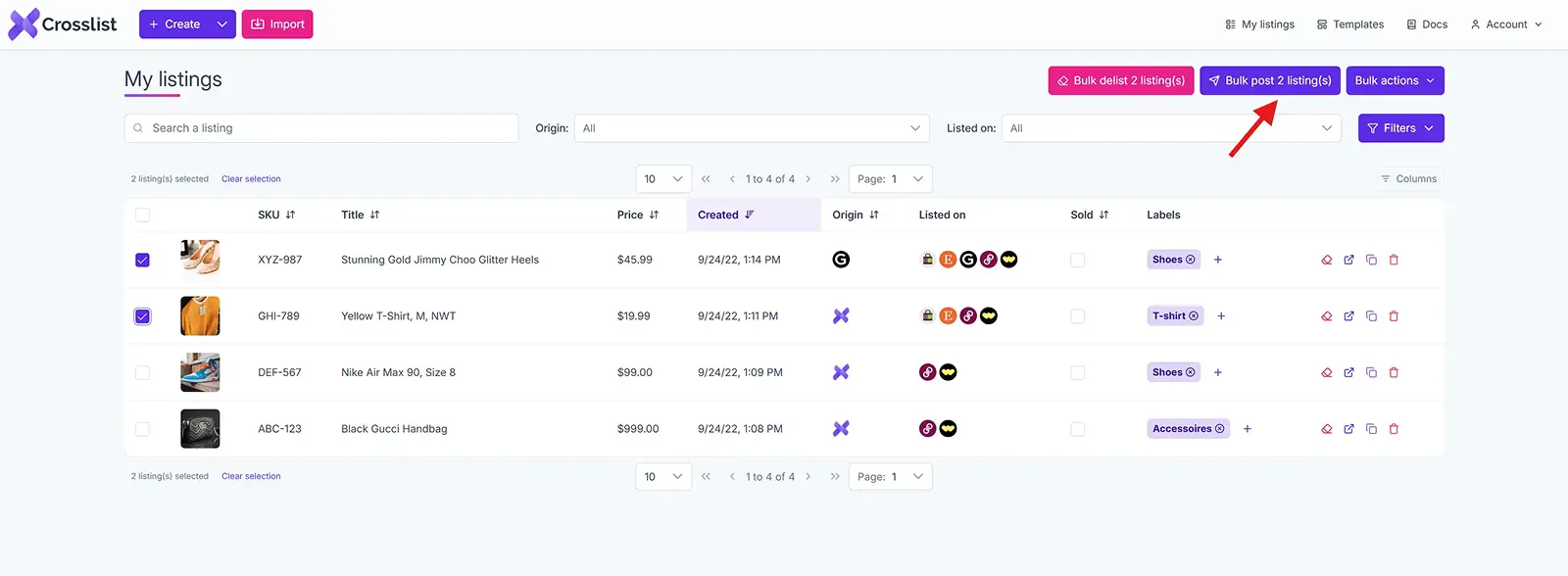
Cross listing software won't source for you, price for you, or make a bad item desirable, but it will remove the multiplier.
With Crosslist, you fill in one universal form and publish to 11+ marketplaces, including eBay, Poshmark, Mercari, Depop, Etsy, Facebook Marketplace, Whatnot, WooCommerce, and more.
Autoposting handles publishing in the background, while Autodelist removes sold items from other marketplaces to help prevent double-selling.
Apply that to the season above. A tool priced at $30 a month, taking you from one marketplace to eleven, needs to sell about two extra items a season to pay for itself.
Everything beyond that is additional profit you weren't getting before.
So, is reselling worth it?
It's worth it if you can source consistently, because supply is the actual constraint and everything downstream depends on having decent inventory.
It's worth it if you're willing to treat unsold items as a cost rather than as inventory that will eventually sell, since that's one of the more significant parts setting your wage.
And it's worth it if you're listing in more than one place, because single-marketplace reselling is a fine hobby but a structurally weak business.
It's not worth it if you're expecting the fee math alone to make you rich, if you're not willing to put in the sourcing work, or if you'll spend more time filling out listing forms than sourcing inventory.
The good news is that one of those three problems is solvable with software, and it happens to be the one that takes up the most hours.
Try Crosslist risk-free and spend your time finding inventory instead of retyping it.
FAQ
How much can you realistically make reselling?
It depends far more on your sell-through rate than your profit margins.
Say you source 100 items at $6 each and sell 60 at an average of $40. That could net you roughly $1,320 after commission and inventory costs.
If only 40 items sell, however, your profit drops to around $680 for nearly the same amount of work.
Which marketplace has the lowest platform fees?
Depop for eligible US sellers at 0% commission plus 3.3% and $0.45 in payment processing, followed by Mercari at a flat 10%, eBay at 13.6% plus a per-order fee in most categories.
Poshmark sits at the top end, with a 20% commission on sales of $15 or more.
Is the resale market too saturated to start now?
No. The shortage is on the supply side, not the buyer side. The Resale Report identifies supply, rather than consumer demand, as resale's primary constraint.
Do you need cross listing software to make money reselling?
Not to start, but it's unavoidable when you start listing to more than one or two marketplaces.
A tool like Crosslist only needs to increase your sell-through by a few items each season to cover its cost.
It also removes listings from other marketplaces when an item sells, helping prevent overselling.
Reselling has a marketing problem, and it's that the good stories are all true. Somebody really did buy a Patagonia fleece for four dollars and sell it for ninety.
That happens all the time, which is exactly why it's such a bad way to decide whether this works as a business.
The flip you remember is never the flip that pays your rent. What pays is the average across everything you ever tried selling: the winners, the slow movers, and the eleven items sitting in a bin because nobody wanted them at any asking price.
Reselling is worth it, or isn't, based on that average.
Most people never work it out, partly because it takes effort and partly because the answer involves counting hours you'd rather not count.
In this article, we'll dive deeper into reselling, but not with vague encouragement about hustle and consistency.
Instead, we'll look at the fee rates every marketplace publishes, what's left after those rates, and the one variable that decides whether your hourly rate looks more like a career than a hobby you're subsidizing.
Key takeaways
Your profit doesn't depend on what your best flips are but on your sell-through rate. Unsold items cost you the same listing time as sold ones and return $0, which is what sets your hourly rate.
Listing on more marketplaces increases sales, but doing it manually multiplies your work. This arrangement only works if extra listings take close to zero extra time, which is where a tool like Crosslist helps.
The profit calculation every reseller starts with
Here's how nearly every new reseller evaluates a sale. You buy a jacket for $6 at a thrift store. It sells on Poshmark for $45.
Poshmark charges a 20% commission on sales of $15 or more, with a flat $2.95 fee on anything under $15, and no listing fees or monthly subscription, so $9 goes to Poshmark, $36 lands in your account, and after the $6 you spent, you cleared $30 on a jacket you found in twenty seconds.
Thirty dollars on a six-dollar item. That's a 500% return on selling clothing online that would be extraordinary in any other context.
That number isn't wrong, but it's incomplete in one meaningful way: profit per item doesn't tell you much about profit per hour, and profit per hour determines whether you should be doing this instead of something else with your Saturdays.
Seller fees across the major platforms
Before we get to hours, let's look at what the platforms charge since the cost can be significant enough to change what's even worth listing.
eBay charges a 13.6% final value fee in most categories plus a $0.30 or $0.40 per-order fee, and that percentage applies to the total of the item price, buyer-paid shipping, and sales tax. That last part is important, since you're essentially paying a commission on money that was never yours.
Mercari has a flat 10% selling fee with no separate payment processing charge on new listings.
Depop charges eligible US sellers 0% commission and only 3.3% plus $0.45 in payment processing.
Now we see that the same $50 item with $5 of buyer-paid shipping costs $10.00 in fees on Poshmark, $5.50 on Mercari, and roughly $2.27 on Depop.
So naturally, the tempting conclusion is to list everything where fees are lowest, keep more money, and call it a day.
Except that logic is backwards, and the reason why comes down to something that changes your take-home far more than any commission rate.
But before we get to that, how much does inventory factor into your hourly rate?
How unsold inventory impacts your profit margins
Say you source 100 items over a season at $6 each. That's $600 out of pocket, plus maybe fifteen hours of sourcing across a handful of trips.
Now, let's take back the same argument from earlier and say that 60 of them sell at an average of $40 on Poshmark.
That's $2,400 in revenue, $480 to Poshmark, $1,920 net, minus your $600 in inventory, so $1,320 in your pocket.
Now add the labor: roughly fifteen minutes to photograph, write, and post each of the 100 items, which is twenty-five hours, plus ten minutes packing each of the 60 orders for another ten hours.
Fifty hours all in. That's about $26 an hour, which is a genuinely fine outcome for work you can do in your kitchen.
Now let's change one number and sell only 40 items instead of 60. Revenue drops to $1,600, fees to $320, and after inventory you're left with $680.
Your working hours barely change, because you still photographed and listed all 100 items and maybe saved a few hours of packing, but now you're at roughly $14 an hour.
The same sourcing, the same listings, the same effort, and your hourly rate got cut nearly in half.
Not by fees but by sell-through: the share of what you list that finds a buyer.
It's not your winners but your unsold stock that sets your hourly rate, because every item that doesn't sell was still fully paid for in time and cash.
This is why chasing the lowest-fee marketplace is nowhere near as important as getting more of your inventory in front of more buyers.
Saving 10% in commission on the things that sell will never make up for the 40% that didn't.
And the quickest way to change that isn't by shooting better photos or writing cleverer titles, but by simply listing in more places at once.
Your vintage Nike windbreaker might stay listed for months on Mercari and sell in days on Depop.
Since you can't predict where an item will sell fastest, the best approach is to reach buyers across multiple marketplaces.
Is the resale market already too crowded?
Fair question, especially since every second person on TikTok appears to be flipping thrift store finds. If the market is saturated, none of the above matters.
Luckily, it isn't, and the data is fairly emphatic.
ThredUp's 2026 Resale Report, conducted by GlobalData, puts the global secondhand market at $393 billion, roughly 10% of total apparel spend, with the US secondhand market growing nearly four times faster than the broader retail clothing market in 2025.
The US secondhand apparel market is projected to reach $78.8 billion by 2030. Through 2030, 71% of that growth is expected to come from Gen Z and Millennials.
But there's another, more useful finding for anyone deciding whether to start.
The report identifies supply, not consumer demand, as resale's primary constraint, which means there are more buyers than there is good inventory to sell them.
That reframes the competition entirely. You're not competing with other resellers for buyers.
You're competing with them at the thrift store, at estate sales, in the clearance aisle, for the stock itself. Sourcing is the hard part, and it's still largely manual.
The time cost of listing everywhere
Remember those fifteen minutes per listing we talked about? Let's see how deceptive that estimate really is.
If listing to one marketplace takes fifteen minutes, listing to five takes... well, that depends entirely on how you do it.
Done manually, you're retyping the same title, the same description, the same measurements, the same condition notes into five different forms with five different category trees and five different sets of required fields.
Call it fifty minutes an item, and your fifty-hour season just became a hundred and thirty.
At that point, better sell-through hasn't bought you anything because you paid for it in hours at the worst possible exchange rate.
But some parts are genuinely stressful rather than merely tedious and time-consuming.
When something sells, you need to remove it from every other platform immediately. If you miss one, you risk overselling the same item to two different buyers.
That means canceling an order and potentially hurting your seller metrics.
On eBay, that's not just embarrassing but also costly, since sellers rated Below Standard pay an additional 6% on final value fees, turning a 13.6% category into 19.6%.
Reselling on one marketplace is straightforward, but it limits your reach.
Selling on five can bring much better results, but quickly becomes unsustainable when done manually. The key is finding a way to close that gap.
Luckily, solutions exist.
How cross listing tools solve the time problem
Cross listing software won't source for you, price for you, or make a bad item desirable, but it will remove the multiplier.
With Crosslist, you fill in one universal form and publish to 11+ marketplaces, including eBay, Poshmark, Mercari, Depop, Etsy, Facebook Marketplace, Whatnot, WooCommerce, and more.
Autoposting handles publishing in the background, while Autodelist removes sold items from other marketplaces to help prevent double-selling.
Apply that to the season above. A tool priced at $30 a month, taking you from one marketplace to eleven, needs to sell about two extra items a season to pay for itself.
Everything beyond that is additional profit you weren't getting before.
So, is reselling worth it?
It's worth it if you can source consistently, because supply is the actual constraint and everything downstream depends on having decent inventory.
It's worth it if you're willing to treat unsold items as a cost rather than as inventory that will eventually sell, since that's one of the more significant parts setting your wage.
And it's worth it if you're listing in more than one place, because single-marketplace reselling is a fine hobby but a structurally weak business.
It's not worth it if you're expecting the fee math alone to make you rich, if you're not willing to put in the sourcing work, or if you'll spend more time filling out listing forms than sourcing inventory.
The good news is that one of those three problems is solvable with software, and it happens to be the one that takes up the most hours.
Try Crosslist risk-free and spend your time finding inventory instead of retyping it.
FAQ
How much can you realistically make reselling?
It depends far more on your sell-through rate than your profit margins.
Say you source 100 items at $6 each and sell 60 at an average of $40. That could net you roughly $1,320 after commission and inventory costs.
If only 40 items sell, however, your profit drops to around $680 for nearly the same amount of work.
Which marketplace has the lowest platform fees?
Depop for eligible US sellers at 0% commission plus 3.3% and $0.45 in payment processing, followed by Mercari at a flat 10%, eBay at 13.6% plus a per-order fee in most categories.
Poshmark sits at the top end, with a 20% commission on sales of $15 or more.
Is the resale market too saturated to start now?
No. The shortage is on the supply side, not the buyer side. The Resale Report identifies supply, rather than consumer demand, as resale's primary constraint.
Do you need cross listing software to make money reselling?
Not to start, but it's unavoidable when you start listing to more than one or two marketplaces.
A tool like Crosslist only needs to increase your sell-through by a few items each season to cover its cost.
It also removes listings from other marketplaces when an item sells, helping prevent overselling.
Reselling has a marketing problem, and it's that the good stories are all true. Somebody really did buy a Patagonia fleece for four dollars and sell it for ninety.
That happens all the time, which is exactly why it's such a bad way to decide whether this works as a business.
The flip you remember is never the flip that pays your rent. What pays is the average across everything you ever tried selling: the winners, the slow movers, and the eleven items sitting in a bin because nobody wanted them at any asking price.
Reselling is worth it, or isn't, based on that average.
Most people never work it out, partly because it takes effort and partly because the answer involves counting hours you'd rather not count.
In this article, we'll dive deeper into reselling, but not with vague encouragement about hustle and consistency.
Instead, we'll look at the fee rates every marketplace publishes, what's left after those rates, and the one variable that decides whether your hourly rate looks more like a career than a hobby you're subsidizing.
Key takeaways
Your profit doesn't depend on what your best flips are but on your sell-through rate. Unsold items cost you the same listing time as sold ones and return $0, which is what sets your hourly rate.
Listing on more marketplaces increases sales, but doing it manually multiplies your work. This arrangement only works if extra listings take close to zero extra time, which is where a tool like Crosslist helps.
The profit calculation every reseller starts with
Here's how nearly every new reseller evaluates a sale. You buy a jacket for $6 at a thrift store. It sells on Poshmark for $45.
Poshmark charges a 20% commission on sales of $15 or more, with a flat $2.95 fee on anything under $15, and no listing fees or monthly subscription, so $9 goes to Poshmark, $36 lands in your account, and after the $6 you spent, you cleared $30 on a jacket you found in twenty seconds.
Thirty dollars on a six-dollar item. That's a 500% return on selling clothing online that would be extraordinary in any other context.
That number isn't wrong, but it's incomplete in one meaningful way: profit per item doesn't tell you much about profit per hour, and profit per hour determines whether you should be doing this instead of something else with your Saturdays.
Seller fees across the major platforms
Before we get to hours, let's look at what the platforms charge since the cost can be significant enough to change what's even worth listing.
eBay charges a 13.6% final value fee in most categories plus a $0.30 or $0.40 per-order fee, and that percentage applies to the total of the item price, buyer-paid shipping, and sales tax. That last part is important, since you're essentially paying a commission on money that was never yours.
Mercari has a flat 10% selling fee with no separate payment processing charge on new listings.
Depop charges eligible US sellers 0% commission and only 3.3% plus $0.45 in payment processing.
Now we see that the same $50 item with $5 of buyer-paid shipping costs $10.00 in fees on Poshmark, $5.50 on Mercari, and roughly $2.27 on Depop.
So naturally, the tempting conclusion is to list everything where fees are lowest, keep more money, and call it a day.
Except that logic is backwards, and the reason why comes down to something that changes your take-home far more than any commission rate.
But before we get to that, how much does inventory factor into your hourly rate?
How unsold inventory impacts your profit margins
Say you source 100 items over a season at $6 each. That's $600 out of pocket, plus maybe fifteen hours of sourcing across a handful of trips.
Now, let's take back the same argument from earlier and say that 60 of them sell at an average of $40 on Poshmark.
That's $2,400 in revenue, $480 to Poshmark, $1,920 net, minus your $600 in inventory, so $1,320 in your pocket.
Now add the labor: roughly fifteen minutes to photograph, write, and post each of the 100 items, which is twenty-five hours, plus ten minutes packing each of the 60 orders for another ten hours.
Fifty hours all in. That's about $26 an hour, which is a genuinely fine outcome for work you can do in your kitchen.
Now let's change one number and sell only 40 items instead of 60. Revenue drops to $1,600, fees to $320, and after inventory you're left with $680.
Your working hours barely change, because you still photographed and listed all 100 items and maybe saved a few hours of packing, but now you're at roughly $14 an hour.
The same sourcing, the same listings, the same effort, and your hourly rate got cut nearly in half.
Not by fees but by sell-through: the share of what you list that finds a buyer.
It's not your winners but your unsold stock that sets your hourly rate, because every item that doesn't sell was still fully paid for in time and cash.
This is why chasing the lowest-fee marketplace is nowhere near as important as getting more of your inventory in front of more buyers.
Saving 10% in commission on the things that sell will never make up for the 40% that didn't.
And the quickest way to change that isn't by shooting better photos or writing cleverer titles, but by simply listing in more places at once.
Your vintage Nike windbreaker might stay listed for months on Mercari and sell in days on Depop.
Since you can't predict where an item will sell fastest, the best approach is to reach buyers across multiple marketplaces.
Is the resale market already too crowded?
Fair question, especially since every second person on TikTok appears to be flipping thrift store finds. If the market is saturated, none of the above matters.
Luckily, it isn't, and the data is fairly emphatic.
ThredUp's 2026 Resale Report, conducted by GlobalData, puts the global secondhand market at $393 billion, roughly 10% of total apparel spend, with the US secondhand market growing nearly four times faster than the broader retail clothing market in 2025.
The US secondhand apparel market is projected to reach $78.8 billion by 2030. Through 2030, 71% of that growth is expected to come from Gen Z and Millennials.
But there's another, more useful finding for anyone deciding whether to start.
The report identifies supply, not consumer demand, as resale's primary constraint, which means there are more buyers than there is good inventory to sell them.
That reframes the competition entirely. You're not competing with other resellers for buyers.
You're competing with them at the thrift store, at estate sales, in the clearance aisle, for the stock itself. Sourcing is the hard part, and it's still largely manual.
The time cost of listing everywhere
Remember those fifteen minutes per listing we talked about? Let's see how deceptive that estimate really is.
If listing to one marketplace takes fifteen minutes, listing to five takes... well, that depends entirely on how you do it.
Done manually, you're retyping the same title, the same description, the same measurements, the same condition notes into five different forms with five different category trees and five different sets of required fields.
Call it fifty minutes an item, and your fifty-hour season just became a hundred and thirty.
At that point, better sell-through hasn't bought you anything because you paid for it in hours at the worst possible exchange rate.
But some parts are genuinely stressful rather than merely tedious and time-consuming.
When something sells, you need to remove it from every other platform immediately. If you miss one, you risk overselling the same item to two different buyers.
That means canceling an order and potentially hurting your seller metrics.
On eBay, that's not just embarrassing but also costly, since sellers rated Below Standard pay an additional 6% on final value fees, turning a 13.6% category into 19.6%.
Reselling on one marketplace is straightforward, but it limits your reach.
Selling on five can bring much better results, but quickly becomes unsustainable when done manually. The key is finding a way to close that gap.
Luckily, solutions exist.
How cross listing tools solve the time problem
Cross listing software won't source for you, price for you, or make a bad item desirable, but it will remove the multiplier.
With Crosslist, you fill in one universal form and publish to 11+ marketplaces, including eBay, Poshmark, Mercari, Depop, Etsy, Facebook Marketplace, Whatnot, WooCommerce, and more.
Autoposting handles publishing in the background, while Autodelist removes sold items from other marketplaces to help prevent double-selling.
Apply that to the season above. A tool priced at $30 a month, taking you from one marketplace to eleven, needs to sell about two extra items a season to pay for itself.
Everything beyond that is additional profit you weren't getting before.
So, is reselling worth it?
It's worth it if you can source consistently, because supply is the actual constraint and everything downstream depends on having decent inventory.
It's worth it if you're willing to treat unsold items as a cost rather than as inventory that will eventually sell, since that's one of the more significant parts setting your wage.
And it's worth it if you're listing in more than one place, because single-marketplace reselling is a fine hobby but a structurally weak business.
It's not worth it if you're expecting the fee math alone to make you rich, if you're not willing to put in the sourcing work, or if you'll spend more time filling out listing forms than sourcing inventory.
The good news is that one of those three problems is solvable with software, and it happens to be the one that takes up the most hours.
Try Crosslist risk-free and spend your time finding inventory instead of retyping it.
FAQ
How much can you realistically make reselling?
It depends far more on your sell-through rate than your profit margins.
Say you source 100 items at $6 each and sell 60 at an average of $40. That could net you roughly $1,320 after commission and inventory costs.
If only 40 items sell, however, your profit drops to around $680 for nearly the same amount of work.
Which marketplace has the lowest platform fees?
Depop for eligible US sellers at 0% commission plus 3.3% and $0.45 in payment processing, followed by Mercari at a flat 10%, eBay at 13.6% plus a per-order fee in most categories.
Poshmark sits at the top end, with a 20% commission on sales of $15 or more.
Is the resale market too saturated to start now?
No. The shortage is on the supply side, not the buyer side. The Resale Report identifies supply, rather than consumer demand, as resale's primary constraint.
Do you need cross listing software to make money reselling?
Not to start, but it's unavoidable when you start listing to more than one or two marketplaces.
A tool like Crosslist only needs to increase your sell-through by a few items each season to cover its cost.
It also removes listings from other marketplaces when an item sells, helping prevent overselling.
Reselling has a marketing problem, and it's that the good stories are all true. Somebody really did buy a Patagonia fleece for four dollars and sell it for ninety.
That happens all the time, which is exactly why it's such a bad way to decide whether this works as a business.
The flip you remember is never the flip that pays your rent. What pays is the average across everything you ever tried selling: the winners, the slow movers, and the eleven items sitting in a bin because nobody wanted them at any asking price.
Reselling is worth it, or isn't, based on that average.
Most people never work it out, partly because it takes effort and partly because the answer involves counting hours you'd rather not count.
In this article, we'll dive deeper into reselling, but not with vague encouragement about hustle and consistency.
Instead, we'll look at the fee rates every marketplace publishes, what's left after those rates, and the one variable that decides whether your hourly rate looks more like a career than a hobby you're subsidizing.
Key takeaways
Your profit doesn't depend on what your best flips are but on your sell-through rate. Unsold items cost you the same listing time as sold ones and return $0, which is what sets your hourly rate.
Listing on more marketplaces increases sales, but doing it manually multiplies your work. This arrangement only works if extra listings take close to zero extra time, which is where a tool like Crosslist helps.
The profit calculation every reseller starts with
Here's how nearly every new reseller evaluates a sale. You buy a jacket for $6 at a thrift store. It sells on Poshmark for $45.
Poshmark charges a 20% commission on sales of $15 or more, with a flat $2.95 fee on anything under $15, and no listing fees or monthly subscription, so $9 goes to Poshmark, $36 lands in your account, and after the $6 you spent, you cleared $30 on a jacket you found in twenty seconds.
Thirty dollars on a six-dollar item. That's a 500% return on selling clothing online that would be extraordinary in any other context.
That number isn't wrong, but it's incomplete in one meaningful way: profit per item doesn't tell you much about profit per hour, and profit per hour determines whether you should be doing this instead of something else with your Saturdays.
Seller fees across the major platforms
Before we get to hours, let's look at what the platforms charge since the cost can be significant enough to change what's even worth listing.
eBay charges a 13.6% final value fee in most categories plus a $0.30 or $0.40 per-order fee, and that percentage applies to the total of the item price, buyer-paid shipping, and sales tax. That last part is important, since you're essentially paying a commission on money that was never yours.
Mercari has a flat 10% selling fee with no separate payment processing charge on new listings.
Depop charges eligible US sellers 0% commission and only 3.3% plus $0.45 in payment processing.
Now we see that the same $50 item with $5 of buyer-paid shipping costs $10.00 in fees on Poshmark, $5.50 on Mercari, and roughly $2.27 on Depop.
So naturally, the tempting conclusion is to list everything where fees are lowest, keep more money, and call it a day.
Except that logic is backwards, and the reason why comes down to something that changes your take-home far more than any commission rate.
But before we get to that, how much does inventory factor into your hourly rate?
How unsold inventory impacts your profit margins
Say you source 100 items over a season at $6 each. That's $600 out of pocket, plus maybe fifteen hours of sourcing across a handful of trips.
Now, let's take back the same argument from earlier and say that 60 of them sell at an average of $40 on Poshmark.
That's $2,400 in revenue, $480 to Poshmark, $1,920 net, minus your $600 in inventory, so $1,320 in your pocket.
Now add the labor: roughly fifteen minutes to photograph, write, and post each of the 100 items, which is twenty-five hours, plus ten minutes packing each of the 60 orders for another ten hours.
Fifty hours all in. That's about $26 an hour, which is a genuinely fine outcome for work you can do in your kitchen.
Now let's change one number and sell only 40 items instead of 60. Revenue drops to $1,600, fees to $320, and after inventory you're left with $680.
Your working hours barely change, because you still photographed and listed all 100 items and maybe saved a few hours of packing, but now you're at roughly $14 an hour.
The same sourcing, the same listings, the same effort, and your hourly rate got cut nearly in half.
Not by fees but by sell-through: the share of what you list that finds a buyer.
It's not your winners but your unsold stock that sets your hourly rate, because every item that doesn't sell was still fully paid for in time and cash.
This is why chasing the lowest-fee marketplace is nowhere near as important as getting more of your inventory in front of more buyers.
Saving 10% in commission on the things that sell will never make up for the 40% that didn't.
And the quickest way to change that isn't by shooting better photos or writing cleverer titles, but by simply listing in more places at once.
Your vintage Nike windbreaker might stay listed for months on Mercari and sell in days on Depop.
Since you can't predict where an item will sell fastest, the best approach is to reach buyers across multiple marketplaces.
Is the resale market already too crowded?
Fair question, especially since every second person on TikTok appears to be flipping thrift store finds. If the market is saturated, none of the above matters.
Luckily, it isn't, and the data is fairly emphatic.
ThredUp's 2026 Resale Report, conducted by GlobalData, puts the global secondhand market at $393 billion, roughly 10% of total apparel spend, with the US secondhand market growing nearly four times faster than the broader retail clothing market in 2025.
The US secondhand apparel market is projected to reach $78.8 billion by 2030. Through 2030, 71% of that growth is expected to come from Gen Z and Millennials.
But there's another, more useful finding for anyone deciding whether to start.
The report identifies supply, not consumer demand, as resale's primary constraint, which means there are more buyers than there is good inventory to sell them.
That reframes the competition entirely. You're not competing with other resellers for buyers.
You're competing with them at the thrift store, at estate sales, in the clearance aisle, for the stock itself. Sourcing is the hard part, and it's still largely manual.
The time cost of listing everywhere
Remember those fifteen minutes per listing we talked about? Let's see how deceptive that estimate really is.
If listing to one marketplace takes fifteen minutes, listing to five takes... well, that depends entirely on how you do it.
Done manually, you're retyping the same title, the same description, the same measurements, the same condition notes into five different forms with five different category trees and five different sets of required fields.
Call it fifty minutes an item, and your fifty-hour season just became a hundred and thirty.
At that point, better sell-through hasn't bought you anything because you paid for it in hours at the worst possible exchange rate.
But some parts are genuinely stressful rather than merely tedious and time-consuming.
When something sells, you need to remove it from every other platform immediately. If you miss one, you risk overselling the same item to two different buyers.
That means canceling an order and potentially hurting your seller metrics.
On eBay, that's not just embarrassing but also costly, since sellers rated Below Standard pay an additional 6% on final value fees, turning a 13.6% category into 19.6%.
Reselling on one marketplace is straightforward, but it limits your reach.
Selling on five can bring much better results, but quickly becomes unsustainable when done manually. The key is finding a way to close that gap.
Luckily, solutions exist.
How cross listing tools solve the time problem
Cross listing software won't source for you, price for you, or make a bad item desirable, but it will remove the multiplier.
With Crosslist, you fill in one universal form and publish to 11+ marketplaces, including eBay, Poshmark, Mercari, Depop, Etsy, Facebook Marketplace, Whatnot, WooCommerce, and more.
Autoposting handles publishing in the background, while Autodelist removes sold items from other marketplaces to help prevent double-selling.
Apply that to the season above. A tool priced at $30 a month, taking you from one marketplace to eleven, needs to sell about two extra items a season to pay for itself.
Everything beyond that is additional profit you weren't getting before.
So, is reselling worth it?
It's worth it if you can source consistently, because supply is the actual constraint and everything downstream depends on having decent inventory.
It's worth it if you're willing to treat unsold items as a cost rather than as inventory that will eventually sell, since that's one of the more significant parts setting your wage.
And it's worth it if you're listing in more than one place, because single-marketplace reselling is a fine hobby but a structurally weak business.
It's not worth it if you're expecting the fee math alone to make you rich, if you're not willing to put in the sourcing work, or if you'll spend more time filling out listing forms than sourcing inventory.
The good news is that one of those three problems is solvable with software, and it happens to be the one that takes up the most hours.
Try Crosslist risk-free and spend your time finding inventory instead of retyping it.
FAQ
How much can you realistically make reselling?
It depends far more on your sell-through rate than your profit margins.
Say you source 100 items at $6 each and sell 60 at an average of $40. That could net you roughly $1,320 after commission and inventory costs.
If only 40 items sell, however, your profit drops to around $680 for nearly the same amount of work.
Which marketplace has the lowest platform fees?
Depop for eligible US sellers at 0% commission plus 3.3% and $0.45 in payment processing, followed by Mercari at a flat 10%, eBay at 13.6% plus a per-order fee in most categories.
Poshmark sits at the top end, with a 20% commission on sales of $15 or more.
Is the resale market too saturated to start now?
No. The shortage is on the supply side, not the buyer side. The Resale Report identifies supply, rather than consumer demand, as resale's primary constraint.
Do you need cross listing software to make money reselling?
Not to start, but it's unavoidable when you start listing to more than one or two marketplaces.
A tool like Crosslist only needs to increase your sell-through by a few items each season to cover its cost.
It also removes listings from other marketplaces when an item sells, helping prevent overselling.