

If you do a quick Google search for “which platform should I sell my handmade goods on,” two of the top results that will pop up are Etsy and Amazon Handmade.
The next question, of course, is “which one do I choose?” Well, both the platforms have their own strengths and weaknesses, so it all depends on your needs and goals (and how much you’ll have to fork over in fees).
Whether you’re looking to pick only one of these platforms for your e-commerce crafts business, or are considering both and just want to look into their features, we’ve got you. Let’s jump into an in-depth comparison of Etsy and Amazon Handmade.
Key takeaways
Etsy is easier to start (no application) and better for one-of-a-kind, custom, digital, and vintage items; Amazon Handmade requires an application and approval but offers Amazon's huge audience and FBA fulfillment.
Etsy's fees are lower for most items, and Amazon Handmade charges a flat 15% referral fee with no listing or processing fees.
Amazon Handmade waives its $39.99/month Professional plan fee once you're approved as a Handmade seller.
Etsy gives you more storefront branding and instant payouts; Amazon Handmade prioritizes its own branding and releases funds after items ship.
There's no rule against selling on both, and if you sell on Etsy, a cross listing tool like Crosslist lets you list those items across your other marketplaces from one place.
Etsy vs. Amazon Handmade at a glance
Features | Etsy | Amazon Handmade |
Target audience | Smaller; focused on craft enthusiasts | Larger; focused on casual shoppers who want something handmade |
User interface | Clean, easy to use, allows for storefront personalization | Clean, easy to use, allows for storefront personalization |
Store set-up | Very easy; can sign up and start selling | Need to apply and pass a strict review |
Product categories | Anything unique that’s made, designed, handpicked, or sourced by you; digital items allowed | Anything that’s handcrafted, hand-altered, hand-designed, upcycled, or repurposed by you; no digital items allowed |
Setup fee | $15-$29 | $39.99 for the Professional Seller Account |
Listing fee | $0.20/item/listing; need to renew after 4 months | No listing fees |
Transaction fee | 6.5% | 15% |
Payment processing fee | 3% + $0.25 | No payment processing fees |
Advertising tools | Onsite and offsite ads | Onsite ads; sponsored placements |
Fulfillment | Seller is responsible; discounted USPS shipping labels available through Etsy | You can use Fulfillment by Amazon (FBA) or ship on your own |
Now, an in-depth examination and comparison of each feature.
The basics
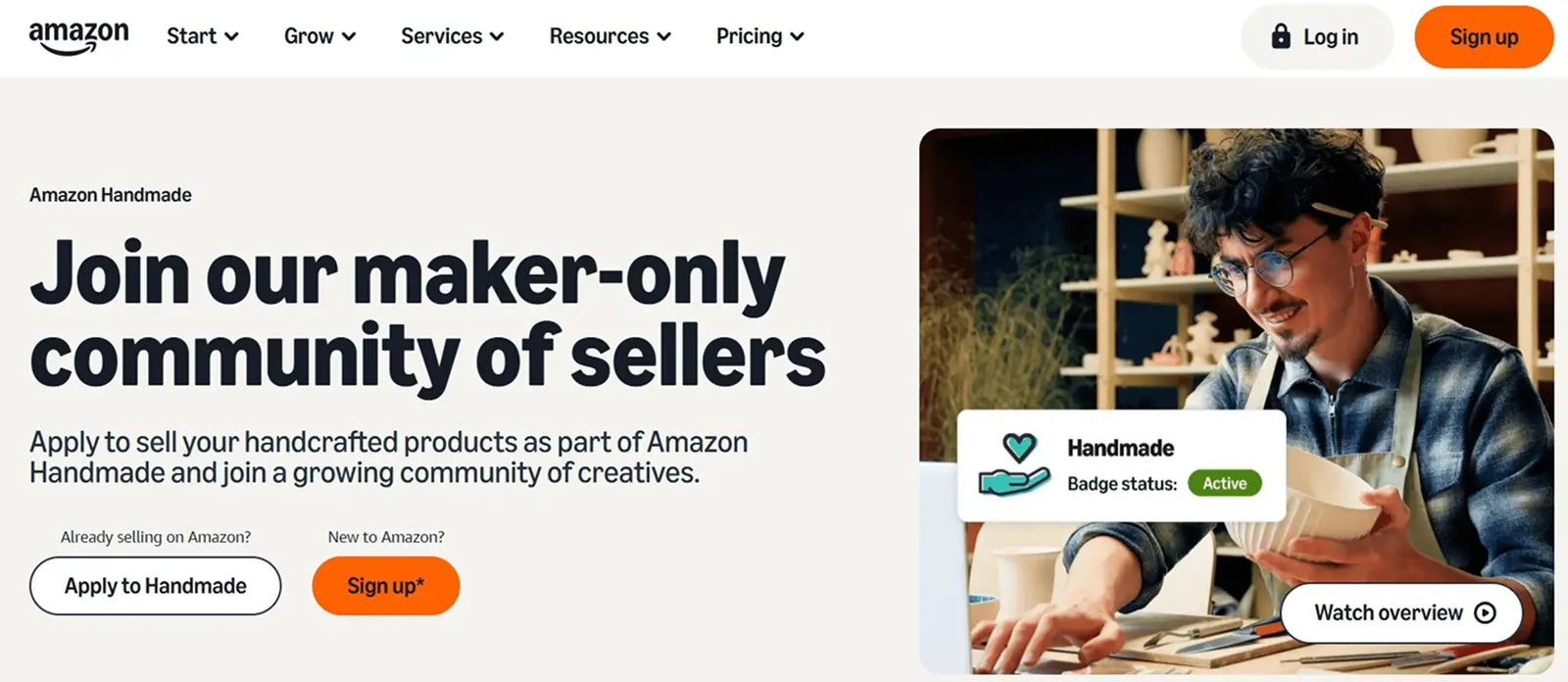
Both Etsy and Amazon Handmade are spaces focused on handmade goods. Both of them have a clean interface (although we are partial to the Etsy one), are easy to use, and come with a readymade audience.
Both platforms also let you customize your seller profile with custom banners, bios, and featured products. However, Etsy does offer more personalization options to make your storefront your own. With Amazon Handmade, their branding always comes first, so your options are limited.
They do have some differences, though, mainly pertaining to their customer base. While Etsy’s focus is exclusively on selling handcrafted items, Amazon Handmade is simply a part of the larger Amazon ecosystem.
This means that even if you sell on Amazon Handmade, your items will still show up in the search results of the general Amazon store. While this does give you a larger customer base, your buyers likely won’t be people looking for unique handmade pieces.
Getting started with a storefront
Anybody and their grandmother can sign up to Etsy, list their products, and start selling. All you have to do is create an account, come up with an Etsy shop name, create your first listing, and boom! You’re all set.
Getting started with selling on Amazon Handmade is a little bit more complicated than that. First, you need to sign up as a professional seller — something that costs $39.99/month (although it can be waived later).
The next step is applying to become an Amazon Handmade seller. As part of this process, you’ll need to answer detailed questions about your business and provide any necessary documentation (including info about your production process and designs, and photos about your tools and workspace).
You can only start selling if Amazon approves your application. This is Amazon’s way of making sure that only handmade goods are being sold on Handmade.
What type of sellers get approved?
Sellers who work individually, or with fewer than 20 others
Co-operatives
Non-profits, charities, and NGOs
Social enterprises
It’s worth noting that the vetting process may take a few weeks. If you don’t get approved, you’ll have to wait 30 days before applying again.
Product categories
Etsy has 17 main product categories, with hundreds of sub-categories. You can list and sell anything that’s artisan-made (even if the artisan wasn’t you). In short, Etsy lets you sell anything unique that you made, designed, handpicked, or sourced.
Thrifted a vintage product that’s one of a kind? You can sell it on Etsy. Similarly, digital goods (such as printable planners, art, etc.) are also allowed, so long as they were designed by you.
Here’s a brief overview of the type of products you can sell on Etsy:
Made by a seller: Physical items handcrafted by you. Also includes hand-altered and hand-assembled items
Designed by a seller: Your original designs that are being sold as digital files, or are being printed on third-party products
Handpicked by a seller: Vintage items, things from nature, or curated collections
Sourced by a seller: Items that have been personalized by you. Also includes craft and party supplies
Amazon Handmade, on the other hand, has stricter rules about what is and isn’t allowed. For starters, there are 15 main categories. Any item that doesn’t fall into these categories can’t be sold on the Handmade platform.
To sell on Amazon Handmade, your product must be:
Handcrafted or hand-designed:: Physically designed and produced by you. Shouldn’t be mass-produced
Hand-altered: Adding significant personalizations to pre-made items
Upcycled: Upgrading an already existing product
Repurposed: Creating a new product out of an old product
Unlike Etsy, though, you cannot sell digital items or crafting supplies (unless the items included in the crafting supplies, such as the yarn, etc. were made or hand-altered by you).
Fees
Each platform comes with various fees that will eat into your profit. Let’s look at how much each platform will set you back.
Setup fee
Etsy charges you a one-time setup fee between $15 and $29, depending on your location.
While Amazon doesn’t charge you a setup fee, per se, you do need a Professional Seller Account to sell on Handmade. This costs $39.99/month. However, once you get approved as a Handmade seller, this fee will be waived for you, so it’s essentially a one-time fee.
Listing fee
You need to pay a fee of $0.20 for each listing you create on Etsy. You’ll have to shoulder this fee even if your item doesn’t sell. Multiple quantities are considered as different listings, meaning if you list 10 pieces of a doll, each piece is subject to the listing fee.
Another thing to note is that this listing fee is valid only for 4 months. After this time period ends, you’ll have to renew your listing and pay the fees again.
Amazon Handmade doesn’t charge any listing fees.
Transaction and payment processing fees
Amazon Handmade has higher transaction fees than Etsy. While Etsy charges you a 6.5% fee on the total sale amount, Amazon Handmade charges a whopping 15%.
However, when it comes to payment processing fees, Amazon Handmade fares better, as it doesn’t charge anything. Etsy does.
The payment processing fee you’ll pay for an Etsy sale depends on your region.
For US sellers: 3% + $0.25
For UK sellers: 4% + £0.20
💡 Use Crosslist’s free Etsy fee calculator to do the math on how much you owe the platform.
When it comes to payouts, though, Etsy takes the lead as the funds of a sale become available to you instantly after the purchase has been made. You can also transfer the funds to your bank account on your own schedule.
Amazon Handmade, however, only makes the funds available to you once products are marked as “shipped.” You can also transfer the payments only once every 2 weeks.
Advertising fees
Both Etsy and Amazon Handmade have a pay-per-click advertisement model where you’ll only have to pay if a potential buyer clicks on your ad.
Other than that, Etsy also runs offsite ads for you, and you can’t opt out of them (unless you made less than $10,000 in a year). However, you’ll only pay for these ads if a user clicks on your ad and then purchases the item within 30 days.
If your annual Etsy revenue was less than $10,000, you’ll pay a 15% commission fee on any sales you made through Etsy ads. If your annual revenue crosses $10,000, you’ll only pay 12% in fees.
Other fees
Some other fees that you may incur on both of these platforms include currency conversion fees and shipping fees. These depend on your location, the place you’re delivering to, and the size and weight of your packages.
Advertising tools
Both platforms have various advertising tools that you can use to boost your sales.
On Etsy, you have:
Offsite ads where you pay a commission fee only when a sale is made directly through the ads
Pay-per-click onsite ads
Coupons and discounts
Dedicated Etsy teams
Etsy Shop Optimization Outreach Program
Affiliate programs
Amazon Handmade gives you the following advertising options:
Pay-per-click ads
Sponsored placements
Amazon Live
Promotions and coupons
External promotional strategies
In addition to these, we highly recommend that you also use external promotional methods to increase your shop visibility. Here are some strategies that work for Etsy and Amazon Handmade:
Partnering with influencers
Building an email list
Promoting your listings on social media
Collaborating with other artisans
Taking part in local crafts fairs
Delisting and relisting your listings through a platform like Crosslist to enhance their visibility
Fulfillment
E-commerce shipping is a whole other beast to tackle. How do these platforms fare in this regard?
With Etsy, you’re responsible for shipping the items, although you can purchase discounted USPS shipping labels directly through the platform. Once the label is generated, all you have to do is print it out, stick it to your package, and schedule a USPS package pick-up.
As soon as you get the label, Etsy will automatically mark the item as shipped and give the buyer a tracking number.
Amazon, however, goes one step further and offers an entire fulfillment option. This means the platform will handle all the logistics of shipping for you, including warehousing. You do have to pay a warehousing fee for storing all your products, though.
How does it work? You send your inventory to Amazon, who will store it in a warehouse. Once a product is sold, Amazon will pick it up, pack it up, and ship it. A completely headache-free option for those who prefer a hands-off shipping approach.
Which is better for artisans? Etsy, or Amazon Handmade?
Both Etsy and Amazon Handmade come with their own strengths and weaknesses, so the better question is: which platform is the right pick for your business needs?
You should pick Etsy if:
You sell highly customizable or one-of-a-kind products
You sell digital items
You want to create a personal brand online
You’re focused on selling to niche shoppers who can appreciate your craft
You want brand loyalty
You should pick Amazon Handmade if:
Your handcrafted products can be produced relatively quickly
You want a very large customer base
You’re focused on just the selling, and don’t mind selling to casual shoppers
Building a personal brand isn’t a priority
Of course, there’s no rule saying you can’t sell on both. 😉
And if you go with Etsy, Crosslist lets you cross list your Etsy items across other marketplaces too, so the same handmade pieces reach buyers on Poshmark, eBay, and beyond from a single dashboard.
Other places to sell handmade items
Etsy and Amazon Handmade are two of the biggest names in the handmade space, but they’re not the only options.
Depending on what you sell, how much control you want over your brand, and how much you’re willing to pay in fees, another marketplace may be a better fit. Some platforms are more niche, some give you more customization options, and others help you reach a different type of buyer altogether.
Below, we’ll walk through some of the best places to sell handmade items online, so you can find the right platform for your products.
1. Goimagine
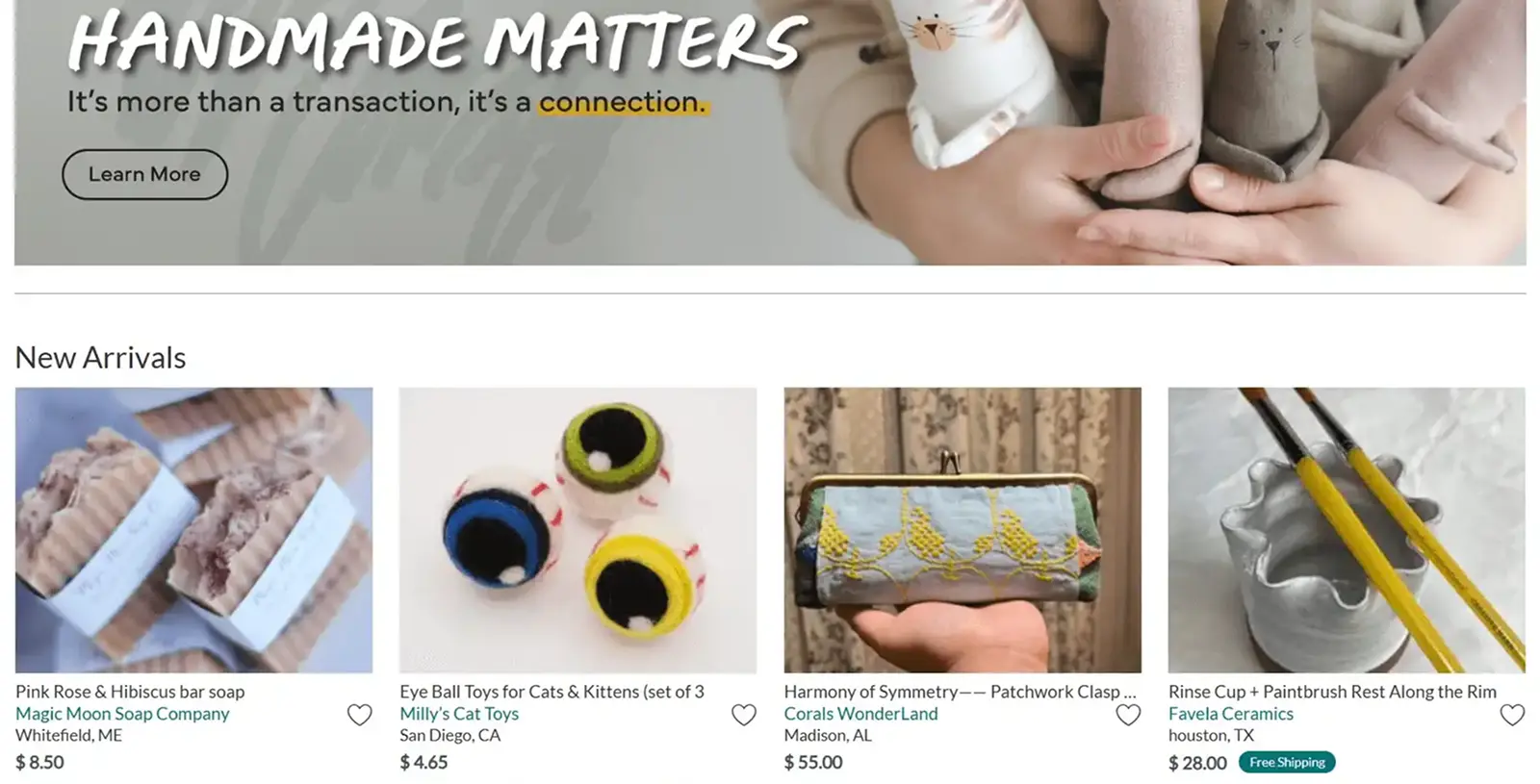
Goimagine is a purely handmade marketplace + community for US-based artisans.
Like Etsy, you can sell all sorts of handcrafted items, ranging from clothes and jewelry to art and collectibles.
This platform is created by and for true artisans, so everybody needs to go through an application process to get approved to sell.
There are also different membership levels:
Community (Free): 12 product listings; 6.5% transaction fees
Thrive ($5/ month): 200 product listings; 5% transaction fees
Mosaic ($15/ month): 1,000 product listings; 2% transaction fees
With the Mosaic plan, you can create your own storefront, complete with a custom domain, free SSL certificate, and USPS shipping integration! Cheaper than Shopify, but with all the necessary features included.
New to selling your handmade products online?
Goimagine also has a community forum where you can get advice from and connect with other sellers. The best part about this platform, though? They donate 2% of all purchases to charities!
Since Goimagine (and all the other websites on this list) are not as well-known as Etsy, you might have to do a little promotion of your own to get more buyers, either through social media, collaborations, or your own marketing.
2. Society6
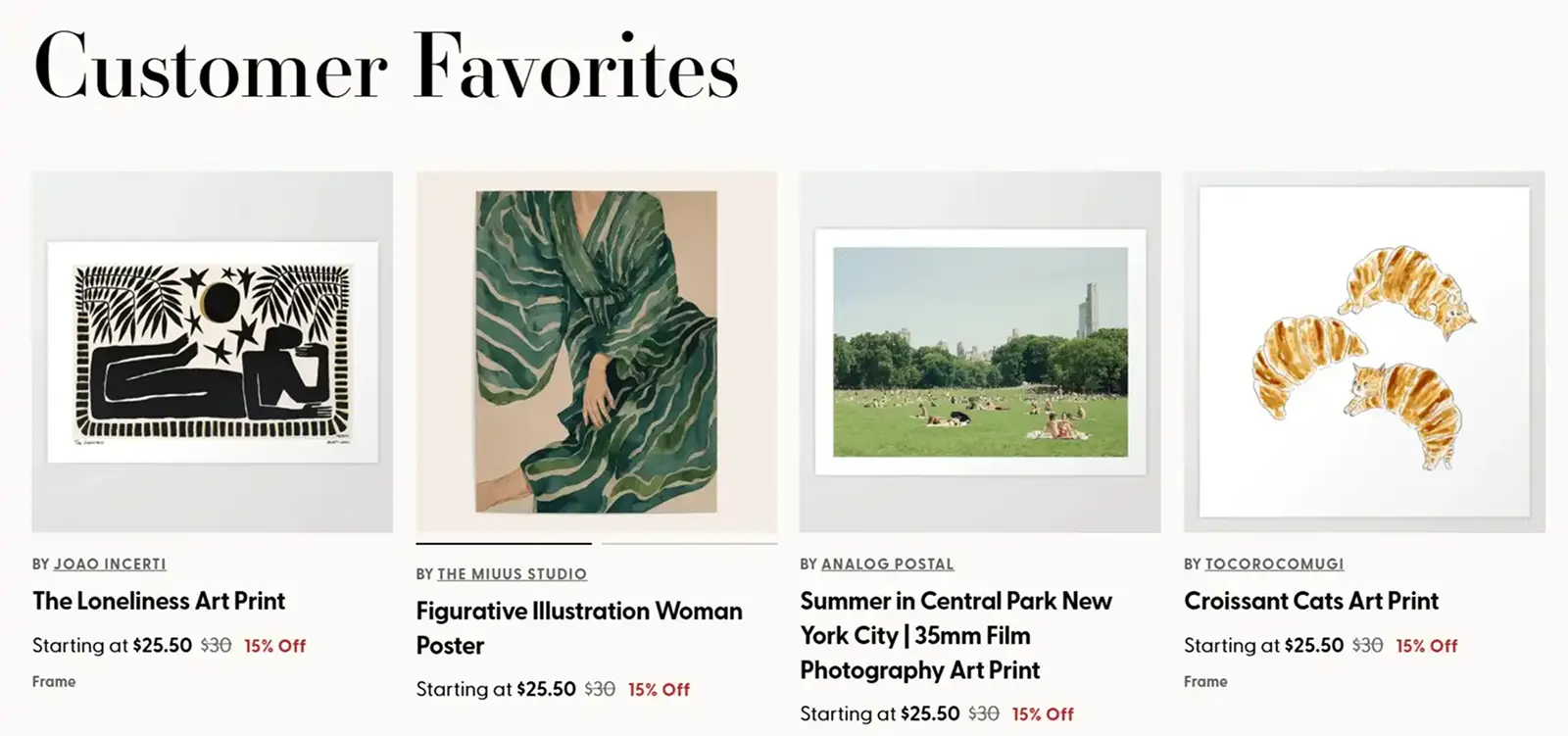
Made specifically for artists and designers, Society6 helps them market and sell their products online.
You can sell home decor products, art prints, phone cases, and clothing and accessories — as long as they have your original designs on them.
What we really liked about Society6 is that they highlight the artists every chance they get.
Under each product, there’s an option to “see more from the artist” and shop their other designs. Each artist also gets their own shop page.
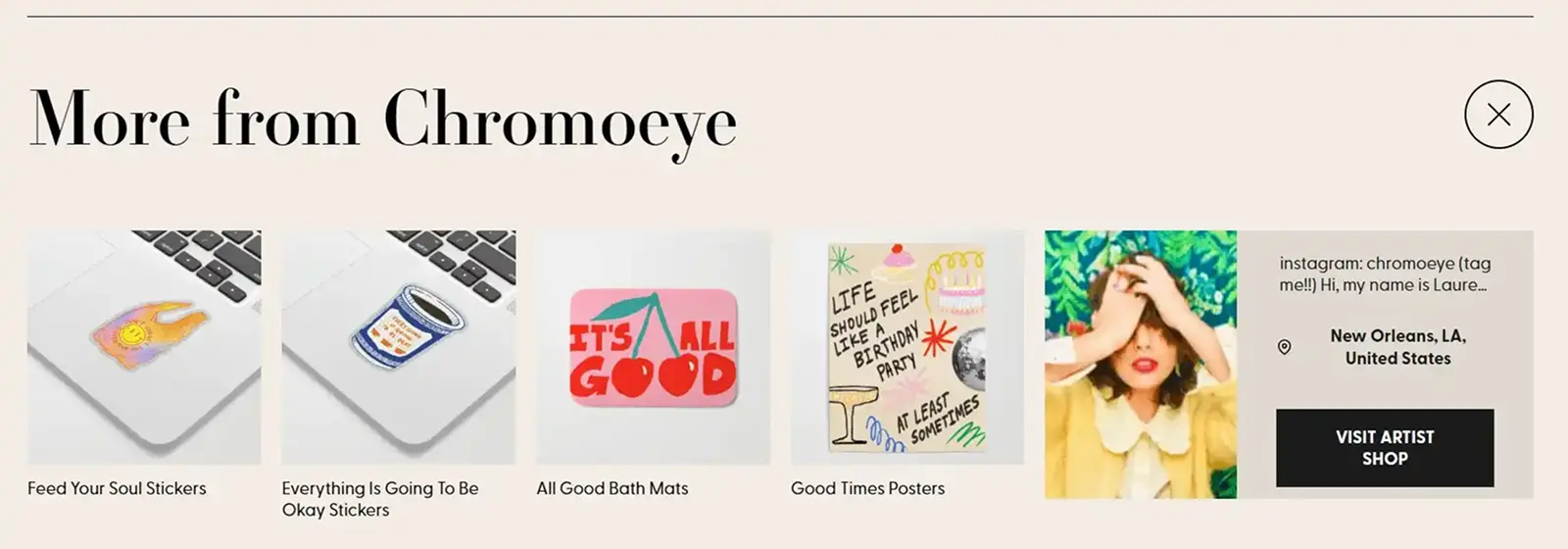
While Society6 used to be an open platform, since March 2025, they’ve updated their policy terms. They’ve pivoted towards a more curated approach where they select a few artists and showcase only their work.
If you want to get in on the action, you’ll need to apply as an artist. Good news, though — it’s open to global artists.
Society6 takes a small percentage of each sale. With the new terms, they’ve also done away with their artist subscription plans and artist shipping fees, which means more profit for the artists!
3. Bonanza
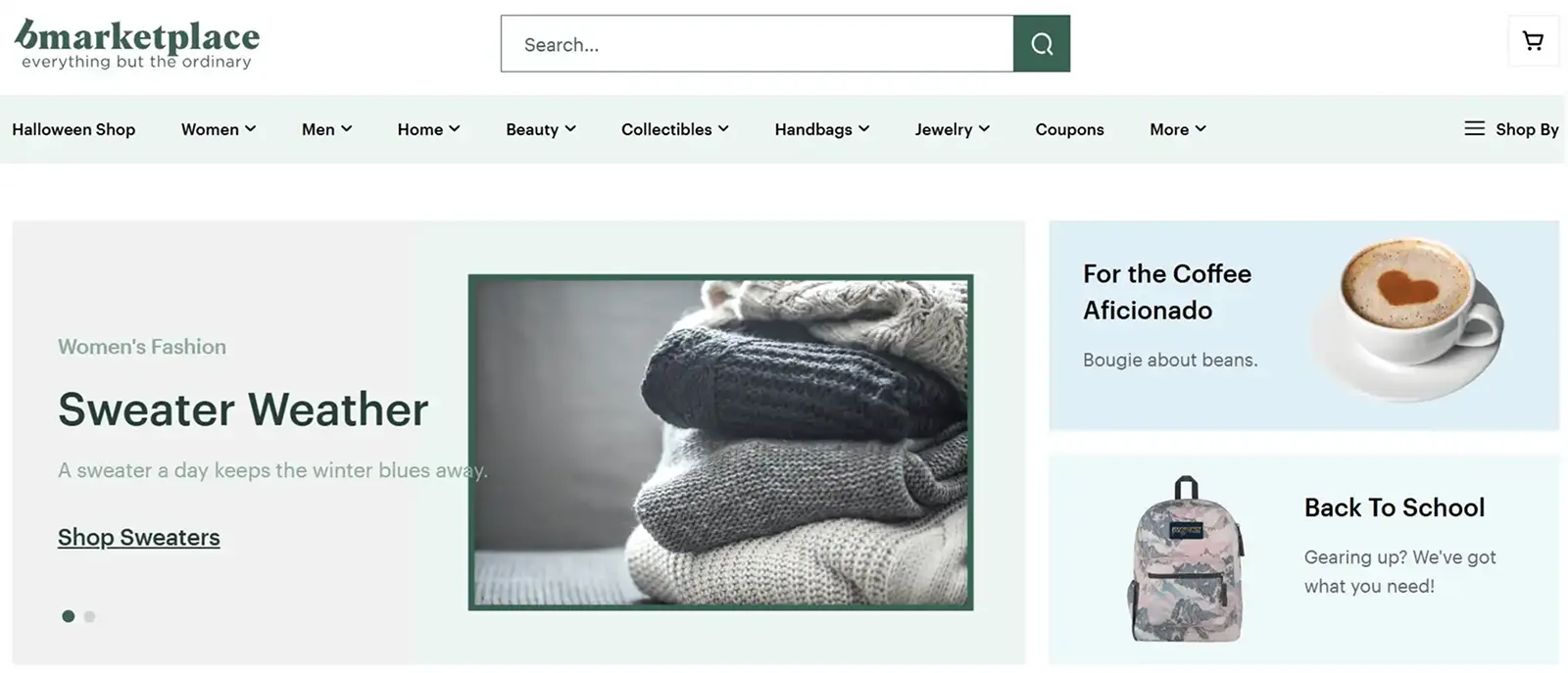
While Bonanza isn’t made exclusively for handmade items, you can sell your crafts there and take away more profits when compared to Etsy.
Each seller is given a virtual “booth” to showcase all of their products. There are no listing fees for up to 50 active listings per month.
Bonanza advertises your products on your behalf and only takes a fee when you make a sale. The platform also has a community where you can bounce ideas off of other sellers like you, and marketing tools like discount coupons for you to use.
Pricing:
A one-time set-up fee: $14.99
$0.25 transaction fee
Final value fee: 11%
A 1.5% flat fee on orders above $4,000 (applied only to the portion exceeding $4,000)
A $0.03 listing fee per item per month, with a maximum of $20 per month (when you exceed 50 active listings per month)
4. Uncommon Goods
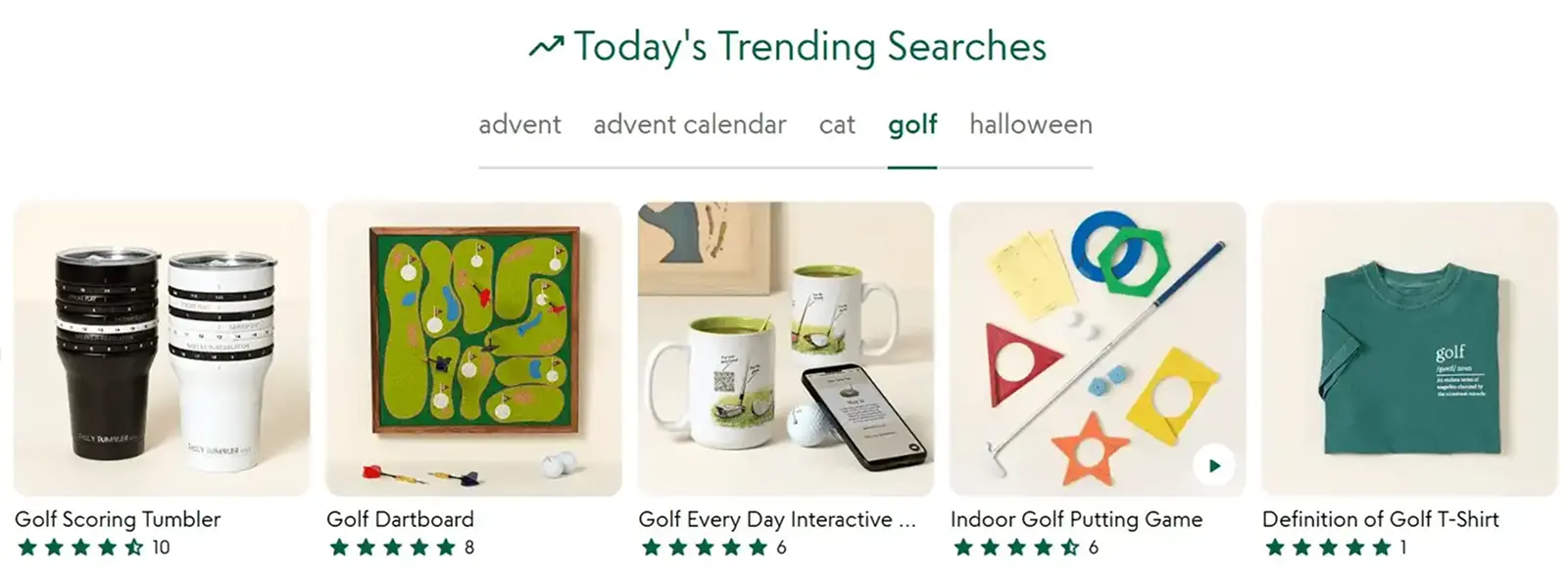
Uncommon Goods is on a mission to sell the most unique handcrafted products out there. But it isn’t your typical online marketplace, though.
The website has a team that ethically sources one-of-a-kind products from all over the world. So, if you want your product to be featured there? You’ll have to apply. UG also creates many products in-house.
If your product gets approved, you’ll sell it to UG at wholesale prices; they’ll take care of the retail sales.
Any other commissions and fees are negotiated directly based on your product.
UG is environmentally-conscious and donates $1 per purchase to a charity of the buyer’s choice. While you won’t get to sell directly to the customer, you can get a lot of visibility through this platform — especially if you have the same values as UG.
5. Cratejoy
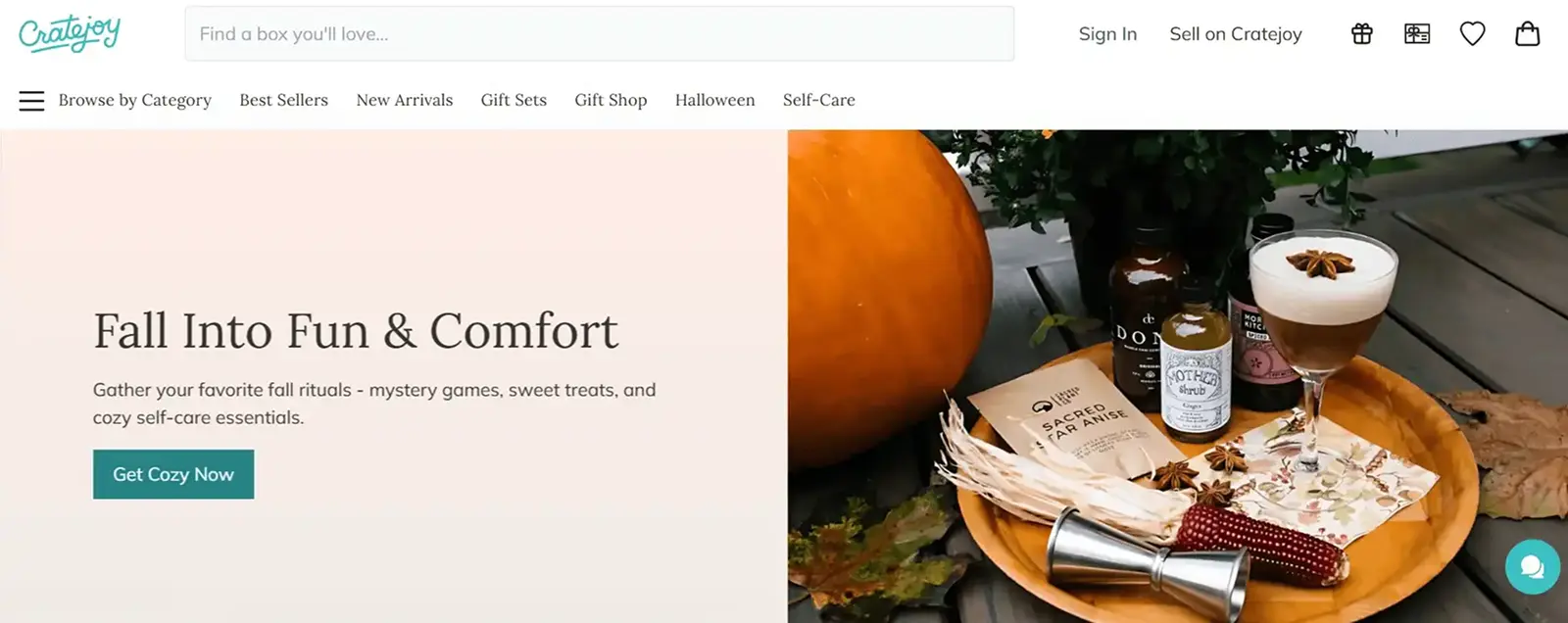
Do you make a few related items that would sell like hotcakes when bundled together? You could sell them as subscription boxes! And Cratejoy is the perfect website for that.
You can sell anything there — a self-care box, a snack box with an assortment of healthy snacks, or even DIY garden/ art kits. Just make sure each month’s box is unique.
The best thing about selling subscription boxes is that once someone signs up, you get recurring revenue from them! And hey, you can always charge top-notch prices for tailored boxes.
You can either sell on Cratejoy’s marketplace, or create a custom storefront of your own! You need to pay a membership fee for both, though.
Pricing:
Selling on the Cratejoy marketplace: From $24.99 per month; 1.25% + $0.10 fees per transaction
Your own website: $59 or $159 per month (depending on the features you want); 1.25% + $0.10 fees per transaction
6. Spoonflower
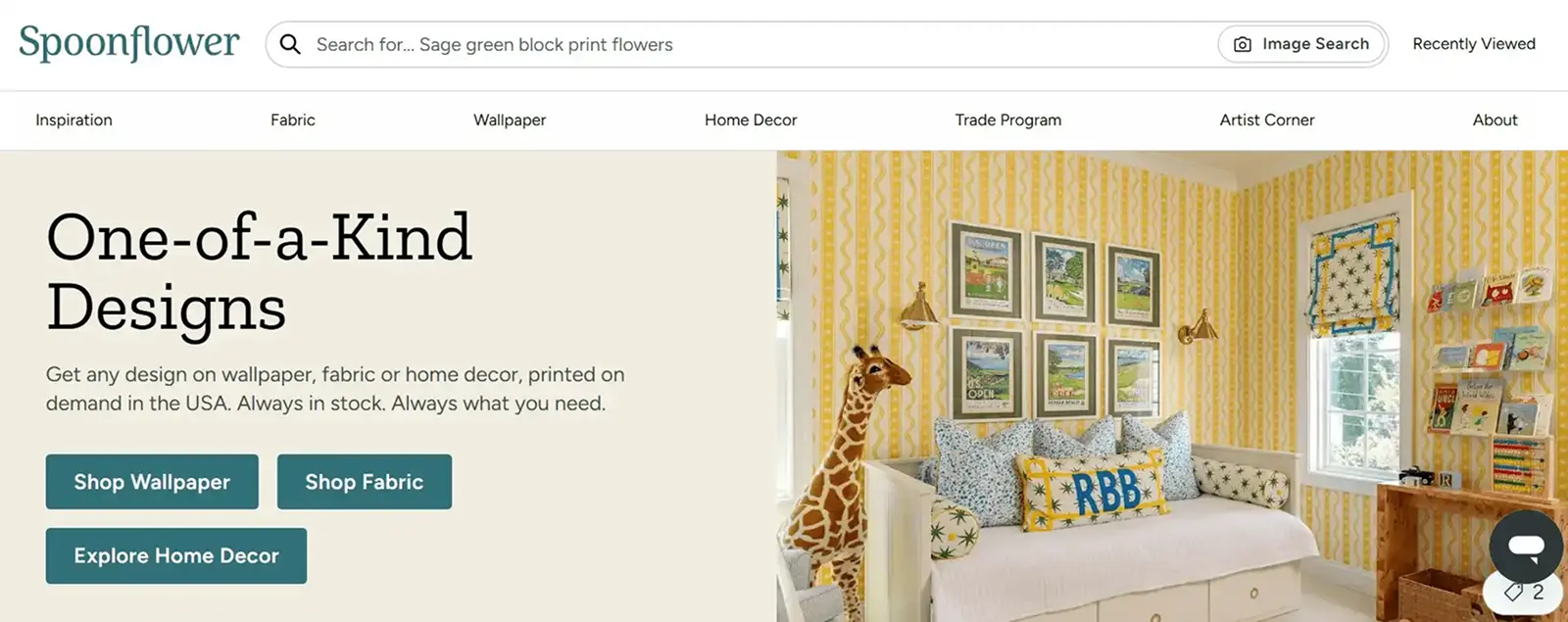
SpoonFlower sells unique print-on-demand fabrics, wallpapers, and home decor items (such as table napkins, bedding, etc.) designed by artists from all over the world.
All you need to do is upload a digital file of your design to the platform and proof it to make sure it prints well.
Once that’s done, upload your design for sale. When someone orders your design, Spoonflower will take care of the printing and shipping.
You’ll get a 10% commission for each sale. There are also bonuses if you hit certain commission milestones in a month!
Overall, selling here is a great way to make some money without a lot of effort.
7. IndieCart
This one is for those of you who want to sell your handmade products online, but with minimal overhead costs. For a small all-inclusive fee of $7.50 per month, you can sell your handcrafted items on IndieCart — no listing fees or commissions from your sales.
However, you will have to pay PayPal’s fees (since IndieCart only integrates with PayPal), so factor that into your selling prices. You also need to take care of all the labeling and shipping yourself.
There’s no limit to the number of items you can list and sell. You’re also free to apply your own discount coupons and run sales whenever you want.
In short, you get a no-frills website to sell your items on, and full control over how you run your online business.
8. iCraft Gifts
iCraft Gifts is a Canadian-based marketplace that’s exclusively for handmade gifts. You can sell your handcrafted jewelry, clothing, accessories, bath and body items, toys and games, home decor, and craft items.
Although it’s Canada-based, you’ll find a lot of US- and UK-based sellers as well.
You get your own storefront where all of your products are displayed. iCraft Gifts also automatically promotes your items on social media and through newsletters.
You can connect your iCraft store to Google Analytics for performance data. There’s also a forum where you can connect with other artisans like you.
Fees:
A one-time registration fee of $25 USD
A subscription fee, where a monthly package costs $15 USD, a 6-month package costs $12 USD, and a 12-month package costs $10 USD
No transaction, listing, or final value fees. However, you’ll have to take care of the shipping yourself.
Another good thing about iCraft Gifts is that it gives you a free .store domain for a year. Alternatively, if you want a .com domain, you can get one for 50% off.
There are also a variety of sales tools (such as discounts) that you can use to boost your sales!
And that’s a wrap on the best places to sell handmade items online.
If you do a quick Google search for “which platform should I sell my handmade goods on,” two of the top results that will pop up are Etsy and Amazon Handmade.
The next question, of course, is “which one do I choose?” Well, both the platforms have their own strengths and weaknesses, so it all depends on your needs and goals (and how much you’ll have to fork over in fees).
Whether you’re looking to pick only one of these platforms for your e-commerce crafts business, or are considering both and just want to look into their features, we’ve got you. Let’s jump into an in-depth comparison of Etsy and Amazon Handmade.
Key takeaways
Etsy is easier to start (no application) and better for one-of-a-kind, custom, digital, and vintage items; Amazon Handmade requires an application and approval but offers Amazon's huge audience and FBA fulfillment.
Etsy's fees are lower for most items, and Amazon Handmade charges a flat 15% referral fee with no listing or processing fees.
Amazon Handmade waives its $39.99/month Professional plan fee once you're approved as a Handmade seller.
Etsy gives you more storefront branding and instant payouts; Amazon Handmade prioritizes its own branding and releases funds after items ship.
There's no rule against selling on both, and if you sell on Etsy, a cross listing tool like Crosslist lets you list those items across your other marketplaces from one place.
Etsy vs. Amazon Handmade at a glance
Features | Etsy | Amazon Handmade |
Target audience | Smaller; focused on craft enthusiasts | Larger; focused on casual shoppers who want something handmade |
User interface | Clean, easy to use, allows for storefront personalization | Clean, easy to use, allows for storefront personalization |
Store set-up | Very easy; can sign up and start selling | Need to apply and pass a strict review |
Product categories | Anything unique that’s made, designed, handpicked, or sourced by you; digital items allowed | Anything that’s handcrafted, hand-altered, hand-designed, upcycled, or repurposed by you; no digital items allowed |
Setup fee | $15-$29 | $39.99 for the Professional Seller Account |
Listing fee | $0.20/item/listing; need to renew after 4 months | No listing fees |
Transaction fee | 6.5% | 15% |
Payment processing fee | 3% + $0.25 | No payment processing fees |
Advertising tools | Onsite and offsite ads | Onsite ads; sponsored placements |
Fulfillment | Seller is responsible; discounted USPS shipping labels available through Etsy | You can use Fulfillment by Amazon (FBA) or ship on your own |
Now, an in-depth examination and comparison of each feature.
The basics
Both Etsy and Amazon Handmade are spaces focused on handmade goods. Both of them have a clean interface (although we are partial to the Etsy one), are easy to use, and come with a readymade audience.
Both platforms also let you customize your seller profile with custom banners, bios, and featured products. However, Etsy does offer more personalization options to make your storefront your own. With Amazon Handmade, their branding always comes first, so your options are limited.
They do have some differences, though, mainly pertaining to their customer base. While Etsy’s focus is exclusively on selling handcrafted items, Amazon Handmade is simply a part of the larger Amazon ecosystem.
This means that even if you sell on Amazon Handmade, your items will still show up in the search results of the general Amazon store. While this does give you a larger customer base, your buyers likely won’t be people looking for unique handmade pieces.
Getting started with a storefront
Anybody and their grandmother can sign up to Etsy, list their products, and start selling. All you have to do is create an account, come up with an Etsy shop name, create your first listing, and boom! You’re all set.
Getting started with selling on Amazon Handmade is a little bit more complicated than that. First, you need to sign up as a professional seller — something that costs $39.99/month (although it can be waived later).
The next step is applying to become an Amazon Handmade seller. As part of this process, you’ll need to answer detailed questions about your business and provide any necessary documentation (including info about your production process and designs, and photos about your tools and workspace).
You can only start selling if Amazon approves your application. This is Amazon’s way of making sure that only handmade goods are being sold on Handmade.
What type of sellers get approved?
Sellers who work individually, or with fewer than 20 others
Co-operatives
Non-profits, charities, and NGOs
Social enterprises
It’s worth noting that the vetting process may take a few weeks. If you don’t get approved, you’ll have to wait 30 days before applying again.
Product categories
Etsy has 17 main product categories, with hundreds of sub-categories. You can list and sell anything that’s artisan-made (even if the artisan wasn’t you). In short, Etsy lets you sell anything unique that you made, designed, handpicked, or sourced.
Thrifted a vintage product that’s one of a kind? You can sell it on Etsy. Similarly, digital goods (such as printable planners, art, etc.) are also allowed, so long as they were designed by you.
Here’s a brief overview of the type of products you can sell on Etsy:
Made by a seller: Physical items handcrafted by you. Also includes hand-altered and hand-assembled items
Designed by a seller: Your original designs that are being sold as digital files, or are being printed on third-party products
Handpicked by a seller: Vintage items, things from nature, or curated collections
Sourced by a seller: Items that have been personalized by you. Also includes craft and party supplies
Amazon Handmade, on the other hand, has stricter rules about what is and isn’t allowed. For starters, there are 15 main categories. Any item that doesn’t fall into these categories can’t be sold on the Handmade platform.
To sell on Amazon Handmade, your product must be:
Handcrafted or hand-designed:: Physically designed and produced by you. Shouldn’t be mass-produced
Hand-altered: Adding significant personalizations to pre-made items
Upcycled: Upgrading an already existing product
Repurposed: Creating a new product out of an old product
Unlike Etsy, though, you cannot sell digital items or crafting supplies (unless the items included in the crafting supplies, such as the yarn, etc. were made or hand-altered by you).
Fees
Each platform comes with various fees that will eat into your profit. Let’s look at how much each platform will set you back.
Setup fee
Etsy charges you a one-time setup fee between $15 and $29, depending on your location.
While Amazon doesn’t charge you a setup fee, per se, you do need a Professional Seller Account to sell on Handmade. This costs $39.99/month. However, once you get approved as a Handmade seller, this fee will be waived for you, so it’s essentially a one-time fee.
Listing fee
You need to pay a fee of $0.20 for each listing you create on Etsy. You’ll have to shoulder this fee even if your item doesn’t sell. Multiple quantities are considered as different listings, meaning if you list 10 pieces of a doll, each piece is subject to the listing fee.
Another thing to note is that this listing fee is valid only for 4 months. After this time period ends, you’ll have to renew your listing and pay the fees again.
Amazon Handmade doesn’t charge any listing fees.
Transaction and payment processing fees
Amazon Handmade has higher transaction fees than Etsy. While Etsy charges you a 6.5% fee on the total sale amount, Amazon Handmade charges a whopping 15%.
However, when it comes to payment processing fees, Amazon Handmade fares better, as it doesn’t charge anything. Etsy does.
The payment processing fee you’ll pay for an Etsy sale depends on your region.
For US sellers: 3% + $0.25
For UK sellers: 4% + £0.20
💡 Use Crosslist’s free Etsy fee calculator to do the math on how much you owe the platform.
When it comes to payouts, though, Etsy takes the lead as the funds of a sale become available to you instantly after the purchase has been made. You can also transfer the funds to your bank account on your own schedule.
Amazon Handmade, however, only makes the funds available to you once products are marked as “shipped.” You can also transfer the payments only once every 2 weeks.
Advertising fees
Both Etsy and Amazon Handmade have a pay-per-click advertisement model where you’ll only have to pay if a potential buyer clicks on your ad.
Other than that, Etsy also runs offsite ads for you, and you can’t opt out of them (unless you made less than $10,000 in a year). However, you’ll only pay for these ads if a user clicks on your ad and then purchases the item within 30 days.
If your annual Etsy revenue was less than $10,000, you’ll pay a 15% commission fee on any sales you made through Etsy ads. If your annual revenue crosses $10,000, you’ll only pay 12% in fees.
Other fees
Some other fees that you may incur on both of these platforms include currency conversion fees and shipping fees. These depend on your location, the place you’re delivering to, and the size and weight of your packages.
Advertising tools
Both platforms have various advertising tools that you can use to boost your sales.
On Etsy, you have:
Offsite ads where you pay a commission fee only when a sale is made directly through the ads
Pay-per-click onsite ads
Coupons and discounts
Dedicated Etsy teams
Etsy Shop Optimization Outreach Program
Affiliate programs
Amazon Handmade gives you the following advertising options:
Pay-per-click ads
Sponsored placements
Amazon Live
Promotions and coupons
External promotional strategies
In addition to these, we highly recommend that you also use external promotional methods to increase your shop visibility. Here are some strategies that work for Etsy and Amazon Handmade:
Partnering with influencers
Building an email list
Promoting your listings on social media
Collaborating with other artisans
Taking part in local crafts fairs
Delisting and relisting your listings through a platform like Crosslist to enhance their visibility
Fulfillment
E-commerce shipping is a whole other beast to tackle. How do these platforms fare in this regard?
With Etsy, you’re responsible for shipping the items, although you can purchase discounted USPS shipping labels directly through the platform. Once the label is generated, all you have to do is print it out, stick it to your package, and schedule a USPS package pick-up.
As soon as you get the label, Etsy will automatically mark the item as shipped and give the buyer a tracking number.
Amazon, however, goes one step further and offers an entire fulfillment option. This means the platform will handle all the logistics of shipping for you, including warehousing. You do have to pay a warehousing fee for storing all your products, though.
How does it work? You send your inventory to Amazon, who will store it in a warehouse. Once a product is sold, Amazon will pick it up, pack it up, and ship it. A completely headache-free option for those who prefer a hands-off shipping approach.
Which is better for artisans? Etsy, or Amazon Handmade?
Both Etsy and Amazon Handmade come with their own strengths and weaknesses, so the better question is: which platform is the right pick for your business needs?
You should pick Etsy if:
You sell highly customizable or one-of-a-kind products
You sell digital items
You want to create a personal brand online
You’re focused on selling to niche shoppers who can appreciate your craft
You want brand loyalty
You should pick Amazon Handmade if:
Your handcrafted products can be produced relatively quickly
You want a very large customer base
You’re focused on just the selling, and don’t mind selling to casual shoppers
Building a personal brand isn’t a priority
Of course, there’s no rule saying you can’t sell on both. 😉
And if you go with Etsy, Crosslist lets you cross list your Etsy items across other marketplaces too, so the same handmade pieces reach buyers on Poshmark, eBay, and beyond from a single dashboard.
Other places to sell handmade items
Etsy and Amazon Handmade are two of the biggest names in the handmade space, but they’re not the only options.
Depending on what you sell, how much control you want over your brand, and how much you’re willing to pay in fees, another marketplace may be a better fit. Some platforms are more niche, some give you more customization options, and others help you reach a different type of buyer altogether.
Below, we’ll walk through some of the best places to sell handmade items online, so you can find the right platform for your products.
1. Goimagine
Goimagine is a purely handmade marketplace + community for US-based artisans.
Like Etsy, you can sell all sorts of handcrafted items, ranging from clothes and jewelry to art and collectibles.
This platform is created by and for true artisans, so everybody needs to go through an application process to get approved to sell.
There are also different membership levels:
Community (Free): 12 product listings; 6.5% transaction fees
Thrive ($5/ month): 200 product listings; 5% transaction fees
Mosaic ($15/ month): 1,000 product listings; 2% transaction fees
With the Mosaic plan, you can create your own storefront, complete with a custom domain, free SSL certificate, and USPS shipping integration! Cheaper than Shopify, but with all the necessary features included.
New to selling your handmade products online?
Goimagine also has a community forum where you can get advice from and connect with other sellers. The best part about this platform, though? They donate 2% of all purchases to charities!
Since Goimagine (and all the other websites on this list) are not as well-known as Etsy, you might have to do a little promotion of your own to get more buyers, either through social media, collaborations, or your own marketing.
2. Society6
Made specifically for artists and designers, Society6 helps them market and sell their products online.
You can sell home decor products, art prints, phone cases, and clothing and accessories — as long as they have your original designs on them.
What we really liked about Society6 is that they highlight the artists every chance they get.
Under each product, there’s an option to “see more from the artist” and shop their other designs. Each artist also gets their own shop page.
While Society6 used to be an open platform, since March 2025, they’ve updated their policy terms. They’ve pivoted towards a more curated approach where they select a few artists and showcase only their work.
If you want to get in on the action, you’ll need to apply as an artist. Good news, though — it’s open to global artists.
Society6 takes a small percentage of each sale. With the new terms, they’ve also done away with their artist subscription plans and artist shipping fees, which means more profit for the artists!
3. Bonanza
While Bonanza isn’t made exclusively for handmade items, you can sell your crafts there and take away more profits when compared to Etsy.
Each seller is given a virtual “booth” to showcase all of their products. There are no listing fees for up to 50 active listings per month.
Bonanza advertises your products on your behalf and only takes a fee when you make a sale. The platform also has a community where you can bounce ideas off of other sellers like you, and marketing tools like discount coupons for you to use.
Pricing:
A one-time set-up fee: $14.99
$0.25 transaction fee
Final value fee: 11%
A 1.5% flat fee on orders above $4,000 (applied only to the portion exceeding $4,000)
A $0.03 listing fee per item per month, with a maximum of $20 per month (when you exceed 50 active listings per month)
4. Uncommon Goods
Uncommon Goods is on a mission to sell the most unique handcrafted products out there. But it isn’t your typical online marketplace, though.
The website has a team that ethically sources one-of-a-kind products from all over the world. So, if you want your product to be featured there? You’ll have to apply. UG also creates many products in-house.
If your product gets approved, you’ll sell it to UG at wholesale prices; they’ll take care of the retail sales.
Any other commissions and fees are negotiated directly based on your product.
UG is environmentally-conscious and donates $1 per purchase to a charity of the buyer’s choice. While you won’t get to sell directly to the customer, you can get a lot of visibility through this platform — especially if you have the same values as UG.
5. Cratejoy
Do you make a few related items that would sell like hotcakes when bundled together? You could sell them as subscription boxes! And Cratejoy is the perfect website for that.
You can sell anything there — a self-care box, a snack box with an assortment of healthy snacks, or even DIY garden/ art kits. Just make sure each month’s box is unique.
The best thing about selling subscription boxes is that once someone signs up, you get recurring revenue from them! And hey, you can always charge top-notch prices for tailored boxes.
You can either sell on Cratejoy’s marketplace, or create a custom storefront of your own! You need to pay a membership fee for both, though.
Pricing:
Selling on the Cratejoy marketplace: From $24.99 per month; 1.25% + $0.10 fees per transaction
Your own website: $59 or $159 per month (depending on the features you want); 1.25% + $0.10 fees per transaction
6. Spoonflower
SpoonFlower sells unique print-on-demand fabrics, wallpapers, and home decor items (such as table napkins, bedding, etc.) designed by artists from all over the world.
All you need to do is upload a digital file of your design to the platform and proof it to make sure it prints well.
Once that’s done, upload your design for sale. When someone orders your design, Spoonflower will take care of the printing and shipping.
You’ll get a 10% commission for each sale. There are also bonuses if you hit certain commission milestones in a month!
Overall, selling here is a great way to make some money without a lot of effort.
7. IndieCart
This one is for those of you who want to sell your handmade products online, but with minimal overhead costs. For a small all-inclusive fee of $7.50 per month, you can sell your handcrafted items on IndieCart — no listing fees or commissions from your sales.
However, you will have to pay PayPal’s fees (since IndieCart only integrates with PayPal), so factor that into your selling prices. You also need to take care of all the labeling and shipping yourself.
There’s no limit to the number of items you can list and sell. You’re also free to apply your own discount coupons and run sales whenever you want.
In short, you get a no-frills website to sell your items on, and full control over how you run your online business.
8. iCraft Gifts
iCraft Gifts is a Canadian-based marketplace that’s exclusively for handmade gifts. You can sell your handcrafted jewelry, clothing, accessories, bath and body items, toys and games, home decor, and craft items.
Although it’s Canada-based, you’ll find a lot of US- and UK-based sellers as well.
You get your own storefront where all of your products are displayed. iCraft Gifts also automatically promotes your items on social media and through newsletters.
You can connect your iCraft store to Google Analytics for performance data. There’s also a forum where you can connect with other artisans like you.
Fees:
A one-time registration fee of $25 USD
A subscription fee, where a monthly package costs $15 USD, a 6-month package costs $12 USD, and a 12-month package costs $10 USD
No transaction, listing, or final value fees. However, you’ll have to take care of the shipping yourself.
Another good thing about iCraft Gifts is that it gives you a free .store domain for a year. Alternatively, if you want a .com domain, you can get one for 50% off.
There are also a variety of sales tools (such as discounts) that you can use to boost your sales!
And that’s a wrap on the best places to sell handmade items online.
If you do a quick Google search for “which platform should I sell my handmade goods on,” two of the top results that will pop up are Etsy and Amazon Handmade.
The next question, of course, is “which one do I choose?” Well, both the platforms have their own strengths and weaknesses, so it all depends on your needs and goals (and how much you’ll have to fork over in fees).
Whether you’re looking to pick only one of these platforms for your e-commerce crafts business, or are considering both and just want to look into their features, we’ve got you. Let’s jump into an in-depth comparison of Etsy and Amazon Handmade.
Key takeaways
Etsy is easier to start (no application) and better for one-of-a-kind, custom, digital, and vintage items; Amazon Handmade requires an application and approval but offers Amazon's huge audience and FBA fulfillment.
Etsy's fees are lower for most items, and Amazon Handmade charges a flat 15% referral fee with no listing or processing fees.
Amazon Handmade waives its $39.99/month Professional plan fee once you're approved as a Handmade seller.
Etsy gives you more storefront branding and instant payouts; Amazon Handmade prioritizes its own branding and releases funds after items ship.
There's no rule against selling on both, and if you sell on Etsy, a cross listing tool like Crosslist lets you list those items across your other marketplaces from one place.
Etsy vs. Amazon Handmade at a glance
Features | Etsy | Amazon Handmade |
Target audience | Smaller; focused on craft enthusiasts | Larger; focused on casual shoppers who want something handmade |
User interface | Clean, easy to use, allows for storefront personalization | Clean, easy to use, allows for storefront personalization |
Store set-up | Very easy; can sign up and start selling | Need to apply and pass a strict review |
Product categories | Anything unique that’s made, designed, handpicked, or sourced by you; digital items allowed | Anything that’s handcrafted, hand-altered, hand-designed, upcycled, or repurposed by you; no digital items allowed |
Setup fee | $15-$29 | $39.99 for the Professional Seller Account |
Listing fee | $0.20/item/listing; need to renew after 4 months | No listing fees |
Transaction fee | 6.5% | 15% |
Payment processing fee | 3% + $0.25 | No payment processing fees |
Advertising tools | Onsite and offsite ads | Onsite ads; sponsored placements |
Fulfillment | Seller is responsible; discounted USPS shipping labels available through Etsy | You can use Fulfillment by Amazon (FBA) or ship on your own |
Now, an in-depth examination and comparison of each feature.
The basics
Both Etsy and Amazon Handmade are spaces focused on handmade goods. Both of them have a clean interface (although we are partial to the Etsy one), are easy to use, and come with a readymade audience.
Both platforms also let you customize your seller profile with custom banners, bios, and featured products. However, Etsy does offer more personalization options to make your storefront your own. With Amazon Handmade, their branding always comes first, so your options are limited.
They do have some differences, though, mainly pertaining to their customer base. While Etsy’s focus is exclusively on selling handcrafted items, Amazon Handmade is simply a part of the larger Amazon ecosystem.
This means that even if you sell on Amazon Handmade, your items will still show up in the search results of the general Amazon store. While this does give you a larger customer base, your buyers likely won’t be people looking for unique handmade pieces.
Getting started with a storefront
Anybody and their grandmother can sign up to Etsy, list their products, and start selling. All you have to do is create an account, come up with an Etsy shop name, create your first listing, and boom! You’re all set.
Getting started with selling on Amazon Handmade is a little bit more complicated than that. First, you need to sign up as a professional seller — something that costs $39.99/month (although it can be waived later).
The next step is applying to become an Amazon Handmade seller. As part of this process, you’ll need to answer detailed questions about your business and provide any necessary documentation (including info about your production process and designs, and photos about your tools and workspace).
You can only start selling if Amazon approves your application. This is Amazon’s way of making sure that only handmade goods are being sold on Handmade.
What type of sellers get approved?
Sellers who work individually, or with fewer than 20 others
Co-operatives
Non-profits, charities, and NGOs
Social enterprises
It’s worth noting that the vetting process may take a few weeks. If you don’t get approved, you’ll have to wait 30 days before applying again.
Product categories
Etsy has 17 main product categories, with hundreds of sub-categories. You can list and sell anything that’s artisan-made (even if the artisan wasn’t you). In short, Etsy lets you sell anything unique that you made, designed, handpicked, or sourced.
Thrifted a vintage product that’s one of a kind? You can sell it on Etsy. Similarly, digital goods (such as printable planners, art, etc.) are also allowed, so long as they were designed by you.
Here’s a brief overview of the type of products you can sell on Etsy:
Made by a seller: Physical items handcrafted by you. Also includes hand-altered and hand-assembled items
Designed by a seller: Your original designs that are being sold as digital files, or are being printed on third-party products
Handpicked by a seller: Vintage items, things from nature, or curated collections
Sourced by a seller: Items that have been personalized by you. Also includes craft and party supplies
Amazon Handmade, on the other hand, has stricter rules about what is and isn’t allowed. For starters, there are 15 main categories. Any item that doesn’t fall into these categories can’t be sold on the Handmade platform.
To sell on Amazon Handmade, your product must be:
Handcrafted or hand-designed:: Physically designed and produced by you. Shouldn’t be mass-produced
Hand-altered: Adding significant personalizations to pre-made items
Upcycled: Upgrading an already existing product
Repurposed: Creating a new product out of an old product
Unlike Etsy, though, you cannot sell digital items or crafting supplies (unless the items included in the crafting supplies, such as the yarn, etc. were made or hand-altered by you).
Fees
Each platform comes with various fees that will eat into your profit. Let’s look at how much each platform will set you back.
Setup fee
Etsy charges you a one-time setup fee between $15 and $29, depending on your location.
While Amazon doesn’t charge you a setup fee, per se, you do need a Professional Seller Account to sell on Handmade. This costs $39.99/month. However, once you get approved as a Handmade seller, this fee will be waived for you, so it’s essentially a one-time fee.
Listing fee
You need to pay a fee of $0.20 for each listing you create on Etsy. You’ll have to shoulder this fee even if your item doesn’t sell. Multiple quantities are considered as different listings, meaning if you list 10 pieces of a doll, each piece is subject to the listing fee.
Another thing to note is that this listing fee is valid only for 4 months. After this time period ends, you’ll have to renew your listing and pay the fees again.
Amazon Handmade doesn’t charge any listing fees.
Transaction and payment processing fees
Amazon Handmade has higher transaction fees than Etsy. While Etsy charges you a 6.5% fee on the total sale amount, Amazon Handmade charges a whopping 15%.
However, when it comes to payment processing fees, Amazon Handmade fares better, as it doesn’t charge anything. Etsy does.
The payment processing fee you’ll pay for an Etsy sale depends on your region.
For US sellers: 3% + $0.25
For UK sellers: 4% + £0.20
💡 Use Crosslist’s free Etsy fee calculator to do the math on how much you owe the platform.
When it comes to payouts, though, Etsy takes the lead as the funds of a sale become available to you instantly after the purchase has been made. You can also transfer the funds to your bank account on your own schedule.
Amazon Handmade, however, only makes the funds available to you once products are marked as “shipped.” You can also transfer the payments only once every 2 weeks.
Advertising fees
Both Etsy and Amazon Handmade have a pay-per-click advertisement model where you’ll only have to pay if a potential buyer clicks on your ad.
Other than that, Etsy also runs offsite ads for you, and you can’t opt out of them (unless you made less than $10,000 in a year). However, you’ll only pay for these ads if a user clicks on your ad and then purchases the item within 30 days.
If your annual Etsy revenue was less than $10,000, you’ll pay a 15% commission fee on any sales you made through Etsy ads. If your annual revenue crosses $10,000, you’ll only pay 12% in fees.
Other fees
Some other fees that you may incur on both of these platforms include currency conversion fees and shipping fees. These depend on your location, the place you’re delivering to, and the size and weight of your packages.
Advertising tools
Both platforms have various advertising tools that you can use to boost your sales.
On Etsy, you have:
Offsite ads where you pay a commission fee only when a sale is made directly through the ads
Pay-per-click onsite ads
Coupons and discounts
Dedicated Etsy teams
Etsy Shop Optimization Outreach Program
Affiliate programs
Amazon Handmade gives you the following advertising options:
Pay-per-click ads
Sponsored placements
Amazon Live
Promotions and coupons
External promotional strategies
In addition to these, we highly recommend that you also use external promotional methods to increase your shop visibility. Here are some strategies that work for Etsy and Amazon Handmade:
Partnering with influencers
Building an email list
Promoting your listings on social media
Collaborating with other artisans
Taking part in local crafts fairs
Delisting and relisting your listings through a platform like Crosslist to enhance their visibility
Fulfillment
E-commerce shipping is a whole other beast to tackle. How do these platforms fare in this regard?
With Etsy, you’re responsible for shipping the items, although you can purchase discounted USPS shipping labels directly through the platform. Once the label is generated, all you have to do is print it out, stick it to your package, and schedule a USPS package pick-up.
As soon as you get the label, Etsy will automatically mark the item as shipped and give the buyer a tracking number.
Amazon, however, goes one step further and offers an entire fulfillment option. This means the platform will handle all the logistics of shipping for you, including warehousing. You do have to pay a warehousing fee for storing all your products, though.
How does it work? You send your inventory to Amazon, who will store it in a warehouse. Once a product is sold, Amazon will pick it up, pack it up, and ship it. A completely headache-free option for those who prefer a hands-off shipping approach.
Which is better for artisans? Etsy, or Amazon Handmade?
Both Etsy and Amazon Handmade come with their own strengths and weaknesses, so the better question is: which platform is the right pick for your business needs?
You should pick Etsy if:
You sell highly customizable or one-of-a-kind products
You sell digital items
You want to create a personal brand online
You’re focused on selling to niche shoppers who can appreciate your craft
You want brand loyalty
You should pick Amazon Handmade if:
Your handcrafted products can be produced relatively quickly
You want a very large customer base
You’re focused on just the selling, and don’t mind selling to casual shoppers
Building a personal brand isn’t a priority
Of course, there’s no rule saying you can’t sell on both. 😉
And if you go with Etsy, Crosslist lets you cross list your Etsy items across other marketplaces too, so the same handmade pieces reach buyers on Poshmark, eBay, and beyond from a single dashboard.
Other places to sell handmade items
Etsy and Amazon Handmade are two of the biggest names in the handmade space, but they’re not the only options.
Depending on what you sell, how much control you want over your brand, and how much you’re willing to pay in fees, another marketplace may be a better fit. Some platforms are more niche, some give you more customization options, and others help you reach a different type of buyer altogether.
Below, we’ll walk through some of the best places to sell handmade items online, so you can find the right platform for your products.
1. Goimagine
Goimagine is a purely handmade marketplace + community for US-based artisans.
Like Etsy, you can sell all sorts of handcrafted items, ranging from clothes and jewelry to art and collectibles.
This platform is created by and for true artisans, so everybody needs to go through an application process to get approved to sell.
There are also different membership levels:
Community (Free): 12 product listings; 6.5% transaction fees
Thrive ($5/ month): 200 product listings; 5% transaction fees
Mosaic ($15/ month): 1,000 product listings; 2% transaction fees
With the Mosaic plan, you can create your own storefront, complete with a custom domain, free SSL certificate, and USPS shipping integration! Cheaper than Shopify, but with all the necessary features included.
New to selling your handmade products online?
Goimagine also has a community forum where you can get advice from and connect with other sellers. The best part about this platform, though? They donate 2% of all purchases to charities!
Since Goimagine (and all the other websites on this list) are not as well-known as Etsy, you might have to do a little promotion of your own to get more buyers, either through social media, collaborations, or your own marketing.
2. Society6
Made specifically for artists and designers, Society6 helps them market and sell their products online.
You can sell home decor products, art prints, phone cases, and clothing and accessories — as long as they have your original designs on them.
What we really liked about Society6 is that they highlight the artists every chance they get.
Under each product, there’s an option to “see more from the artist” and shop their other designs. Each artist also gets their own shop page.
While Society6 used to be an open platform, since March 2025, they’ve updated their policy terms. They’ve pivoted towards a more curated approach where they select a few artists and showcase only their work.
If you want to get in on the action, you’ll need to apply as an artist. Good news, though — it’s open to global artists.
Society6 takes a small percentage of each sale. With the new terms, they’ve also done away with their artist subscription plans and artist shipping fees, which means more profit for the artists!
3. Bonanza
While Bonanza isn’t made exclusively for handmade items, you can sell your crafts there and take away more profits when compared to Etsy.
Each seller is given a virtual “booth” to showcase all of their products. There are no listing fees for up to 50 active listings per month.
Bonanza advertises your products on your behalf and only takes a fee when you make a sale. The platform also has a community where you can bounce ideas off of other sellers like you, and marketing tools like discount coupons for you to use.
Pricing:
A one-time set-up fee: $14.99
$0.25 transaction fee
Final value fee: 11%
A 1.5% flat fee on orders above $4,000 (applied only to the portion exceeding $4,000)
A $0.03 listing fee per item per month, with a maximum of $20 per month (when you exceed 50 active listings per month)
4. Uncommon Goods
Uncommon Goods is on a mission to sell the most unique handcrafted products out there. But it isn’t your typical online marketplace, though.
The website has a team that ethically sources one-of-a-kind products from all over the world. So, if you want your product to be featured there? You’ll have to apply. UG also creates many products in-house.
If your product gets approved, you’ll sell it to UG at wholesale prices; they’ll take care of the retail sales.
Any other commissions and fees are negotiated directly based on your product.
UG is environmentally-conscious and donates $1 per purchase to a charity of the buyer’s choice. While you won’t get to sell directly to the customer, you can get a lot of visibility through this platform — especially if you have the same values as UG.
5. Cratejoy
Do you make a few related items that would sell like hotcakes when bundled together? You could sell them as subscription boxes! And Cratejoy is the perfect website for that.
You can sell anything there — a self-care box, a snack box with an assortment of healthy snacks, or even DIY garden/ art kits. Just make sure each month’s box is unique.
The best thing about selling subscription boxes is that once someone signs up, you get recurring revenue from them! And hey, you can always charge top-notch prices for tailored boxes.
You can either sell on Cratejoy’s marketplace, or create a custom storefront of your own! You need to pay a membership fee for both, though.
Pricing:
Selling on the Cratejoy marketplace: From $24.99 per month; 1.25% + $0.10 fees per transaction
Your own website: $59 or $159 per month (depending on the features you want); 1.25% + $0.10 fees per transaction
6. Spoonflower
SpoonFlower sells unique print-on-demand fabrics, wallpapers, and home decor items (such as table napkins, bedding, etc.) designed by artists from all over the world.
All you need to do is upload a digital file of your design to the platform and proof it to make sure it prints well.
Once that’s done, upload your design for sale. When someone orders your design, Spoonflower will take care of the printing and shipping.
You’ll get a 10% commission for each sale. There are also bonuses if you hit certain commission milestones in a month!
Overall, selling here is a great way to make some money without a lot of effort.
7. IndieCart
This one is for those of you who want to sell your handmade products online, but with minimal overhead costs. For a small all-inclusive fee of $7.50 per month, you can sell your handcrafted items on IndieCart — no listing fees or commissions from your sales.
However, you will have to pay PayPal’s fees (since IndieCart only integrates with PayPal), so factor that into your selling prices. You also need to take care of all the labeling and shipping yourself.
There’s no limit to the number of items you can list and sell. You’re also free to apply your own discount coupons and run sales whenever you want.
In short, you get a no-frills website to sell your items on, and full control over how you run your online business.
8. iCraft Gifts
iCraft Gifts is a Canadian-based marketplace that’s exclusively for handmade gifts. You can sell your handcrafted jewelry, clothing, accessories, bath and body items, toys and games, home decor, and craft items.
Although it’s Canada-based, you’ll find a lot of US- and UK-based sellers as well.
You get your own storefront where all of your products are displayed. iCraft Gifts also automatically promotes your items on social media and through newsletters.
You can connect your iCraft store to Google Analytics for performance data. There’s also a forum where you can connect with other artisans like you.
Fees:
A one-time registration fee of $25 USD
A subscription fee, where a monthly package costs $15 USD, a 6-month package costs $12 USD, and a 12-month package costs $10 USD
No transaction, listing, or final value fees. However, you’ll have to take care of the shipping yourself.
Another good thing about iCraft Gifts is that it gives you a free .store domain for a year. Alternatively, if you want a .com domain, you can get one for 50% off.
There are also a variety of sales tools (such as discounts) that you can use to boost your sales!
And that’s a wrap on the best places to sell handmade items online.
If you do a quick Google search for “which platform should I sell my handmade goods on,” two of the top results that will pop up are Etsy and Amazon Handmade.
The next question, of course, is “which one do I choose?” Well, both the platforms have their own strengths and weaknesses, so it all depends on your needs and goals (and how much you’ll have to fork over in fees).
Whether you’re looking to pick only one of these platforms for your e-commerce crafts business, or are considering both and just want to look into their features, we’ve got you. Let’s jump into an in-depth comparison of Etsy and Amazon Handmade.
Key takeaways
Etsy is easier to start (no application) and better for one-of-a-kind, custom, digital, and vintage items; Amazon Handmade requires an application and approval but offers Amazon's huge audience and FBA fulfillment.
Etsy's fees are lower for most items, and Amazon Handmade charges a flat 15% referral fee with no listing or processing fees.
Amazon Handmade waives its $39.99/month Professional plan fee once you're approved as a Handmade seller.
Etsy gives you more storefront branding and instant payouts; Amazon Handmade prioritizes its own branding and releases funds after items ship.
There's no rule against selling on both, and if you sell on Etsy, a cross listing tool like Crosslist lets you list those items across your other marketplaces from one place.
Etsy vs. Amazon Handmade at a glance
Features | Etsy | Amazon Handmade |
Target audience | Smaller; focused on craft enthusiasts | Larger; focused on casual shoppers who want something handmade |
User interface | Clean, easy to use, allows for storefront personalization | Clean, easy to use, allows for storefront personalization |
Store set-up | Very easy; can sign up and start selling | Need to apply and pass a strict review |
Product categories | Anything unique that’s made, designed, handpicked, or sourced by you; digital items allowed | Anything that’s handcrafted, hand-altered, hand-designed, upcycled, or repurposed by you; no digital items allowed |
Setup fee | $15-$29 | $39.99 for the Professional Seller Account |
Listing fee | $0.20/item/listing; need to renew after 4 months | No listing fees |
Transaction fee | 6.5% | 15% |
Payment processing fee | 3% + $0.25 | No payment processing fees |
Advertising tools | Onsite and offsite ads | Onsite ads; sponsored placements |
Fulfillment | Seller is responsible; discounted USPS shipping labels available through Etsy | You can use Fulfillment by Amazon (FBA) or ship on your own |
Now, an in-depth examination and comparison of each feature.
The basics
Both Etsy and Amazon Handmade are spaces focused on handmade goods. Both of them have a clean interface (although we are partial to the Etsy one), are easy to use, and come with a readymade audience.
Both platforms also let you customize your seller profile with custom banners, bios, and featured products. However, Etsy does offer more personalization options to make your storefront your own. With Amazon Handmade, their branding always comes first, so your options are limited.
They do have some differences, though, mainly pertaining to their customer base. While Etsy’s focus is exclusively on selling handcrafted items, Amazon Handmade is simply a part of the larger Amazon ecosystem.
This means that even if you sell on Amazon Handmade, your items will still show up in the search results of the general Amazon store. While this does give you a larger customer base, your buyers likely won’t be people looking for unique handmade pieces.
Getting started with a storefront
Anybody and their grandmother can sign up to Etsy, list their products, and start selling. All you have to do is create an account, come up with an Etsy shop name, create your first listing, and boom! You’re all set.
Getting started with selling on Amazon Handmade is a little bit more complicated than that. First, you need to sign up as a professional seller — something that costs $39.99/month (although it can be waived later).
The next step is applying to become an Amazon Handmade seller. As part of this process, you’ll need to answer detailed questions about your business and provide any necessary documentation (including info about your production process and designs, and photos about your tools and workspace).
You can only start selling if Amazon approves your application. This is Amazon’s way of making sure that only handmade goods are being sold on Handmade.
What type of sellers get approved?
Sellers who work individually, or with fewer than 20 others
Co-operatives
Non-profits, charities, and NGOs
Social enterprises
It’s worth noting that the vetting process may take a few weeks. If you don’t get approved, you’ll have to wait 30 days before applying again.
Product categories
Etsy has 17 main product categories, with hundreds of sub-categories. You can list and sell anything that’s artisan-made (even if the artisan wasn’t you). In short, Etsy lets you sell anything unique that you made, designed, handpicked, or sourced.
Thrifted a vintage product that’s one of a kind? You can sell it on Etsy. Similarly, digital goods (such as printable planners, art, etc.) are also allowed, so long as they were designed by you.
Here’s a brief overview of the type of products you can sell on Etsy:
Made by a seller: Physical items handcrafted by you. Also includes hand-altered and hand-assembled items
Designed by a seller: Your original designs that are being sold as digital files, or are being printed on third-party products
Handpicked by a seller: Vintage items, things from nature, or curated collections
Sourced by a seller: Items that have been personalized by you. Also includes craft and party supplies
Amazon Handmade, on the other hand, has stricter rules about what is and isn’t allowed. For starters, there are 15 main categories. Any item that doesn’t fall into these categories can’t be sold on the Handmade platform.
To sell on Amazon Handmade, your product must be:
Handcrafted or hand-designed:: Physically designed and produced by you. Shouldn’t be mass-produced
Hand-altered: Adding significant personalizations to pre-made items
Upcycled: Upgrading an already existing product
Repurposed: Creating a new product out of an old product
Unlike Etsy, though, you cannot sell digital items or crafting supplies (unless the items included in the crafting supplies, such as the yarn, etc. were made or hand-altered by you).
Fees
Each platform comes with various fees that will eat into your profit. Let’s look at how much each platform will set you back.
Setup fee
Etsy charges you a one-time setup fee between $15 and $29, depending on your location.
While Amazon doesn’t charge you a setup fee, per se, you do need a Professional Seller Account to sell on Handmade. This costs $39.99/month. However, once you get approved as a Handmade seller, this fee will be waived for you, so it’s essentially a one-time fee.
Listing fee
You need to pay a fee of $0.20 for each listing you create on Etsy. You’ll have to shoulder this fee even if your item doesn’t sell. Multiple quantities are considered as different listings, meaning if you list 10 pieces of a doll, each piece is subject to the listing fee.
Another thing to note is that this listing fee is valid only for 4 months. After this time period ends, you’ll have to renew your listing and pay the fees again.
Amazon Handmade doesn’t charge any listing fees.
Transaction and payment processing fees
Amazon Handmade has higher transaction fees than Etsy. While Etsy charges you a 6.5% fee on the total sale amount, Amazon Handmade charges a whopping 15%.
However, when it comes to payment processing fees, Amazon Handmade fares better, as it doesn’t charge anything. Etsy does.
The payment processing fee you’ll pay for an Etsy sale depends on your region.
For US sellers: 3% + $0.25
For UK sellers: 4% + £0.20
💡 Use Crosslist’s free Etsy fee calculator to do the math on how much you owe the platform.
When it comes to payouts, though, Etsy takes the lead as the funds of a sale become available to you instantly after the purchase has been made. You can also transfer the funds to your bank account on your own schedule.
Amazon Handmade, however, only makes the funds available to you once products are marked as “shipped.” You can also transfer the payments only once every 2 weeks.
Advertising fees
Both Etsy and Amazon Handmade have a pay-per-click advertisement model where you’ll only have to pay if a potential buyer clicks on your ad.
Other than that, Etsy also runs offsite ads for you, and you can’t opt out of them (unless you made less than $10,000 in a year). However, you’ll only pay for these ads if a user clicks on your ad and then purchases the item within 30 days.
If your annual Etsy revenue was less than $10,000, you’ll pay a 15% commission fee on any sales you made through Etsy ads. If your annual revenue crosses $10,000, you’ll only pay 12% in fees.
Other fees
Some other fees that you may incur on both of these platforms include currency conversion fees and shipping fees. These depend on your location, the place you’re delivering to, and the size and weight of your packages.
Advertising tools
Both platforms have various advertising tools that you can use to boost your sales.
On Etsy, you have:
Offsite ads where you pay a commission fee only when a sale is made directly through the ads
Pay-per-click onsite ads
Coupons and discounts
Dedicated Etsy teams
Etsy Shop Optimization Outreach Program
Affiliate programs
Amazon Handmade gives you the following advertising options:
Pay-per-click ads
Sponsored placements
Amazon Live
Promotions and coupons
External promotional strategies
In addition to these, we highly recommend that you also use external promotional methods to increase your shop visibility. Here are some strategies that work for Etsy and Amazon Handmade:
Partnering with influencers
Building an email list
Promoting your listings on social media
Collaborating with other artisans
Taking part in local crafts fairs
Delisting and relisting your listings through a platform like Crosslist to enhance their visibility
Fulfillment
E-commerce shipping is a whole other beast to tackle. How do these platforms fare in this regard?
With Etsy, you’re responsible for shipping the items, although you can purchase discounted USPS shipping labels directly through the platform. Once the label is generated, all you have to do is print it out, stick it to your package, and schedule a USPS package pick-up.
As soon as you get the label, Etsy will automatically mark the item as shipped and give the buyer a tracking number.
Amazon, however, goes one step further and offers an entire fulfillment option. This means the platform will handle all the logistics of shipping for you, including warehousing. You do have to pay a warehousing fee for storing all your products, though.
How does it work? You send your inventory to Amazon, who will store it in a warehouse. Once a product is sold, Amazon will pick it up, pack it up, and ship it. A completely headache-free option for those who prefer a hands-off shipping approach.
Which is better for artisans? Etsy, or Amazon Handmade?
Both Etsy and Amazon Handmade come with their own strengths and weaknesses, so the better question is: which platform is the right pick for your business needs?
You should pick Etsy if:
You sell highly customizable or one-of-a-kind products
You sell digital items
You want to create a personal brand online
You’re focused on selling to niche shoppers who can appreciate your craft
You want brand loyalty
You should pick Amazon Handmade if:
Your handcrafted products can be produced relatively quickly
You want a very large customer base
You’re focused on just the selling, and don’t mind selling to casual shoppers
Building a personal brand isn’t a priority
Of course, there’s no rule saying you can’t sell on both. 😉
And if you go with Etsy, Crosslist lets you cross list your Etsy items across other marketplaces too, so the same handmade pieces reach buyers on Poshmark, eBay, and beyond from a single dashboard.
Other places to sell handmade items
Etsy and Amazon Handmade are two of the biggest names in the handmade space, but they’re not the only options.
Depending on what you sell, how much control you want over your brand, and how much you’re willing to pay in fees, another marketplace may be a better fit. Some platforms are more niche, some give you more customization options, and others help you reach a different type of buyer altogether.
Below, we’ll walk through some of the best places to sell handmade items online, so you can find the right platform for your products.
1. Goimagine
Goimagine is a purely handmade marketplace + community for US-based artisans.
Like Etsy, you can sell all sorts of handcrafted items, ranging from clothes and jewelry to art and collectibles.
This platform is created by and for true artisans, so everybody needs to go through an application process to get approved to sell.
There are also different membership levels:
Community (Free): 12 product listings; 6.5% transaction fees
Thrive ($5/ month): 200 product listings; 5% transaction fees
Mosaic ($15/ month): 1,000 product listings; 2% transaction fees
With the Mosaic plan, you can create your own storefront, complete with a custom domain, free SSL certificate, and USPS shipping integration! Cheaper than Shopify, but with all the necessary features included.
New to selling your handmade products online?
Goimagine also has a community forum where you can get advice from and connect with other sellers. The best part about this platform, though? They donate 2% of all purchases to charities!
Since Goimagine (and all the other websites on this list) are not as well-known as Etsy, you might have to do a little promotion of your own to get more buyers, either through social media, collaborations, or your own marketing.
2. Society6
Made specifically for artists and designers, Society6 helps them market and sell their products online.
You can sell home decor products, art prints, phone cases, and clothing and accessories — as long as they have your original designs on them.
What we really liked about Society6 is that they highlight the artists every chance they get.
Under each product, there’s an option to “see more from the artist” and shop their other designs. Each artist also gets their own shop page.
While Society6 used to be an open platform, since March 2025, they’ve updated their policy terms. They’ve pivoted towards a more curated approach where they select a few artists and showcase only their work.
If you want to get in on the action, you’ll need to apply as an artist. Good news, though — it’s open to global artists.
Society6 takes a small percentage of each sale. With the new terms, they’ve also done away with their artist subscription plans and artist shipping fees, which means more profit for the artists!
3. Bonanza
While Bonanza isn’t made exclusively for handmade items, you can sell your crafts there and take away more profits when compared to Etsy.
Each seller is given a virtual “booth” to showcase all of their products. There are no listing fees for up to 50 active listings per month.
Bonanza advertises your products on your behalf and only takes a fee when you make a sale. The platform also has a community where you can bounce ideas off of other sellers like you, and marketing tools like discount coupons for you to use.
Pricing:
A one-time set-up fee: $14.99
$0.25 transaction fee
Final value fee: 11%
A 1.5% flat fee on orders above $4,000 (applied only to the portion exceeding $4,000)
A $0.03 listing fee per item per month, with a maximum of $20 per month (when you exceed 50 active listings per month)
4. Uncommon Goods
Uncommon Goods is on a mission to sell the most unique handcrafted products out there. But it isn’t your typical online marketplace, though.
The website has a team that ethically sources one-of-a-kind products from all over the world. So, if you want your product to be featured there? You’ll have to apply. UG also creates many products in-house.
If your product gets approved, you’ll sell it to UG at wholesale prices; they’ll take care of the retail sales.
Any other commissions and fees are negotiated directly based on your product.
UG is environmentally-conscious and donates $1 per purchase to a charity of the buyer’s choice. While you won’t get to sell directly to the customer, you can get a lot of visibility through this platform — especially if you have the same values as UG.
5. Cratejoy
Do you make a few related items that would sell like hotcakes when bundled together? You could sell them as subscription boxes! And Cratejoy is the perfect website for that.
You can sell anything there — a self-care box, a snack box with an assortment of healthy snacks, or even DIY garden/ art kits. Just make sure each month’s box is unique.
The best thing about selling subscription boxes is that once someone signs up, you get recurring revenue from them! And hey, you can always charge top-notch prices for tailored boxes.
You can either sell on Cratejoy’s marketplace, or create a custom storefront of your own! You need to pay a membership fee for both, though.
Pricing:
Selling on the Cratejoy marketplace: From $24.99 per month; 1.25% + $0.10 fees per transaction
Your own website: $59 or $159 per month (depending on the features you want); 1.25% + $0.10 fees per transaction
6. Spoonflower
SpoonFlower sells unique print-on-demand fabrics, wallpapers, and home decor items (such as table napkins, bedding, etc.) designed by artists from all over the world.
All you need to do is upload a digital file of your design to the platform and proof it to make sure it prints well.
Once that’s done, upload your design for sale. When someone orders your design, Spoonflower will take care of the printing and shipping.
You’ll get a 10% commission for each sale. There are also bonuses if you hit certain commission milestones in a month!
Overall, selling here is a great way to make some money without a lot of effort.
7. IndieCart
This one is for those of you who want to sell your handmade products online, but with minimal overhead costs. For a small all-inclusive fee of $7.50 per month, you can sell your handcrafted items on IndieCart — no listing fees or commissions from your sales.
However, you will have to pay PayPal’s fees (since IndieCart only integrates with PayPal), so factor that into your selling prices. You also need to take care of all the labeling and shipping yourself.
There’s no limit to the number of items you can list and sell. You’re also free to apply your own discount coupons and run sales whenever you want.
In short, you get a no-frills website to sell your items on, and full control over how you run your online business.
8. iCraft Gifts
iCraft Gifts is a Canadian-based marketplace that’s exclusively for handmade gifts. You can sell your handcrafted jewelry, clothing, accessories, bath and body items, toys and games, home decor, and craft items.
Although it’s Canada-based, you’ll find a lot of US- and UK-based sellers as well.
You get your own storefront where all of your products are displayed. iCraft Gifts also automatically promotes your items on social media and through newsletters.
You can connect your iCraft store to Google Analytics for performance data. There’s also a forum where you can connect with other artisans like you.
Fees:
A one-time registration fee of $25 USD
A subscription fee, where a monthly package costs $15 USD, a 6-month package costs $12 USD, and a 12-month package costs $10 USD
No transaction, listing, or final value fees. However, you’ll have to take care of the shipping yourself.
Another good thing about iCraft Gifts is that it gives you a free .store domain for a year. Alternatively, if you want a .com domain, you can get one for 50% off.
There are also a variety of sales tools (such as discounts) that you can use to boost your sales!
And that’s a wrap on the best places to sell handmade items online.