

As an online reseller, you will have come across eBay and Etsy in your search for a suitable selling platform.
Perhaps you're even selling on one of them. If you've been toying with the idea of branching out to one of these platforms but are unsure what the big difference between them is, we've got you covered.
We've compiled an in-depth analysis of eBay vs Etsy to help you gauge whether they fit your multi-channel selling strategy.
Key takeaways
Etsy charges ~9.5% per sale. eBay charges 13.6% for most categories plus $0.30–$0.40 per order, with payment processing included.
Etsy is built for handmade, vintage, and craft supply sellers. eBay sells everything from electronics and collectibles to fashion and home goods.
eBay gives you 250 free listings per month. Etsy charges $0.20 for every listing and renews listings every 4 months.
Etsy's audience is willing to pay a premium for uniqueness and craftsmanship. eBay's audience tends to shop based on price, selection, and availability.
Both platforms can be valuable sales channels. Crosslist lets you list on Etsy, eBay, and other major marketplaces from a single form.
First, let's go back to the beginning...
2005 wasn't just the birth year of YouTube or the year Brangelina coupled up…it was also the beginning of Etsy.
It emerged like a silent rebel in a world drowning in mass production.
Etsy didn't just say, "Let's sell stuff." It went, "Let's celebrate individuality, craftsmanship, and the sheer audacity of making something with one's bare hands in a world where machines are taking over."
Etsy gave artisans a platform to showcase their talents and a place where buyers came to appreciate authenticity over brand names.
In the two decades that have passed, it's maintained its image as a haven for individual creativity, catering to those who appreciate the story behind the seller as much as the product.
Now, step back another decade to 1995. The era of boy bands, oversized flannels, and the inception of eBay.
Its emergence shook up the retail landscape and launched the concept of e-commerce. The internet was young, and eBay was the daring new kid, turning our garages into gold mines.
eBay was born from the idea of connecting folks who had stuff to get rid of with those who wanted it, giving everyone a chance to be a seller or buyer in a dynamic marketplace.
Auctions became less about shouting numbers in a crowded room and more about quietly, anxiously clicking 'Bid Now' at 2 a.m.
From the rare Star Wars collectible to that designer bag you couldn't afford at full price, eBay was, and remains, the universe of possibilities.
1. Target audience and product focus
When you think of Etsy, if you're anything like us, you likely imagine the free-spirited friend who spends weekends at craft fairs and always gives you hand-made birthday presents.
Etsy is for the bohemian at heart, those who appreciate the time it takes to carve a piece of wood into art, and those who want their homes filled with stories, not just decor.
It's where you find items infused with personal touches, bearing traces of the creator's soul. But it's not just the buyer who's different; the seller is often a passionate creator who puts blood, sweat, and often tears into their creations.
Conversely, eBay is like that enormous flea market that sells everything from vintage comics to the latest tech gadgets. Because of this, the platform attracts a diverse crowd.
From the tech geek wanting the latest gadget to the historian hunting for a century-old manuscript, eBay caters to all. It's not so much about the handcrafted touch here.
On eBay, variety is the spice of life; there is the thrill of finding that diamond in the rough or scoring a product at half its market price.
And for sellers? It's about reaching a global audience and being able to sell almost anything.
2. User interface and experience
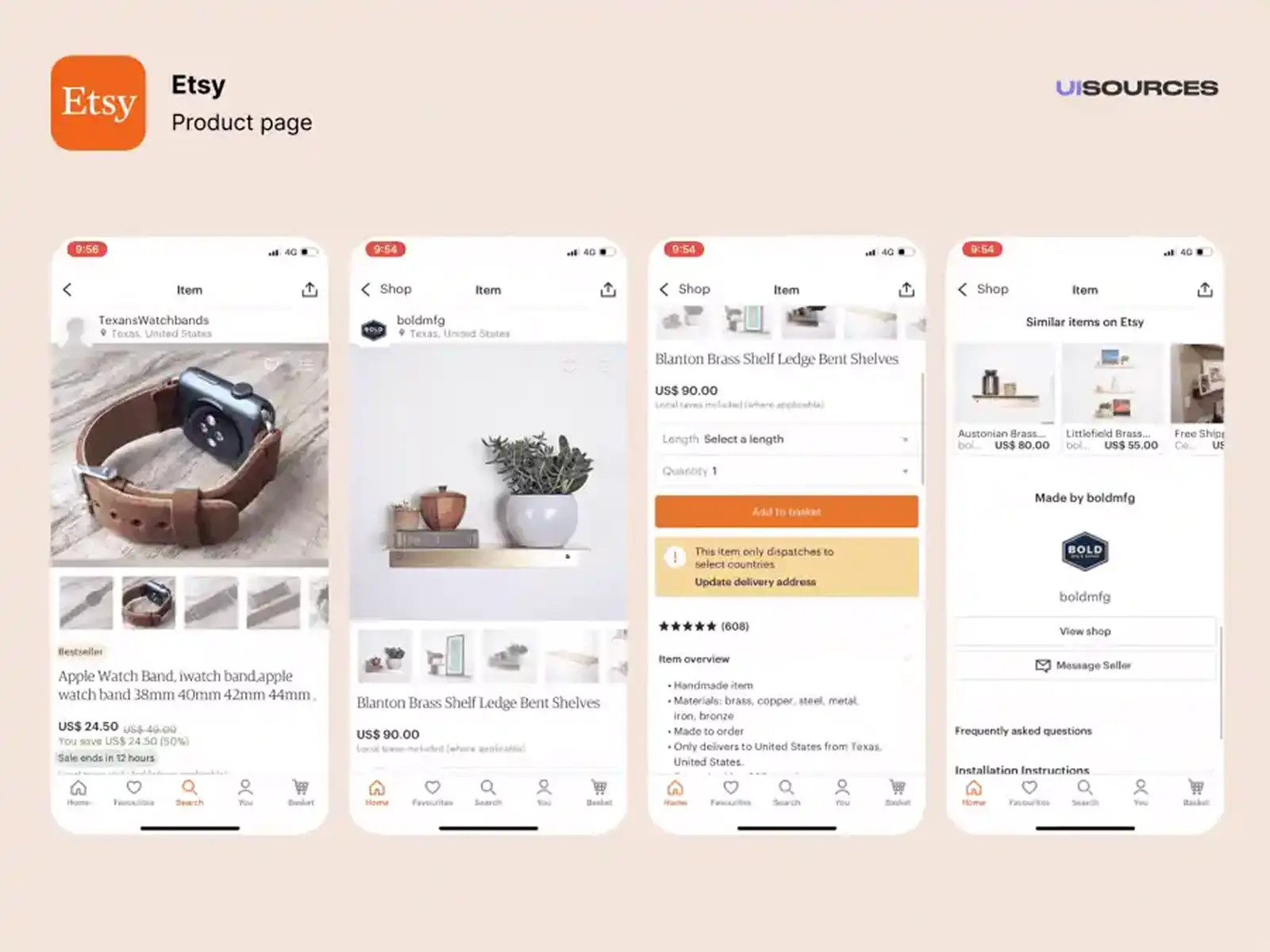
Navigating Etsy feels a bit like strolling through your local art district. The aesthetics are deliberately soft and warm, oozing intimacy.
The platform invites you into a world where every item has a story, and every shop has a distinct personality.
The beauty of Etsy is in its details: the passion of sellers is evident in their product photos, descriptions, and even their thank-you notes.
Etsy sellers are known to go above and beyond to provide amazing customer service and add a personal touch to every order.
Source: UI Sources
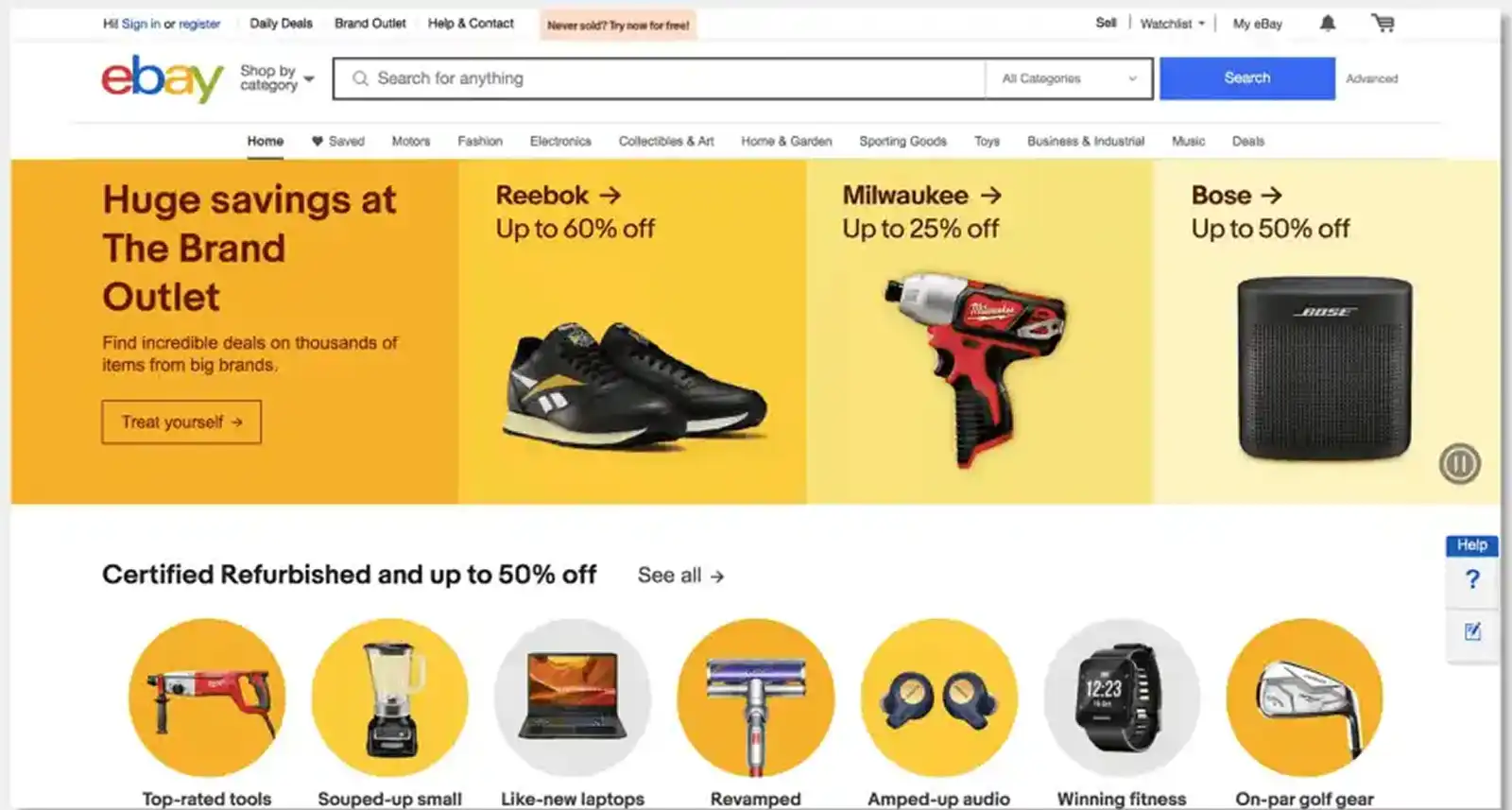
eBay, on the other hand, feels like walking into a bustling metropolitan plaza. It's vast, brimming with energy, and incredibly functional. It's built for the fast-paced, for those who know what they want and want it now.
The interface isn't about cozy aesthetics but rather about efficiently delivering vast amounts of information. Searches yield a spectrum of results, from professional storefronts to amateur garage sales.
The thrill here is in the hunt, sifting through hundreds of listings to discover the perfect deal. You'll notice how a very different experience on eBay immediately greets you than on Etsy!
3. Selling features
For sellers, Etsy is more of a community than simply a sales platform. It equips artists with tools finely tuned to their crafty needs.
Here's a glimpse into its creator-friendly toolkit:
Listing ease: With a straightforward process, listing a product on Etsy feels more like sharing your art than a tedious chore.
Promoted listings: Sellers can push their products to a broader audience. By investing a little extra, your product can get premium visibility, potentially driving more sales.
Shop customization: Sellers can personalize their storefronts, infusing them with personality and branding. From custom banners to selecting featured products and adding personalized thank you messages, Etsy sellers have a fair amount of control over adding a personal touch to their shops.
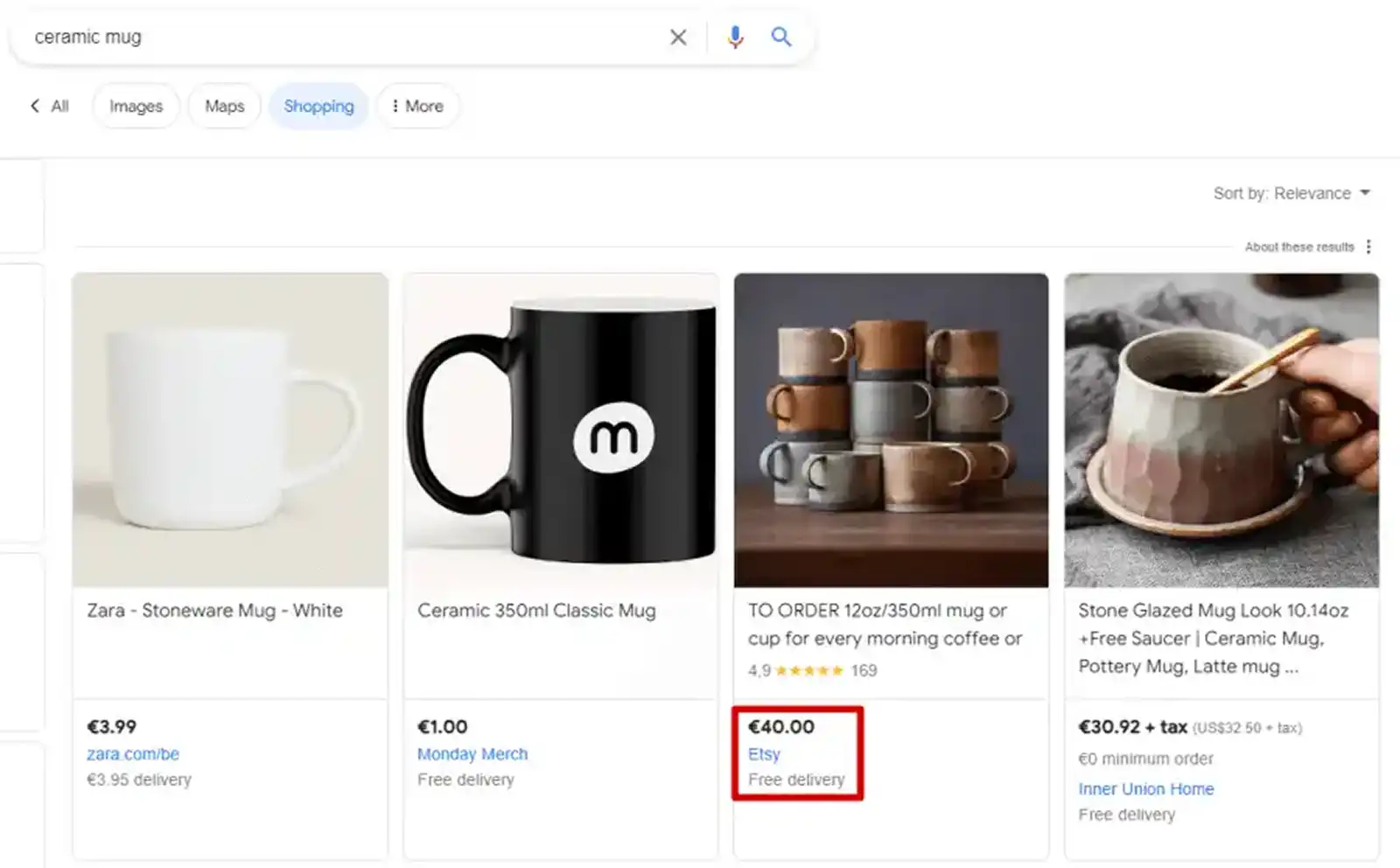
Etsy offsite ads: This feature helps sellers advertise within Etsy and on major search engines like Google, Facebook, Instagram, and Pinterest. The jury is out on just how helpful Etsy ads are because the platform controls targeting, unlike Facebook and Instagram. Here's what that could look like for a seller selling mugs:
Etsy Payments: This tool streamlines the payment process, supporting various methods from credit cards to Apple Pay, ensuring smooth transactions.
Seller protection: This provides a safety net against potential fraud and chargebacks, giving sellers peace of mind.
Etsy Teams: A community feature where sellers can connect, collaborate, and share resources, fostering a sense of camaraderie.
Star Seller badge: Sellers who meet certain criteria can get a "star seller" badge on their profile, which automatically boosts listings in search results.
eBay, with its vast ecosystem, also offers a suite of features tailored for diverse sellers, from garage clear-out enthusiasts to professional enterprises:
Flexible listing options: Whether you opt for a fixed price or set your product up for auction, eBay offers a variety of listing formats to suit your strategy. If you’re finding it difficult to keep up with all of the different listing options, just use Crosslist to create new eBay listings.
eBay Store: For regular sellers, this subscription-based model provides additional tools, branding options, and promotional features.
International shipping program: This simplifies shipping products internationally. eBay handles customs, duties, and logistics.
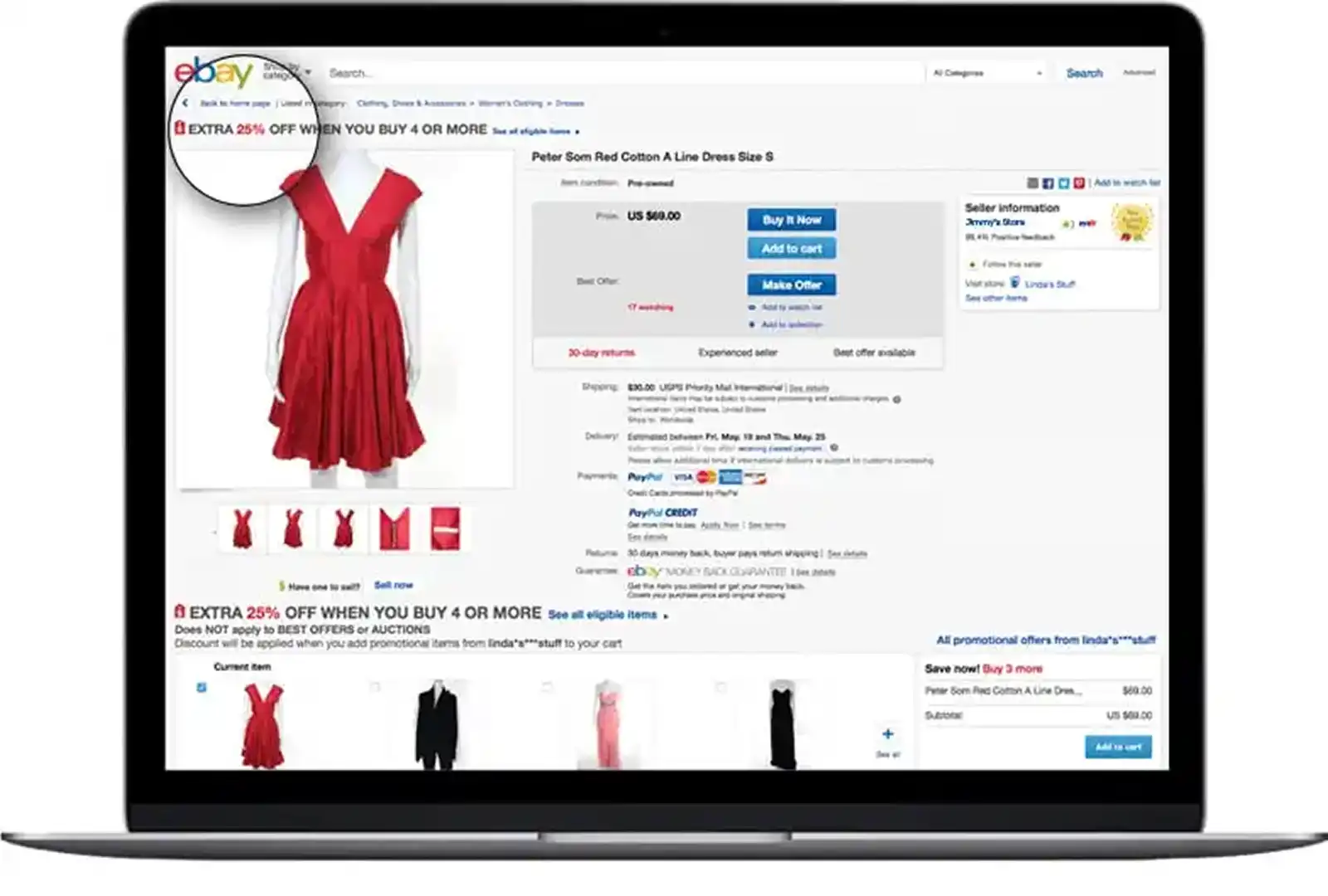
eBay Promotions Manager: Sellers can set up special offers, enticing buyers with deals like BOGO or setting volume discounts. See below how a seller is offering 25% off when you purchase 4 items or more.
Terrapeak product research: Integrated into the Seller Hub, this tool offers insights into market trends, helping sellers price their products competitively. (Psst.. already using Crosslist or looking to try it out? You’ll be happy to know that our AI add-on also gives you optimal pricing suggestions!)
Seller Hub: This central dashboard provides an overview of listings, sales, and performance metrics. It's like the command center for eBay sellers.
Resolution Center: Should issues arise, this feature assists in resolving disputes between buyers and sellers. The Resolution Center is useful in case you need to block a buyer, for example.
4. Seller fees
Money makes the world go round, and Etsy understands that sellers need clarity when it comes to costs. Etsy has made several changes to its fees over the years, which some sellers argue have become too expensive.
We've laid out the current fees below so you can come to your own conclusions on whether it's feasible for your business or not:
Listing fee: Every item you list costs a minor fee, irrespective of whether it sells. This fee is currently $0.20 per item. You will also be charged this fee whenever an item sells, regardless of whether you have more stock.
Transaction fee: Sold something? Great! The bad news? Etsy takes a small percentage of the sale price - 6.5%. It may not sound like much, but it can eat into your profits on low-cost items.
Payment processing fee: This applies when using Etsy Payments. It's generally a fixed amount that varies depending on your location. You can find more information about payment processing fees for your country over here.
Offsite ads fee: Etsy automatically advertises your product outside its platform, so there's an additional fee when it results in a sale. If your store has made under $10,000 in sales in the last year, you'll hand over a 15% commission for the sale. Sellers who earned over $10,000 in the past year cannot opt out, Etsy charges a 12% commission on any sale that came from an offsite ad. Sellers under $10,000 are enrolled by default at 15% but can opt out in their shop settings.
Subscription option: For those wanting to supercharge their store, there's Etsy Plus. It offers advanced features at a monthly charge of $10.
💡 Pro tip: Use our Etsy fee calculator tool for an accurate idea of fees on your items
If you thought Etsy's fees were a doozy, navigating eBay's fee structure might initially feel like solving a Rubik's cube.
Instead of charging a flat fee, different fees apply for different product categories. Let's demystify it:
Insertion fee: This is essentially the cost of listing an item. You get 250 free listings monthly, after which fees apply. This ranges from $0.35 for common categories to $20 for commercial and industrial equipment.
Final value fee: eBay takes a percentage of the final sale price once your item sells.
Store subscription fees: Opting for an eBay Store? Monthly fees vary based on your store level: Starter, Basic, Premium, Anchor, or Enterprise.
Optional listing upgrade fees: Want to make your listing stand out with bold text, subtitles, or other features? There are fees for that, too!
Payment processing fees: These fees apply when buyers pay via eBay's managed payment system.
You can check out eBay's fee breakdown here for an accurate idea of fees. You can also consult our guide to eBay seller fees.
eBay vs Etsy: fee comparison on a $50 sale (US seller)
Fee type | eBay | Etsy |
|---|---|---|
Listing fee | $0 (within 250 free listings) | $0.20 |
Selling/transaction fee | $6.80 (13.6%) | $3.25 (6.5%) |
Payment processing fee | Included | $1.75 (3% + $0.25) |
Per-order fee | $0.40 | — |
Total fees | $7.20 | $5.20 |
Your payout | $42.80 | $44.80 |
Etsy is $2.00 cheaper on base fees.
But there's a catch: if a sale comes through Etsy's Offsite Ads program, you pay an additional 12–15% commission on that sale.
Sellers earning under $10,000 per year can opt out of Offsite Ads. Sellers above that threshold cannot. Factor this into your pricing strategy as your shop grows.
5. Trust and safety
Selling on Etsy may feel like browsing through a quaint corner store, but to the contrary, its safety infrastructure is serious business. The review and rating system helps shine a light on reputable sellers, giving them a natural boost in visibility.
And sellers aren't left to fend for themselves in the dark, Etsy's Seller Protection covers chargebacks and cases where buyers claim they never received an item, as long as you can show valid proof of shipping.
There are some limitations, though. Seller Protection doesn't cover orders over $250, transactions processed outside Etsy.com, or shipments sent to an address not listed on the order.
You'll also need signature confirmation for higher-value items in some countries. For items meeting the criteria, Etsy encourages sellers and buyers to resolve issues directly through the platform's Conversation feature before escalating.
eBay also enforces robust policies and measures to ensure trust. Its feedback system allows buyers and sellers to build reputations based on completed transactions.
Got an issue? The Resolution Center is your go-to mediator, ensuring fair play.
eBay's Money Back Guarantee covers most transactions with a more structured dispute process than Etsy's.
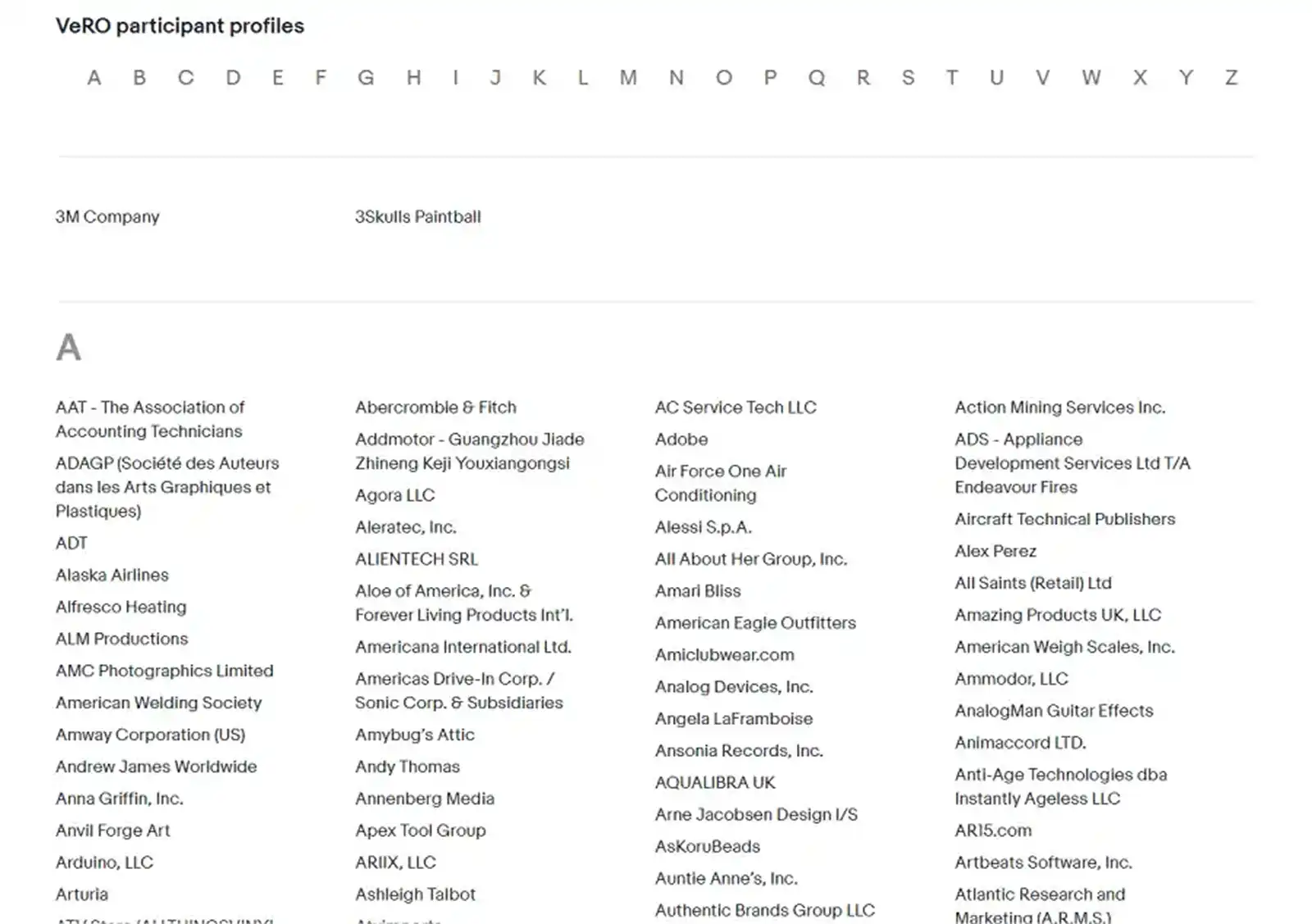
For those worried about counterfeit items, the VeRO Program, Verified Rights Owner Program, protects the intellectual property rights of brands and flags sellers trying to pass off fakes as the real deal.
The bottom line: both platforms take safety seriously, but eBay's system is more established and structured, while Etsy's is warmer and more community-driven.
If you sell high-value items, eBay's Money Back Guarantee offers a more predictable resolution path.
For example, say a seller is trying to pass off fake Abercrombie & Fitch gear as authentic. Their listings can be flagged, and eBay will force them to verify authenticity before continuing to sell. Below is an example of the thousands of brands protected by the policy:
6. Global presence and shipping
Selling on Etsy may feel like browsing through a quaint corner store, but to the contrary, you have access to a global audience. Etsy encourages international selling, allowing artisans to showcase their crafts to buyers worldwide.
The platform provides a detailed playbook on international shipping policies, ensuring sellers are not caught in customs-related red tape. And then there's the hassle of currency exchange.
Etsy simplifies it. With its integrated currency conversion, prices automatically adjust based on where the potential buyer is browsing.
eBay is a sprawling international bazaar.With its International Shipping Program, sellers can ship to a centralized US shipping center, where eBay takes over, ensuring the product reaches international buyers and handling all customs and international shipping intricacies.
7. Community and support
Etsy is a tight-knit community. Sellers and buyers exchange ideas, share experiences, and seek advice on the platform's dedicated forums.
Beyond this community spirit, Etsy empowers its sellers. Educational resources are abundant, from webinars to articles, all designed to ensure sellers master the art and science of online selling.
eBay, given its massive user base, feels more like a metropolis. But within this vast city, neighborhoods thrive. The community forums and discussion boards are bustling with activity, from troubleshooting technical glitches to sharing selling strategies.
And when things go south? eBay's robust customer service infrastructure, from call centers to online chat support, ensures that issues are addressed promptly.
8. Future prospects and innovations
In the fast-paced world of e-commerce, Etsy isn't just knitting in the corner. The platform continually updates its features, aligning with market trends and seller needs. One of its commendable focuses has been on sustainability.
Etsy is committed to reducing its energy usage. This eco-conscious approach isn't just for show; it is reflected in their "Zero Waste" initiatives to promote eco-friendly packaging among sellers and encourage sustainable practices throughout the platform.
eBay isn't resting on its laurels, either. The platform has been dabbling in technological advancements, experimenting with augmented reality features to enhance the shopping experience.
Strategic partnerships and acquisitions complement this tech-forward approach. eBay's keen eye for emerging startups and platforms ensures it remains ahead of the curve, continually evolving to offer better experiences for both buyers and sellers.
Leveraging Etsy and eBay in a multi-channel selling strategy
As an online reseller, putting all your eggs in one basket can be dangerous. Diversifying across multiple platforms is akin to casting a wider net in the vast ocean of online shopping.
Enter the dynamic duo of Etsy and eBay, two giants that, when leveraged together, can elevate a seller's visibility to stratospheric levels.
At its core, multi-channel selling is about amplifying your reach. Think about it: while Etsy caters to a niche audience seeking unique, handcrafted items or vintage treasures, eBay's expansive marketplace appeals to a broader spectrum, from collectors seeking rare finds to everyday shoppers looking for a good deal.
By listing on both platforms, sellers tap into diverse demographics, ensuring their products catch the eye of both the discerning artisanal shopper and the deal-hunting consumer.
But managing listings, inventory, and orders across multiple platforms can get chaotic, right? That's where cross listing tools like Crosslist come to the rescue.
These tools act as a bridge between platforms, streamlining the product listing process across multiple channels.
Imagine creating a listing for a vintage pendant. Instead of manually entering details on both Etsy and eBay, a tool like Crosslist allows sellers to create a single listing and push it to both platforms seamlessly.
Beyond just listings, these tools often come equipped with features that synchronize inventory levels, ensuring that when a product sells on one platform, it's updated or removed from the other.
Now, the burning question: Which products or niches are primed for this dual-platform strategy? Handcrafted items, printables, vintage products, or artisanal goods naturally fit the Etsy mold.
But these items can also find a passionate audience on eBay, especially among collectors or those seeking unique gifts.
On the flip side, while eBay is home to a wide array of products, limited-edition items, DIY kits, or craft supplies can be cross-listed to Etsy, targeting the platform's craft-loving audience.
The trick is to identify products with a universal appeal or those that, while niche, have dedicated audiences on both platforms.
Integrating Etsy and eBay into a cohesive multi-channel selling strategy is not just smart, it's transformative. It maximizes visibility, taps into varied consumer bases, and, with tools like Crosslist, ensures the process remains efficient and manageable.
For sellers eyeing growth, leveraging both these platforms can lead to a significant uptick in visibility and sales, making online selling a playground of limitless possibilities.
Sell on eBay, Etsy, and other marketplaces with Crosslist
The real answer to ‘eBay vs Etsy’ is both as they have different audiences.
Etsy's niche audience pays premium prices for handmade and vintage items. eBay's massive buyer pool moves general merchandise faster.
For example, a vintage pendant or a batch of craft supplies can do well on both, just in front of very different shoppers.
Listing the same inventory on both and other marketplaces would maximizes your exposure.
With Crosslist, you can list items on all major platforms from one universal form. Just fill in listing details once and post your items on different marketplaces at once with background autoposting.
If you would rather not write listings from scratch, the AI listing generator turns your photos into complete listings with titles, descriptions, and condition details you can push to both.
When the item sells anywhere, autodelist removes it from the rest automatically, so you never double-sell.
Both platforms reward fresh listings too, so you can use Crosslist to relist on eBay and relist on Etsy to keep your items near the top of search.
Plans start at $29.99/month. Try Crosslist risk-free with the 3-day money-back guarantee.
As an online reseller, you will have come across eBay and Etsy in your search for a suitable selling platform.
Perhaps you're even selling on one of them. If you've been toying with the idea of branching out to one of these platforms but are unsure what the big difference between them is, we've got you covered.
We've compiled an in-depth analysis of eBay vs Etsy to help you gauge whether they fit your multi-channel selling strategy.
Key takeaways
Etsy charges ~9.5% per sale. eBay charges 13.6% for most categories plus $0.30–$0.40 per order, with payment processing included.
Etsy is built for handmade, vintage, and craft supply sellers. eBay sells everything from electronics and collectibles to fashion and home goods.
eBay gives you 250 free listings per month. Etsy charges $0.20 for every listing and renews listings every 4 months.
Etsy's audience is willing to pay a premium for uniqueness and craftsmanship. eBay's audience tends to shop based on price, selection, and availability.
Both platforms can be valuable sales channels. Crosslist lets you list on Etsy, eBay, and other major marketplaces from a single form.
First, let's go back to the beginning...
2005 wasn't just the birth year of YouTube or the year Brangelina coupled up…it was also the beginning of Etsy.
It emerged like a silent rebel in a world drowning in mass production.
Etsy didn't just say, "Let's sell stuff." It went, "Let's celebrate individuality, craftsmanship, and the sheer audacity of making something with one's bare hands in a world where machines are taking over."
Etsy gave artisans a platform to showcase their talents and a place where buyers came to appreciate authenticity over brand names.
In the two decades that have passed, it's maintained its image as a haven for individual creativity, catering to those who appreciate the story behind the seller as much as the product.
Now, step back another decade to 1995. The era of boy bands, oversized flannels, and the inception of eBay.
Its emergence shook up the retail landscape and launched the concept of e-commerce. The internet was young, and eBay was the daring new kid, turning our garages into gold mines.
eBay was born from the idea of connecting folks who had stuff to get rid of with those who wanted it, giving everyone a chance to be a seller or buyer in a dynamic marketplace.
Auctions became less about shouting numbers in a crowded room and more about quietly, anxiously clicking 'Bid Now' at 2 a.m.
From the rare Star Wars collectible to that designer bag you couldn't afford at full price, eBay was, and remains, the universe of possibilities.
1. Target audience and product focus
When you think of Etsy, if you're anything like us, you likely imagine the free-spirited friend who spends weekends at craft fairs and always gives you hand-made birthday presents.
Etsy is for the bohemian at heart, those who appreciate the time it takes to carve a piece of wood into art, and those who want their homes filled with stories, not just decor.
It's where you find items infused with personal touches, bearing traces of the creator's soul. But it's not just the buyer who's different; the seller is often a passionate creator who puts blood, sweat, and often tears into their creations.
Conversely, eBay is like that enormous flea market that sells everything from vintage comics to the latest tech gadgets. Because of this, the platform attracts a diverse crowd.
From the tech geek wanting the latest gadget to the historian hunting for a century-old manuscript, eBay caters to all. It's not so much about the handcrafted touch here.
On eBay, variety is the spice of life; there is the thrill of finding that diamond in the rough or scoring a product at half its market price.
And for sellers? It's about reaching a global audience and being able to sell almost anything.
2. User interface and experience
Navigating Etsy feels a bit like strolling through your local art district. The aesthetics are deliberately soft and warm, oozing intimacy.
The platform invites you into a world where every item has a story, and every shop has a distinct personality.
The beauty of Etsy is in its details: the passion of sellers is evident in their product photos, descriptions, and even their thank-you notes.
Etsy sellers are known to go above and beyond to provide amazing customer service and add a personal touch to every order.
Source: UI Sources
eBay, on the other hand, feels like walking into a bustling metropolitan plaza. It's vast, brimming with energy, and incredibly functional. It's built for the fast-paced, for those who know what they want and want it now.
The interface isn't about cozy aesthetics but rather about efficiently delivering vast amounts of information. Searches yield a spectrum of results, from professional storefronts to amateur garage sales.
The thrill here is in the hunt, sifting through hundreds of listings to discover the perfect deal. You'll notice how a very different experience on eBay immediately greets you than on Etsy!
3. Selling features
For sellers, Etsy is more of a community than simply a sales platform. It equips artists with tools finely tuned to their crafty needs.
Here's a glimpse into its creator-friendly toolkit:
Listing ease: With a straightforward process, listing a product on Etsy feels more like sharing your art than a tedious chore.
Promoted listings: Sellers can push their products to a broader audience. By investing a little extra, your product can get premium visibility, potentially driving more sales.
Shop customization: Sellers can personalize their storefronts, infusing them with personality and branding. From custom banners to selecting featured products and adding personalized thank you messages, Etsy sellers have a fair amount of control over adding a personal touch to their shops.
Etsy offsite ads: This feature helps sellers advertise within Etsy and on major search engines like Google, Facebook, Instagram, and Pinterest. The jury is out on just how helpful Etsy ads are because the platform controls targeting, unlike Facebook and Instagram. Here's what that could look like for a seller selling mugs:
Etsy Payments: This tool streamlines the payment process, supporting various methods from credit cards to Apple Pay, ensuring smooth transactions.
Seller protection: This provides a safety net against potential fraud and chargebacks, giving sellers peace of mind.
Etsy Teams: A community feature where sellers can connect, collaborate, and share resources, fostering a sense of camaraderie.
Star Seller badge: Sellers who meet certain criteria can get a "star seller" badge on their profile, which automatically boosts listings in search results.
eBay, with its vast ecosystem, also offers a suite of features tailored for diverse sellers, from garage clear-out enthusiasts to professional enterprises:
Flexible listing options: Whether you opt for a fixed price or set your product up for auction, eBay offers a variety of listing formats to suit your strategy. If you’re finding it difficult to keep up with all of the different listing options, just use Crosslist to create new eBay listings.
eBay Store: For regular sellers, this subscription-based model provides additional tools, branding options, and promotional features.
International shipping program: This simplifies shipping products internationally. eBay handles customs, duties, and logistics.
eBay Promotions Manager: Sellers can set up special offers, enticing buyers with deals like BOGO or setting volume discounts. See below how a seller is offering 25% off when you purchase 4 items or more.
Terrapeak product research: Integrated into the Seller Hub, this tool offers insights into market trends, helping sellers price their products competitively. (Psst.. already using Crosslist or looking to try it out? You’ll be happy to know that our AI add-on also gives you optimal pricing suggestions!)
Seller Hub: This central dashboard provides an overview of listings, sales, and performance metrics. It's like the command center for eBay sellers.
Resolution Center: Should issues arise, this feature assists in resolving disputes between buyers and sellers. The Resolution Center is useful in case you need to block a buyer, for example.
4. Seller fees
Money makes the world go round, and Etsy understands that sellers need clarity when it comes to costs. Etsy has made several changes to its fees over the years, which some sellers argue have become too expensive.
We've laid out the current fees below so you can come to your own conclusions on whether it's feasible for your business or not:
Listing fee: Every item you list costs a minor fee, irrespective of whether it sells. This fee is currently $0.20 per item. You will also be charged this fee whenever an item sells, regardless of whether you have more stock.
Transaction fee: Sold something? Great! The bad news? Etsy takes a small percentage of the sale price - 6.5%. It may not sound like much, but it can eat into your profits on low-cost items.
Payment processing fee: This applies when using Etsy Payments. It's generally a fixed amount that varies depending on your location. You can find more information about payment processing fees for your country over here.
Offsite ads fee: Etsy automatically advertises your product outside its platform, so there's an additional fee when it results in a sale. If your store has made under $10,000 in sales in the last year, you'll hand over a 15% commission for the sale. Sellers who earned over $10,000 in the past year cannot opt out, Etsy charges a 12% commission on any sale that came from an offsite ad. Sellers under $10,000 are enrolled by default at 15% but can opt out in their shop settings.
Subscription option: For those wanting to supercharge their store, there's Etsy Plus. It offers advanced features at a monthly charge of $10.
💡 Pro tip: Use our Etsy fee calculator tool for an accurate idea of fees on your items
If you thought Etsy's fees were a doozy, navigating eBay's fee structure might initially feel like solving a Rubik's cube.
Instead of charging a flat fee, different fees apply for different product categories. Let's demystify it:
Insertion fee: This is essentially the cost of listing an item. You get 250 free listings monthly, after which fees apply. This ranges from $0.35 for common categories to $20 for commercial and industrial equipment.
Final value fee: eBay takes a percentage of the final sale price once your item sells.
Store subscription fees: Opting for an eBay Store? Monthly fees vary based on your store level: Starter, Basic, Premium, Anchor, or Enterprise.
Optional listing upgrade fees: Want to make your listing stand out with bold text, subtitles, or other features? There are fees for that, too!
Payment processing fees: These fees apply when buyers pay via eBay's managed payment system.
You can check out eBay's fee breakdown here for an accurate idea of fees. You can also consult our guide to eBay seller fees.
eBay vs Etsy: fee comparison on a $50 sale (US seller)
Fee type | eBay | Etsy |
|---|---|---|
Listing fee | $0 (within 250 free listings) | $0.20 |
Selling/transaction fee | $6.80 (13.6%) | $3.25 (6.5%) |
Payment processing fee | Included | $1.75 (3% + $0.25) |
Per-order fee | $0.40 | — |
Total fees | $7.20 | $5.20 |
Your payout | $42.80 | $44.80 |
Etsy is $2.00 cheaper on base fees.
But there's a catch: if a sale comes through Etsy's Offsite Ads program, you pay an additional 12–15% commission on that sale.
Sellers earning under $10,000 per year can opt out of Offsite Ads. Sellers above that threshold cannot. Factor this into your pricing strategy as your shop grows.
5. Trust and safety
Selling on Etsy may feel like browsing through a quaint corner store, but to the contrary, its safety infrastructure is serious business. The review and rating system helps shine a light on reputable sellers, giving them a natural boost in visibility.
And sellers aren't left to fend for themselves in the dark, Etsy's Seller Protection covers chargebacks and cases where buyers claim they never received an item, as long as you can show valid proof of shipping.
There are some limitations, though. Seller Protection doesn't cover orders over $250, transactions processed outside Etsy.com, or shipments sent to an address not listed on the order.
You'll also need signature confirmation for higher-value items in some countries. For items meeting the criteria, Etsy encourages sellers and buyers to resolve issues directly through the platform's Conversation feature before escalating.
eBay also enforces robust policies and measures to ensure trust. Its feedback system allows buyers and sellers to build reputations based on completed transactions.
Got an issue? The Resolution Center is your go-to mediator, ensuring fair play.
eBay's Money Back Guarantee covers most transactions with a more structured dispute process than Etsy's.
For those worried about counterfeit items, the VeRO Program, Verified Rights Owner Program, protects the intellectual property rights of brands and flags sellers trying to pass off fakes as the real deal.
The bottom line: both platforms take safety seriously, but eBay's system is more established and structured, while Etsy's is warmer and more community-driven.
If you sell high-value items, eBay's Money Back Guarantee offers a more predictable resolution path.
For example, say a seller is trying to pass off fake Abercrombie & Fitch gear as authentic. Their listings can be flagged, and eBay will force them to verify authenticity before continuing to sell. Below is an example of the thousands of brands protected by the policy:
6. Global presence and shipping
Selling on Etsy may feel like browsing through a quaint corner store, but to the contrary, you have access to a global audience. Etsy encourages international selling, allowing artisans to showcase their crafts to buyers worldwide.
The platform provides a detailed playbook on international shipping policies, ensuring sellers are not caught in customs-related red tape. And then there's the hassle of currency exchange.
Etsy simplifies it. With its integrated currency conversion, prices automatically adjust based on where the potential buyer is browsing.
eBay is a sprawling international bazaar.With its International Shipping Program, sellers can ship to a centralized US shipping center, where eBay takes over, ensuring the product reaches international buyers and handling all customs and international shipping intricacies.
7. Community and support
Etsy is a tight-knit community. Sellers and buyers exchange ideas, share experiences, and seek advice on the platform's dedicated forums.
Beyond this community spirit, Etsy empowers its sellers. Educational resources are abundant, from webinars to articles, all designed to ensure sellers master the art and science of online selling.
eBay, given its massive user base, feels more like a metropolis. But within this vast city, neighborhoods thrive. The community forums and discussion boards are bustling with activity, from troubleshooting technical glitches to sharing selling strategies.
And when things go south? eBay's robust customer service infrastructure, from call centers to online chat support, ensures that issues are addressed promptly.
8. Future prospects and innovations
In the fast-paced world of e-commerce, Etsy isn't just knitting in the corner. The platform continually updates its features, aligning with market trends and seller needs. One of its commendable focuses has been on sustainability.
Etsy is committed to reducing its energy usage. This eco-conscious approach isn't just for show; it is reflected in their "Zero Waste" initiatives to promote eco-friendly packaging among sellers and encourage sustainable practices throughout the platform.
eBay isn't resting on its laurels, either. The platform has been dabbling in technological advancements, experimenting with augmented reality features to enhance the shopping experience.
Strategic partnerships and acquisitions complement this tech-forward approach. eBay's keen eye for emerging startups and platforms ensures it remains ahead of the curve, continually evolving to offer better experiences for both buyers and sellers.
Leveraging Etsy and eBay in a multi-channel selling strategy
As an online reseller, putting all your eggs in one basket can be dangerous. Diversifying across multiple platforms is akin to casting a wider net in the vast ocean of online shopping.
Enter the dynamic duo of Etsy and eBay, two giants that, when leveraged together, can elevate a seller's visibility to stratospheric levels.
At its core, multi-channel selling is about amplifying your reach. Think about it: while Etsy caters to a niche audience seeking unique, handcrafted items or vintage treasures, eBay's expansive marketplace appeals to a broader spectrum, from collectors seeking rare finds to everyday shoppers looking for a good deal.
By listing on both platforms, sellers tap into diverse demographics, ensuring their products catch the eye of both the discerning artisanal shopper and the deal-hunting consumer.
But managing listings, inventory, and orders across multiple platforms can get chaotic, right? That's where cross listing tools like Crosslist come to the rescue.
These tools act as a bridge between platforms, streamlining the product listing process across multiple channels.
Imagine creating a listing for a vintage pendant. Instead of manually entering details on both Etsy and eBay, a tool like Crosslist allows sellers to create a single listing and push it to both platforms seamlessly.
Beyond just listings, these tools often come equipped with features that synchronize inventory levels, ensuring that when a product sells on one platform, it's updated or removed from the other.
Now, the burning question: Which products or niches are primed for this dual-platform strategy? Handcrafted items, printables, vintage products, or artisanal goods naturally fit the Etsy mold.
But these items can also find a passionate audience on eBay, especially among collectors or those seeking unique gifts.
On the flip side, while eBay is home to a wide array of products, limited-edition items, DIY kits, or craft supplies can be cross-listed to Etsy, targeting the platform's craft-loving audience.
The trick is to identify products with a universal appeal or those that, while niche, have dedicated audiences on both platforms.
Integrating Etsy and eBay into a cohesive multi-channel selling strategy is not just smart, it's transformative. It maximizes visibility, taps into varied consumer bases, and, with tools like Crosslist, ensures the process remains efficient and manageable.
For sellers eyeing growth, leveraging both these platforms can lead to a significant uptick in visibility and sales, making online selling a playground of limitless possibilities.
Sell on eBay, Etsy, and other marketplaces with Crosslist
The real answer to ‘eBay vs Etsy’ is both as they have different audiences.
Etsy's niche audience pays premium prices for handmade and vintage items. eBay's massive buyer pool moves general merchandise faster.
For example, a vintage pendant or a batch of craft supplies can do well on both, just in front of very different shoppers.
Listing the same inventory on both and other marketplaces would maximizes your exposure.
With Crosslist, you can list items on all major platforms from one universal form. Just fill in listing details once and post your items on different marketplaces at once with background autoposting.
If you would rather not write listings from scratch, the AI listing generator turns your photos into complete listings with titles, descriptions, and condition details you can push to both.
When the item sells anywhere, autodelist removes it from the rest automatically, so you never double-sell.
Both platforms reward fresh listings too, so you can use Crosslist to relist on eBay and relist on Etsy to keep your items near the top of search.
Plans start at $29.99/month. Try Crosslist risk-free with the 3-day money-back guarantee.
As an online reseller, you will have come across eBay and Etsy in your search for a suitable selling platform.
Perhaps you're even selling on one of them. If you've been toying with the idea of branching out to one of these platforms but are unsure what the big difference between them is, we've got you covered.
We've compiled an in-depth analysis of eBay vs Etsy to help you gauge whether they fit your multi-channel selling strategy.
Key takeaways
Etsy charges ~9.5% per sale. eBay charges 13.6% for most categories plus $0.30–$0.40 per order, with payment processing included.
Etsy is built for handmade, vintage, and craft supply sellers. eBay sells everything from electronics and collectibles to fashion and home goods.
eBay gives you 250 free listings per month. Etsy charges $0.20 for every listing and renews listings every 4 months.
Etsy's audience is willing to pay a premium for uniqueness and craftsmanship. eBay's audience tends to shop based on price, selection, and availability.
Both platforms can be valuable sales channels. Crosslist lets you list on Etsy, eBay, and other major marketplaces from a single form.
First, let's go back to the beginning...
2005 wasn't just the birth year of YouTube or the year Brangelina coupled up…it was also the beginning of Etsy.
It emerged like a silent rebel in a world drowning in mass production.
Etsy didn't just say, "Let's sell stuff." It went, "Let's celebrate individuality, craftsmanship, and the sheer audacity of making something with one's bare hands in a world where machines are taking over."
Etsy gave artisans a platform to showcase their talents and a place where buyers came to appreciate authenticity over brand names.
In the two decades that have passed, it's maintained its image as a haven for individual creativity, catering to those who appreciate the story behind the seller as much as the product.
Now, step back another decade to 1995. The era of boy bands, oversized flannels, and the inception of eBay.
Its emergence shook up the retail landscape and launched the concept of e-commerce. The internet was young, and eBay was the daring new kid, turning our garages into gold mines.
eBay was born from the idea of connecting folks who had stuff to get rid of with those who wanted it, giving everyone a chance to be a seller or buyer in a dynamic marketplace.
Auctions became less about shouting numbers in a crowded room and more about quietly, anxiously clicking 'Bid Now' at 2 a.m.
From the rare Star Wars collectible to that designer bag you couldn't afford at full price, eBay was, and remains, the universe of possibilities.
1. Target audience and product focus
When you think of Etsy, if you're anything like us, you likely imagine the free-spirited friend who spends weekends at craft fairs and always gives you hand-made birthday presents.
Etsy is for the bohemian at heart, those who appreciate the time it takes to carve a piece of wood into art, and those who want their homes filled with stories, not just decor.
It's where you find items infused with personal touches, bearing traces of the creator's soul. But it's not just the buyer who's different; the seller is often a passionate creator who puts blood, sweat, and often tears into their creations.
Conversely, eBay is like that enormous flea market that sells everything from vintage comics to the latest tech gadgets. Because of this, the platform attracts a diverse crowd.
From the tech geek wanting the latest gadget to the historian hunting for a century-old manuscript, eBay caters to all. It's not so much about the handcrafted touch here.
On eBay, variety is the spice of life; there is the thrill of finding that diamond in the rough or scoring a product at half its market price.
And for sellers? It's about reaching a global audience and being able to sell almost anything.
2. User interface and experience
Navigating Etsy feels a bit like strolling through your local art district. The aesthetics are deliberately soft and warm, oozing intimacy.
The platform invites you into a world where every item has a story, and every shop has a distinct personality.
The beauty of Etsy is in its details: the passion of sellers is evident in their product photos, descriptions, and even their thank-you notes.
Etsy sellers are known to go above and beyond to provide amazing customer service and add a personal touch to every order.
Source: UI Sources
eBay, on the other hand, feels like walking into a bustling metropolitan plaza. It's vast, brimming with energy, and incredibly functional. It's built for the fast-paced, for those who know what they want and want it now.
The interface isn't about cozy aesthetics but rather about efficiently delivering vast amounts of information. Searches yield a spectrum of results, from professional storefronts to amateur garage sales.
The thrill here is in the hunt, sifting through hundreds of listings to discover the perfect deal. You'll notice how a very different experience on eBay immediately greets you than on Etsy!
3. Selling features
For sellers, Etsy is more of a community than simply a sales platform. It equips artists with tools finely tuned to their crafty needs.
Here's a glimpse into its creator-friendly toolkit:
Listing ease: With a straightforward process, listing a product on Etsy feels more like sharing your art than a tedious chore.
Promoted listings: Sellers can push their products to a broader audience. By investing a little extra, your product can get premium visibility, potentially driving more sales.
Shop customization: Sellers can personalize their storefronts, infusing them with personality and branding. From custom banners to selecting featured products and adding personalized thank you messages, Etsy sellers have a fair amount of control over adding a personal touch to their shops.
Etsy offsite ads: This feature helps sellers advertise within Etsy and on major search engines like Google, Facebook, Instagram, and Pinterest. The jury is out on just how helpful Etsy ads are because the platform controls targeting, unlike Facebook and Instagram. Here's what that could look like for a seller selling mugs:
Etsy Payments: This tool streamlines the payment process, supporting various methods from credit cards to Apple Pay, ensuring smooth transactions.
Seller protection: This provides a safety net against potential fraud and chargebacks, giving sellers peace of mind.
Etsy Teams: A community feature where sellers can connect, collaborate, and share resources, fostering a sense of camaraderie.
Star Seller badge: Sellers who meet certain criteria can get a "star seller" badge on their profile, which automatically boosts listings in search results.
eBay, with its vast ecosystem, also offers a suite of features tailored for diverse sellers, from garage clear-out enthusiasts to professional enterprises:
Flexible listing options: Whether you opt for a fixed price or set your product up for auction, eBay offers a variety of listing formats to suit your strategy. If you’re finding it difficult to keep up with all of the different listing options, just use Crosslist to create new eBay listings.
eBay Store: For regular sellers, this subscription-based model provides additional tools, branding options, and promotional features.
International shipping program: This simplifies shipping products internationally. eBay handles customs, duties, and logistics.
eBay Promotions Manager: Sellers can set up special offers, enticing buyers with deals like BOGO or setting volume discounts. See below how a seller is offering 25% off when you purchase 4 items or more.
Terrapeak product research: Integrated into the Seller Hub, this tool offers insights into market trends, helping sellers price their products competitively. (Psst.. already using Crosslist or looking to try it out? You’ll be happy to know that our AI add-on also gives you optimal pricing suggestions!)
Seller Hub: This central dashboard provides an overview of listings, sales, and performance metrics. It's like the command center for eBay sellers.
Resolution Center: Should issues arise, this feature assists in resolving disputes between buyers and sellers. The Resolution Center is useful in case you need to block a buyer, for example.
4. Seller fees
Money makes the world go round, and Etsy understands that sellers need clarity when it comes to costs. Etsy has made several changes to its fees over the years, which some sellers argue have become too expensive.
We've laid out the current fees below so you can come to your own conclusions on whether it's feasible for your business or not:
Listing fee: Every item you list costs a minor fee, irrespective of whether it sells. This fee is currently $0.20 per item. You will also be charged this fee whenever an item sells, regardless of whether you have more stock.
Transaction fee: Sold something? Great! The bad news? Etsy takes a small percentage of the sale price - 6.5%. It may not sound like much, but it can eat into your profits on low-cost items.
Payment processing fee: This applies when using Etsy Payments. It's generally a fixed amount that varies depending on your location. You can find more information about payment processing fees for your country over here.
Offsite ads fee: Etsy automatically advertises your product outside its platform, so there's an additional fee when it results in a sale. If your store has made under $10,000 in sales in the last year, you'll hand over a 15% commission for the sale. Sellers who earned over $10,000 in the past year cannot opt out, Etsy charges a 12% commission on any sale that came from an offsite ad. Sellers under $10,000 are enrolled by default at 15% but can opt out in their shop settings.
Subscription option: For those wanting to supercharge their store, there's Etsy Plus. It offers advanced features at a monthly charge of $10.
💡 Pro tip: Use our Etsy fee calculator tool for an accurate idea of fees on your items
If you thought Etsy's fees were a doozy, navigating eBay's fee structure might initially feel like solving a Rubik's cube.
Instead of charging a flat fee, different fees apply for different product categories. Let's demystify it:
Insertion fee: This is essentially the cost of listing an item. You get 250 free listings monthly, after which fees apply. This ranges from $0.35 for common categories to $20 for commercial and industrial equipment.
Final value fee: eBay takes a percentage of the final sale price once your item sells.
Store subscription fees: Opting for an eBay Store? Monthly fees vary based on your store level: Starter, Basic, Premium, Anchor, or Enterprise.
Optional listing upgrade fees: Want to make your listing stand out with bold text, subtitles, or other features? There are fees for that, too!
Payment processing fees: These fees apply when buyers pay via eBay's managed payment system.
You can check out eBay's fee breakdown here for an accurate idea of fees. You can also consult our guide to eBay seller fees.
eBay vs Etsy: fee comparison on a $50 sale (US seller)
Fee type | eBay | Etsy |
|---|---|---|
Listing fee | $0 (within 250 free listings) | $0.20 |
Selling/transaction fee | $6.80 (13.6%) | $3.25 (6.5%) |
Payment processing fee | Included | $1.75 (3% + $0.25) |
Per-order fee | $0.40 | — |
Total fees | $7.20 | $5.20 |
Your payout | $42.80 | $44.80 |
Etsy is $2.00 cheaper on base fees.
But there's a catch: if a sale comes through Etsy's Offsite Ads program, you pay an additional 12–15% commission on that sale.
Sellers earning under $10,000 per year can opt out of Offsite Ads. Sellers above that threshold cannot. Factor this into your pricing strategy as your shop grows.
5. Trust and safety
Selling on Etsy may feel like browsing through a quaint corner store, but to the contrary, its safety infrastructure is serious business. The review and rating system helps shine a light on reputable sellers, giving them a natural boost in visibility.
And sellers aren't left to fend for themselves in the dark, Etsy's Seller Protection covers chargebacks and cases where buyers claim they never received an item, as long as you can show valid proof of shipping.
There are some limitations, though. Seller Protection doesn't cover orders over $250, transactions processed outside Etsy.com, or shipments sent to an address not listed on the order.
You'll also need signature confirmation for higher-value items in some countries. For items meeting the criteria, Etsy encourages sellers and buyers to resolve issues directly through the platform's Conversation feature before escalating.
eBay also enforces robust policies and measures to ensure trust. Its feedback system allows buyers and sellers to build reputations based on completed transactions.
Got an issue? The Resolution Center is your go-to mediator, ensuring fair play.
eBay's Money Back Guarantee covers most transactions with a more structured dispute process than Etsy's.
For those worried about counterfeit items, the VeRO Program, Verified Rights Owner Program, protects the intellectual property rights of brands and flags sellers trying to pass off fakes as the real deal.
The bottom line: both platforms take safety seriously, but eBay's system is more established and structured, while Etsy's is warmer and more community-driven.
If you sell high-value items, eBay's Money Back Guarantee offers a more predictable resolution path.
For example, say a seller is trying to pass off fake Abercrombie & Fitch gear as authentic. Their listings can be flagged, and eBay will force them to verify authenticity before continuing to sell. Below is an example of the thousands of brands protected by the policy:
6. Global presence and shipping
Selling on Etsy may feel like browsing through a quaint corner store, but to the contrary, you have access to a global audience. Etsy encourages international selling, allowing artisans to showcase their crafts to buyers worldwide.
The platform provides a detailed playbook on international shipping policies, ensuring sellers are not caught in customs-related red tape. And then there's the hassle of currency exchange.
Etsy simplifies it. With its integrated currency conversion, prices automatically adjust based on where the potential buyer is browsing.
eBay is a sprawling international bazaar.With its International Shipping Program, sellers can ship to a centralized US shipping center, where eBay takes over, ensuring the product reaches international buyers and handling all customs and international shipping intricacies.
7. Community and support
Etsy is a tight-knit community. Sellers and buyers exchange ideas, share experiences, and seek advice on the platform's dedicated forums.
Beyond this community spirit, Etsy empowers its sellers. Educational resources are abundant, from webinars to articles, all designed to ensure sellers master the art and science of online selling.
eBay, given its massive user base, feels more like a metropolis. But within this vast city, neighborhoods thrive. The community forums and discussion boards are bustling with activity, from troubleshooting technical glitches to sharing selling strategies.
And when things go south? eBay's robust customer service infrastructure, from call centers to online chat support, ensures that issues are addressed promptly.
8. Future prospects and innovations
In the fast-paced world of e-commerce, Etsy isn't just knitting in the corner. The platform continually updates its features, aligning with market trends and seller needs. One of its commendable focuses has been on sustainability.
Etsy is committed to reducing its energy usage. This eco-conscious approach isn't just for show; it is reflected in their "Zero Waste" initiatives to promote eco-friendly packaging among sellers and encourage sustainable practices throughout the platform.
eBay isn't resting on its laurels, either. The platform has been dabbling in technological advancements, experimenting with augmented reality features to enhance the shopping experience.
Strategic partnerships and acquisitions complement this tech-forward approach. eBay's keen eye for emerging startups and platforms ensures it remains ahead of the curve, continually evolving to offer better experiences for both buyers and sellers.
Leveraging Etsy and eBay in a multi-channel selling strategy
As an online reseller, putting all your eggs in one basket can be dangerous. Diversifying across multiple platforms is akin to casting a wider net in the vast ocean of online shopping.
Enter the dynamic duo of Etsy and eBay, two giants that, when leveraged together, can elevate a seller's visibility to stratospheric levels.
At its core, multi-channel selling is about amplifying your reach. Think about it: while Etsy caters to a niche audience seeking unique, handcrafted items or vintage treasures, eBay's expansive marketplace appeals to a broader spectrum, from collectors seeking rare finds to everyday shoppers looking for a good deal.
By listing on both platforms, sellers tap into diverse demographics, ensuring their products catch the eye of both the discerning artisanal shopper and the deal-hunting consumer.
But managing listings, inventory, and orders across multiple platforms can get chaotic, right? That's where cross listing tools like Crosslist come to the rescue.
These tools act as a bridge between platforms, streamlining the product listing process across multiple channels.
Imagine creating a listing for a vintage pendant. Instead of manually entering details on both Etsy and eBay, a tool like Crosslist allows sellers to create a single listing and push it to both platforms seamlessly.
Beyond just listings, these tools often come equipped with features that synchronize inventory levels, ensuring that when a product sells on one platform, it's updated or removed from the other.
Now, the burning question: Which products or niches are primed for this dual-platform strategy? Handcrafted items, printables, vintage products, or artisanal goods naturally fit the Etsy mold.
But these items can also find a passionate audience on eBay, especially among collectors or those seeking unique gifts.
On the flip side, while eBay is home to a wide array of products, limited-edition items, DIY kits, or craft supplies can be cross-listed to Etsy, targeting the platform's craft-loving audience.
The trick is to identify products with a universal appeal or those that, while niche, have dedicated audiences on both platforms.
Integrating Etsy and eBay into a cohesive multi-channel selling strategy is not just smart, it's transformative. It maximizes visibility, taps into varied consumer bases, and, with tools like Crosslist, ensures the process remains efficient and manageable.
For sellers eyeing growth, leveraging both these platforms can lead to a significant uptick in visibility and sales, making online selling a playground of limitless possibilities.
Sell on eBay, Etsy, and other marketplaces with Crosslist
The real answer to ‘eBay vs Etsy’ is both as they have different audiences.
Etsy's niche audience pays premium prices for handmade and vintage items. eBay's massive buyer pool moves general merchandise faster.
For example, a vintage pendant or a batch of craft supplies can do well on both, just in front of very different shoppers.
Listing the same inventory on both and other marketplaces would maximizes your exposure.
With Crosslist, you can list items on all major platforms from one universal form. Just fill in listing details once and post your items on different marketplaces at once with background autoposting.
If you would rather not write listings from scratch, the AI listing generator turns your photos into complete listings with titles, descriptions, and condition details you can push to both.
When the item sells anywhere, autodelist removes it from the rest automatically, so you never double-sell.
Both platforms reward fresh listings too, so you can use Crosslist to relist on eBay and relist on Etsy to keep your items near the top of search.
Plans start at $29.99/month. Try Crosslist risk-free with the 3-day money-back guarantee.
As an online reseller, you will have come across eBay and Etsy in your search for a suitable selling platform.
Perhaps you're even selling on one of them. If you've been toying with the idea of branching out to one of these platforms but are unsure what the big difference between them is, we've got you covered.
We've compiled an in-depth analysis of eBay vs Etsy to help you gauge whether they fit your multi-channel selling strategy.
Key takeaways
Etsy charges ~9.5% per sale. eBay charges 13.6% for most categories plus $0.30–$0.40 per order, with payment processing included.
Etsy is built for handmade, vintage, and craft supply sellers. eBay sells everything from electronics and collectibles to fashion and home goods.
eBay gives you 250 free listings per month. Etsy charges $0.20 for every listing and renews listings every 4 months.
Etsy's audience is willing to pay a premium for uniqueness and craftsmanship. eBay's audience tends to shop based on price, selection, and availability.
Both platforms can be valuable sales channels. Crosslist lets you list on Etsy, eBay, and other major marketplaces from a single form.
First, let's go back to the beginning...
2005 wasn't just the birth year of YouTube or the year Brangelina coupled up…it was also the beginning of Etsy.
It emerged like a silent rebel in a world drowning in mass production.
Etsy didn't just say, "Let's sell stuff." It went, "Let's celebrate individuality, craftsmanship, and the sheer audacity of making something with one's bare hands in a world where machines are taking over."
Etsy gave artisans a platform to showcase their talents and a place where buyers came to appreciate authenticity over brand names.
In the two decades that have passed, it's maintained its image as a haven for individual creativity, catering to those who appreciate the story behind the seller as much as the product.
Now, step back another decade to 1995. The era of boy bands, oversized flannels, and the inception of eBay.
Its emergence shook up the retail landscape and launched the concept of e-commerce. The internet was young, and eBay was the daring new kid, turning our garages into gold mines.
eBay was born from the idea of connecting folks who had stuff to get rid of with those who wanted it, giving everyone a chance to be a seller or buyer in a dynamic marketplace.
Auctions became less about shouting numbers in a crowded room and more about quietly, anxiously clicking 'Bid Now' at 2 a.m.
From the rare Star Wars collectible to that designer bag you couldn't afford at full price, eBay was, and remains, the universe of possibilities.
1. Target audience and product focus
When you think of Etsy, if you're anything like us, you likely imagine the free-spirited friend who spends weekends at craft fairs and always gives you hand-made birthday presents.
Etsy is for the bohemian at heart, those who appreciate the time it takes to carve a piece of wood into art, and those who want their homes filled with stories, not just decor.
It's where you find items infused with personal touches, bearing traces of the creator's soul. But it's not just the buyer who's different; the seller is often a passionate creator who puts blood, sweat, and often tears into their creations.
Conversely, eBay is like that enormous flea market that sells everything from vintage comics to the latest tech gadgets. Because of this, the platform attracts a diverse crowd.
From the tech geek wanting the latest gadget to the historian hunting for a century-old manuscript, eBay caters to all. It's not so much about the handcrafted touch here.
On eBay, variety is the spice of life; there is the thrill of finding that diamond in the rough or scoring a product at half its market price.
And for sellers? It's about reaching a global audience and being able to sell almost anything.
2. User interface and experience
Navigating Etsy feels a bit like strolling through your local art district. The aesthetics are deliberately soft and warm, oozing intimacy.
The platform invites you into a world where every item has a story, and every shop has a distinct personality.
The beauty of Etsy is in its details: the passion of sellers is evident in their product photos, descriptions, and even their thank-you notes.
Etsy sellers are known to go above and beyond to provide amazing customer service and add a personal touch to every order.
Source: UI Sources
eBay, on the other hand, feels like walking into a bustling metropolitan plaza. It's vast, brimming with energy, and incredibly functional. It's built for the fast-paced, for those who know what they want and want it now.
The interface isn't about cozy aesthetics but rather about efficiently delivering vast amounts of information. Searches yield a spectrum of results, from professional storefronts to amateur garage sales.
The thrill here is in the hunt, sifting through hundreds of listings to discover the perfect deal. You'll notice how a very different experience on eBay immediately greets you than on Etsy!
3. Selling features
For sellers, Etsy is more of a community than simply a sales platform. It equips artists with tools finely tuned to their crafty needs.
Here's a glimpse into its creator-friendly toolkit:
Listing ease: With a straightforward process, listing a product on Etsy feels more like sharing your art than a tedious chore.
Promoted listings: Sellers can push their products to a broader audience. By investing a little extra, your product can get premium visibility, potentially driving more sales.
Shop customization: Sellers can personalize their storefronts, infusing them with personality and branding. From custom banners to selecting featured products and adding personalized thank you messages, Etsy sellers have a fair amount of control over adding a personal touch to their shops.
Etsy offsite ads: This feature helps sellers advertise within Etsy and on major search engines like Google, Facebook, Instagram, and Pinterest. The jury is out on just how helpful Etsy ads are because the platform controls targeting, unlike Facebook and Instagram. Here's what that could look like for a seller selling mugs:
Etsy Payments: This tool streamlines the payment process, supporting various methods from credit cards to Apple Pay, ensuring smooth transactions.
Seller protection: This provides a safety net against potential fraud and chargebacks, giving sellers peace of mind.
Etsy Teams: A community feature where sellers can connect, collaborate, and share resources, fostering a sense of camaraderie.
Star Seller badge: Sellers who meet certain criteria can get a "star seller" badge on their profile, which automatically boosts listings in search results.
eBay, with its vast ecosystem, also offers a suite of features tailored for diverse sellers, from garage clear-out enthusiasts to professional enterprises:
Flexible listing options: Whether you opt for a fixed price or set your product up for auction, eBay offers a variety of listing formats to suit your strategy. If you’re finding it difficult to keep up with all of the different listing options, just use Crosslist to create new eBay listings.
eBay Store: For regular sellers, this subscription-based model provides additional tools, branding options, and promotional features.
International shipping program: This simplifies shipping products internationally. eBay handles customs, duties, and logistics.
eBay Promotions Manager: Sellers can set up special offers, enticing buyers with deals like BOGO or setting volume discounts. See below how a seller is offering 25% off when you purchase 4 items or more.
Terrapeak product research: Integrated into the Seller Hub, this tool offers insights into market trends, helping sellers price their products competitively. (Psst.. already using Crosslist or looking to try it out? You’ll be happy to know that our AI add-on also gives you optimal pricing suggestions!)
Seller Hub: This central dashboard provides an overview of listings, sales, and performance metrics. It's like the command center for eBay sellers.
Resolution Center: Should issues arise, this feature assists in resolving disputes between buyers and sellers. The Resolution Center is useful in case you need to block a buyer, for example.
4. Seller fees
Money makes the world go round, and Etsy understands that sellers need clarity when it comes to costs. Etsy has made several changes to its fees over the years, which some sellers argue have become too expensive.
We've laid out the current fees below so you can come to your own conclusions on whether it's feasible for your business or not:
Listing fee: Every item you list costs a minor fee, irrespective of whether it sells. This fee is currently $0.20 per item. You will also be charged this fee whenever an item sells, regardless of whether you have more stock.
Transaction fee: Sold something? Great! The bad news? Etsy takes a small percentage of the sale price - 6.5%. It may not sound like much, but it can eat into your profits on low-cost items.
Payment processing fee: This applies when using Etsy Payments. It's generally a fixed amount that varies depending on your location. You can find more information about payment processing fees for your country over here.
Offsite ads fee: Etsy automatically advertises your product outside its platform, so there's an additional fee when it results in a sale. If your store has made under $10,000 in sales in the last year, you'll hand over a 15% commission for the sale. Sellers who earned over $10,000 in the past year cannot opt out, Etsy charges a 12% commission on any sale that came from an offsite ad. Sellers under $10,000 are enrolled by default at 15% but can opt out in their shop settings.
Subscription option: For those wanting to supercharge their store, there's Etsy Plus. It offers advanced features at a monthly charge of $10.
💡 Pro tip: Use our Etsy fee calculator tool for an accurate idea of fees on your items
If you thought Etsy's fees were a doozy, navigating eBay's fee structure might initially feel like solving a Rubik's cube.
Instead of charging a flat fee, different fees apply for different product categories. Let's demystify it:
Insertion fee: This is essentially the cost of listing an item. You get 250 free listings monthly, after which fees apply. This ranges from $0.35 for common categories to $20 for commercial and industrial equipment.
Final value fee: eBay takes a percentage of the final sale price once your item sells.
Store subscription fees: Opting for an eBay Store? Monthly fees vary based on your store level: Starter, Basic, Premium, Anchor, or Enterprise.
Optional listing upgrade fees: Want to make your listing stand out with bold text, subtitles, or other features? There are fees for that, too!
Payment processing fees: These fees apply when buyers pay via eBay's managed payment system.
You can check out eBay's fee breakdown here for an accurate idea of fees. You can also consult our guide to eBay seller fees.
eBay vs Etsy: fee comparison on a $50 sale (US seller)
Fee type | eBay | Etsy |
|---|---|---|
Listing fee | $0 (within 250 free listings) | $0.20 |
Selling/transaction fee | $6.80 (13.6%) | $3.25 (6.5%) |
Payment processing fee | Included | $1.75 (3% + $0.25) |
Per-order fee | $0.40 | — |
Total fees | $7.20 | $5.20 |
Your payout | $42.80 | $44.80 |
Etsy is $2.00 cheaper on base fees.
But there's a catch: if a sale comes through Etsy's Offsite Ads program, you pay an additional 12–15% commission on that sale.
Sellers earning under $10,000 per year can opt out of Offsite Ads. Sellers above that threshold cannot. Factor this into your pricing strategy as your shop grows.
5. Trust and safety
Selling on Etsy may feel like browsing through a quaint corner store, but to the contrary, its safety infrastructure is serious business. The review and rating system helps shine a light on reputable sellers, giving them a natural boost in visibility.
And sellers aren't left to fend for themselves in the dark, Etsy's Seller Protection covers chargebacks and cases where buyers claim they never received an item, as long as you can show valid proof of shipping.
There are some limitations, though. Seller Protection doesn't cover orders over $250, transactions processed outside Etsy.com, or shipments sent to an address not listed on the order.
You'll also need signature confirmation for higher-value items in some countries. For items meeting the criteria, Etsy encourages sellers and buyers to resolve issues directly through the platform's Conversation feature before escalating.
eBay also enforces robust policies and measures to ensure trust. Its feedback system allows buyers and sellers to build reputations based on completed transactions.
Got an issue? The Resolution Center is your go-to mediator, ensuring fair play.
eBay's Money Back Guarantee covers most transactions with a more structured dispute process than Etsy's.
For those worried about counterfeit items, the VeRO Program, Verified Rights Owner Program, protects the intellectual property rights of brands and flags sellers trying to pass off fakes as the real deal.
The bottom line: both platforms take safety seriously, but eBay's system is more established and structured, while Etsy's is warmer and more community-driven.
If you sell high-value items, eBay's Money Back Guarantee offers a more predictable resolution path.
For example, say a seller is trying to pass off fake Abercrombie & Fitch gear as authentic. Their listings can be flagged, and eBay will force them to verify authenticity before continuing to sell. Below is an example of the thousands of brands protected by the policy:
6. Global presence and shipping
Selling on Etsy may feel like browsing through a quaint corner store, but to the contrary, you have access to a global audience. Etsy encourages international selling, allowing artisans to showcase their crafts to buyers worldwide.
The platform provides a detailed playbook on international shipping policies, ensuring sellers are not caught in customs-related red tape. And then there's the hassle of currency exchange.
Etsy simplifies it. With its integrated currency conversion, prices automatically adjust based on where the potential buyer is browsing.
eBay is a sprawling international bazaar.With its International Shipping Program, sellers can ship to a centralized US shipping center, where eBay takes over, ensuring the product reaches international buyers and handling all customs and international shipping intricacies.
7. Community and support
Etsy is a tight-knit community. Sellers and buyers exchange ideas, share experiences, and seek advice on the platform's dedicated forums.
Beyond this community spirit, Etsy empowers its sellers. Educational resources are abundant, from webinars to articles, all designed to ensure sellers master the art and science of online selling.
eBay, given its massive user base, feels more like a metropolis. But within this vast city, neighborhoods thrive. The community forums and discussion boards are bustling with activity, from troubleshooting technical glitches to sharing selling strategies.
And when things go south? eBay's robust customer service infrastructure, from call centers to online chat support, ensures that issues are addressed promptly.
8. Future prospects and innovations
In the fast-paced world of e-commerce, Etsy isn't just knitting in the corner. The platform continually updates its features, aligning with market trends and seller needs. One of its commendable focuses has been on sustainability.
Etsy is committed to reducing its energy usage. This eco-conscious approach isn't just for show; it is reflected in their "Zero Waste" initiatives to promote eco-friendly packaging among sellers and encourage sustainable practices throughout the platform.
eBay isn't resting on its laurels, either. The platform has been dabbling in technological advancements, experimenting with augmented reality features to enhance the shopping experience.
Strategic partnerships and acquisitions complement this tech-forward approach. eBay's keen eye for emerging startups and platforms ensures it remains ahead of the curve, continually evolving to offer better experiences for both buyers and sellers.
Leveraging Etsy and eBay in a multi-channel selling strategy
As an online reseller, putting all your eggs in one basket can be dangerous. Diversifying across multiple platforms is akin to casting a wider net in the vast ocean of online shopping.
Enter the dynamic duo of Etsy and eBay, two giants that, when leveraged together, can elevate a seller's visibility to stratospheric levels.
At its core, multi-channel selling is about amplifying your reach. Think about it: while Etsy caters to a niche audience seeking unique, handcrafted items or vintage treasures, eBay's expansive marketplace appeals to a broader spectrum, from collectors seeking rare finds to everyday shoppers looking for a good deal.
By listing on both platforms, sellers tap into diverse demographics, ensuring their products catch the eye of both the discerning artisanal shopper and the deal-hunting consumer.
But managing listings, inventory, and orders across multiple platforms can get chaotic, right? That's where cross listing tools like Crosslist come to the rescue.
These tools act as a bridge between platforms, streamlining the product listing process across multiple channels.
Imagine creating a listing for a vintage pendant. Instead of manually entering details on both Etsy and eBay, a tool like Crosslist allows sellers to create a single listing and push it to both platforms seamlessly.
Beyond just listings, these tools often come equipped with features that synchronize inventory levels, ensuring that when a product sells on one platform, it's updated or removed from the other.
Now, the burning question: Which products or niches are primed for this dual-platform strategy? Handcrafted items, printables, vintage products, or artisanal goods naturally fit the Etsy mold.
But these items can also find a passionate audience on eBay, especially among collectors or those seeking unique gifts.
On the flip side, while eBay is home to a wide array of products, limited-edition items, DIY kits, or craft supplies can be cross-listed to Etsy, targeting the platform's craft-loving audience.
The trick is to identify products with a universal appeal or those that, while niche, have dedicated audiences on both platforms.
Integrating Etsy and eBay into a cohesive multi-channel selling strategy is not just smart, it's transformative. It maximizes visibility, taps into varied consumer bases, and, with tools like Crosslist, ensures the process remains efficient and manageable.
For sellers eyeing growth, leveraging both these platforms can lead to a significant uptick in visibility and sales, making online selling a playground of limitless possibilities.
Sell on eBay, Etsy, and other marketplaces with Crosslist
The real answer to ‘eBay vs Etsy’ is both as they have different audiences.
Etsy's niche audience pays premium prices for handmade and vintage items. eBay's massive buyer pool moves general merchandise faster.
For example, a vintage pendant or a batch of craft supplies can do well on both, just in front of very different shoppers.
Listing the same inventory on both and other marketplaces would maximizes your exposure.
With Crosslist, you can list items on all major platforms from one universal form. Just fill in listing details once and post your items on different marketplaces at once with background autoposting.
If you would rather not write listings from scratch, the AI listing generator turns your photos into complete listings with titles, descriptions, and condition details you can push to both.
When the item sells anywhere, autodelist removes it from the rest automatically, so you never double-sell.
Both platforms reward fresh listings too, so you can use Crosslist to relist on eBay and relist on Etsy to keep your items near the top of search.
Plans start at $29.99/month. Try Crosslist risk-free with the 3-day money-back guarantee.