


It’s common for your eBay sales to lose steam over time. It could be a seasonal lowering of demand, a post-festive slump, or just a natural part of online selling.
But, this doesn’t mean you can’t do anything about it.
And no, we aren’t talking about paid ads. The easiest way to get more visibility for your eBay listings and boost sales (without spending any money) is this: an eBay relist.
In this guide, we go over how to relist on eBay, why it's necessary, and how a product relister for eBay like Crosslist can speed up the process.
Key takeaways
Relisting on eBay replaces stale listings with fresh ones, giving them a visibility boost in search results and triggering saved alerts for interested buyers.
Wait at least 40–60 days before relisting to avoid being flagged by eBay’s algorithm.
eBay fee note: you get 250 zero-insertion-fee listings per month. After that, each new listing (including relists) costs $0.35. Factor this into your relisting strategy.
With Crosslist, you can bulk relist your entire eBay inventory in minutes, no manual copy-pasting, no tabs to manage.
Crosslist also offers autodelist: when an item sells on any connected marketplace, it's automatically removed from eBay and every other platform to prevent double-selling.
What is eBay relisting?
eBay relisting is the process of deleting your current eBay listing(s) and replacing them with an identical, or updated, listing (for the same products).
It’s essentially giving your old listings a makeover to help them attract more attention.
Picture it this way. When you sell at a brick-and-mortar store, you typically stock the newest products at the front of the shelves, making them more visible.
But, the downside is that your old, unsold products are now at the back of the shelves, invisible to customers.
To clear them out, you may periodically take them, dust them off, and place them at the front. This is essentially what an eBay relist is to your online store.
Does eBay automatically relist your listings?
Partly, and the difference is worth knowing before you start.
There are three ways to get a listing back in front of buyers, and they don't all do the same thing. Here's how they compare:
Automatic eBay relist | Puts your listing back up with its original history, listing ID, and post date | Only good for listings that have great stats and sales history |
eBay relist button | Keeps your sales history and watchers, but reuses the original listing date, so no "newly listed" boost. | When you want to keep watchers and history but don't need a visibility bump. |
Sell similar (i.e. manually relist) | Treats it as a fresh listing; new post date with stats and sales history wiped clean | Great for listings with poor performance |
So why would you ever use the first two?
Automatic relisting is hands-off: eBay just renews the listing for you when it ends.
So it's useful if you sell occasionally and don't want to think about it, but it keeps the original post date, so it does nothing for visibility.
The eBay relist button is the manual version of the same idea.
You choose when to put the item back up, and it holds on to your sales history and watchers, which matters if you've built up interest you don't want to lose.
The catch is the same: it reuses the original listing date, so eBay doesn't treat it as new and you get no search boost.
Sell Similar is the only one that fixes that. It creates a brand-new listing with a fresh post date, so eBay treats it as new and pushes it back up in search.
The trade-off is that you lose the old watchers and sales history.
For stale inventory that isn't moving, that's a trade worth making, which is why Sell Similar is the option most sellers want for relisting.
Benefits of relisting on eBay
eBay relisting essentially gives your listings a second lease on life, which translates to more sales. This is primarily because of how eBay’s algorithm works.
It prioritizes newer listings, showing them first to users. An eBay relist is considered the same as posting a new listing, so you'll get more eyeballs on your listings.
Here are the benefits of an eBay relist in detail:
SEO boost: eBay’s algorithm boosts new listings, so when a user searches for products in your category, they’ll see your relisted items towards the top. The online marketplace will also feature your listings prominently in the news feed.
More visibility: eBay users who have set saved alerts for products in your category will get a notification every time a new item is listed (or relisted). So, by relisting, your potential customers get notified.
Inventory refresh: Relisting old items that have gone stale refreshes your inventory, letting potential buyers know that you’re still actively selling.
More sales: When you relist, you essentially put your products in front of new users (again), which increases your chances of making sales.
When should you relist on eBay?
As a general rule of thumb, you should relist eBay items only when they’ve gone stale.
We recommend waiting at least 40-60 days from the original post date before you go about relisting.
Apart from this, you can (and should) relist if:
You want to make significant changes to the product listing, either because you updated your product, or just want to refresh your listing with new product photos and better tags
You notice your listing accumulating poor statistics (for example, your views trickle down to zero)
You haven’t made a single sale from the listing in over a month
You have multiple variants of a particular product listed, but haven’t had any luck in selling a few of the variants
Your eBay listing has expired, or you ended the listing early, but you still have the product in stock
You’re selling seasonal items and the peak season is coming up
How often should you relist on eBay?
While eBay relisting your stale listings is a good strategy, you should also take care not to do it too often. Let your listings gather data and watchers first.
If it performs well, you may not even have to relist it for a while.
Frequent eBay relists may get your account flagged for suspicious activity, which could result in a warning, suspension, restriction, or even account termination.
On top of that, frequently relisting your eBay items may also send the signal that you don't have any new stock to sell. This may deter potential customers from checking out your account.
One thing to keep in mind: eBay gives you 250 zero-insertion-fee listings per month. After that, each new listing costs $0.35 (here's the full breakdown of eBay's seller fees).
Since a relist counts as a new listing, it eats into that free allowance.
If you’re relisting 50 items a month on top of your regular new listings, make sure you’re not going over the 250 threshold, you’ll start paying $0.35 per relist.
For the full process across every platform you sell on, see our relist and delist guide.
How to relist on eBay manually
The good news is you don't have to copy anything into a separate document. eBay has a built-in Sell Similar option that does the heavy lifting.
Here's the quickest way to do it right from the platform.
Step 1: Head to your Seller Hub and open the Unsold (or Active) section, then find the listing you want to refresh.
Step 2: If the listing is still live, end it first, otherwise eBay won't let you create a duplicate. Once it's ended, click Sell Similar. eBay copies all the details into a brand-new listing for you.
Step 3: Review the details and update anything that's gone stale, like the title, description, price, or photos. This is your chance to refresh tired listings, not just repost them.
Step 4: Post it. eBay treats it as a brand-new listing, which is exactly what gives you the visibility boost. Just delete the old ended listing afterwards so you don't accidentally repost a duplicate.
The manual eBay relisting process is fine for a single listing or two. But, if you’re serious about improving your sales, you need to have a relisting strategy in place.
This involves periodically refreshing your listings so that they aren’t forgotten.
For example, if you have 200 active listings, your relisting strategy might be to refresh 20 listings each week.
Obviously, doing this manually is going to be very difficult and time-consuming.
Even if copying, deleting, and relisting a single listing takes 15 minutes, you’ll be spending 5 hours each week on this process alone.
This is where Crosslist comes into play. It automates the whole process for you, helping you relist eBay items in bulk within minutes instead of hours (yes, really).
Here’s a quick comparison of how the two processes compare:
Relisting on eBay manually | Using Crosslist |
Very time-consuming; will likely eat up hours of your time | Quick and easy; only takes minutes |
Wastes a lot of energy that would be better spent on growth strategy | Only takes the click of a few buttons |
Highly prone to error | Error-free |
Bottom line: Using Crosslist to automate your relisting strategy is the smarter choice.
We’ll show you how it works.
Autodelist: what happens when an item sells?
One thing many relisting guides don’t talk about is what happens after an item sells on eBay.
If you’re selling the same item across multiple marketplaces, a sale on one platform does not automatically remove it from the others.
Until you manually delist the item everywhere else, it can still be purchased by another buyer, without you noticing.
If it happens, you've double-sold. You’re forced to cancel an order, issue a refund, and potentially deal with negative feedback or marketplace penalties.
The more platforms you sell on, the easier it becomes to lose track of inventory manually.
This is why autodelist exists. Cross listing tools like Crosslist can detect when an item sells on any connected marketplace and automatically remove the listing from every other platform.
That means less manual checking, fewer mistakes, and a much lower risk of double-selling.
Note: for some marketplaces, this requires your desktop app or browser extension to be running in the background.
These solve two different problems: relisting refreshes stale inventory to boost visibility, and autodelist protects sold inventory from double-selling.
If you're selling on more than one marketplace, you need both.
How to relist on eBay in bulk (with Crosslist)
This simple 4-step process illustrates how Crosslist makes it easy to relist on eBay in bulk. It will only take you a few minutes, we promise! 🙂
Before we begin, though, you need a Crosslist subscription (if you don’t have one already), so go on and sign up. All of our pricing plans are affordable.
There’s also a 3-day money-back guarantee (as long as you relist 20 or fewer eBay listings).
Step 1: Import your existing eBay inventory to Crosslist
The first step is to bring all of your existing eBay inventory to Crosslist.
If you’ve been using Crosslist for a while, and have your eBay inventory here already, you can skip this step and go right ahead to the next one.
For all the others… Log in to your Crosslist account and head over to the dashboard. You’ll see an Import button at the top left corner of the screen. Click on it.

A pop-up with all the marketplaces supported by Crosslist will appear on the screen.
Since we’re going to be bringing in your eBay listings, choose eBay from the list.
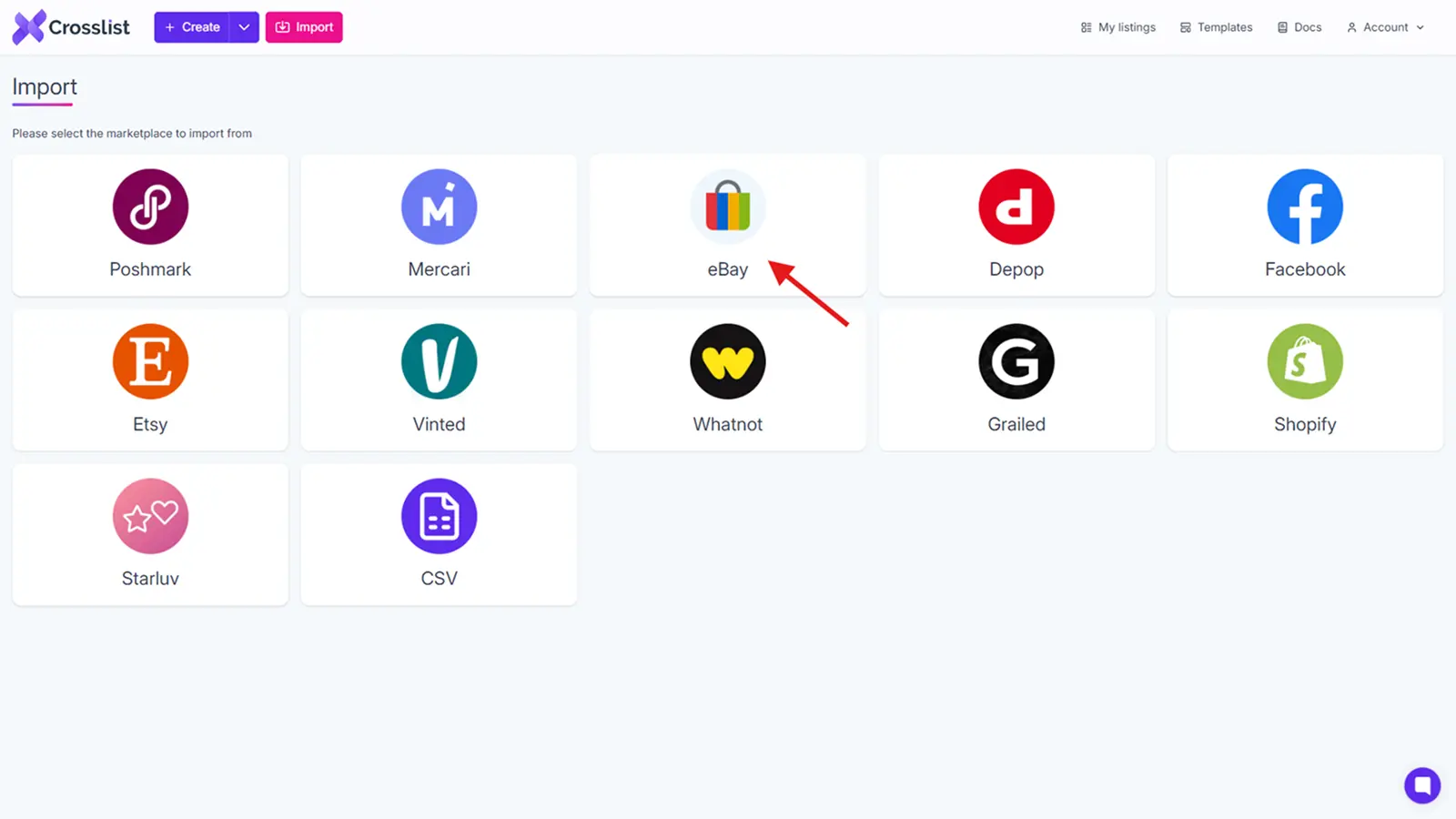
A yellow sync button will appear on the screen to indicate that your eBay inventory is being prepped and synced to Crosslist.
Give it a few minutes to do its job, especially if you have a large inventory.
Once the sync process is complete, you’ll see a list of all of your eBay listings. They are now ready to be imported to Crosslist.
You can import your listings in one of two ways:
Import your full eBay inventory in one go (no matter how many listings you have)
Import specific listings in batches (you can import a maximum of 100 listings in a single batch)
If you have a large number of eBay listings, and are planning to relist them all at some point, the first option will be ideal for you.
This way, even if you relist only a few listings on eBay and save the rest for later, you won’t have to keep repeating this step every time.
Before you ask: yes, whether you have 30 listings or 300, Crosslist will import them all together in bulk.
The first option also makes it easy to cross list your eBay listings to other platforms from Crosslist.
However, if you no longer sell certain items (and don’t think you ever will), or if you’re waiting on some inventory before selling a few products, you can pick the second option.
This will let you search for and select the specific listings you want to relist.
You can use Crosslist’s advanced search bar to search for the listings you want to import.
To make sure you’re not accidentally importing the same listings twice, toggle the Only show listings not yet imported button.
Once you’ve selected all the listings you want to import, click on the Import button and wait for Crosslist to bring all of them in.
Step 2: Navigate to the listing overview on Crosslist
The listing overview is just your dashboard where you’ll see all of your imported listings at a glance. Here’s all the information that this page contains:
Listing title
Preview image
SKU (if available)
Date on which the listing was created
Where the listing originated from (i.e. whether it was created inside Crosslist, or imported from a marketplace. Since we imported from eBay, the origin will show as “eBay”)
All the marketplaces it has been listed on
Any labels you’ve added to the listings
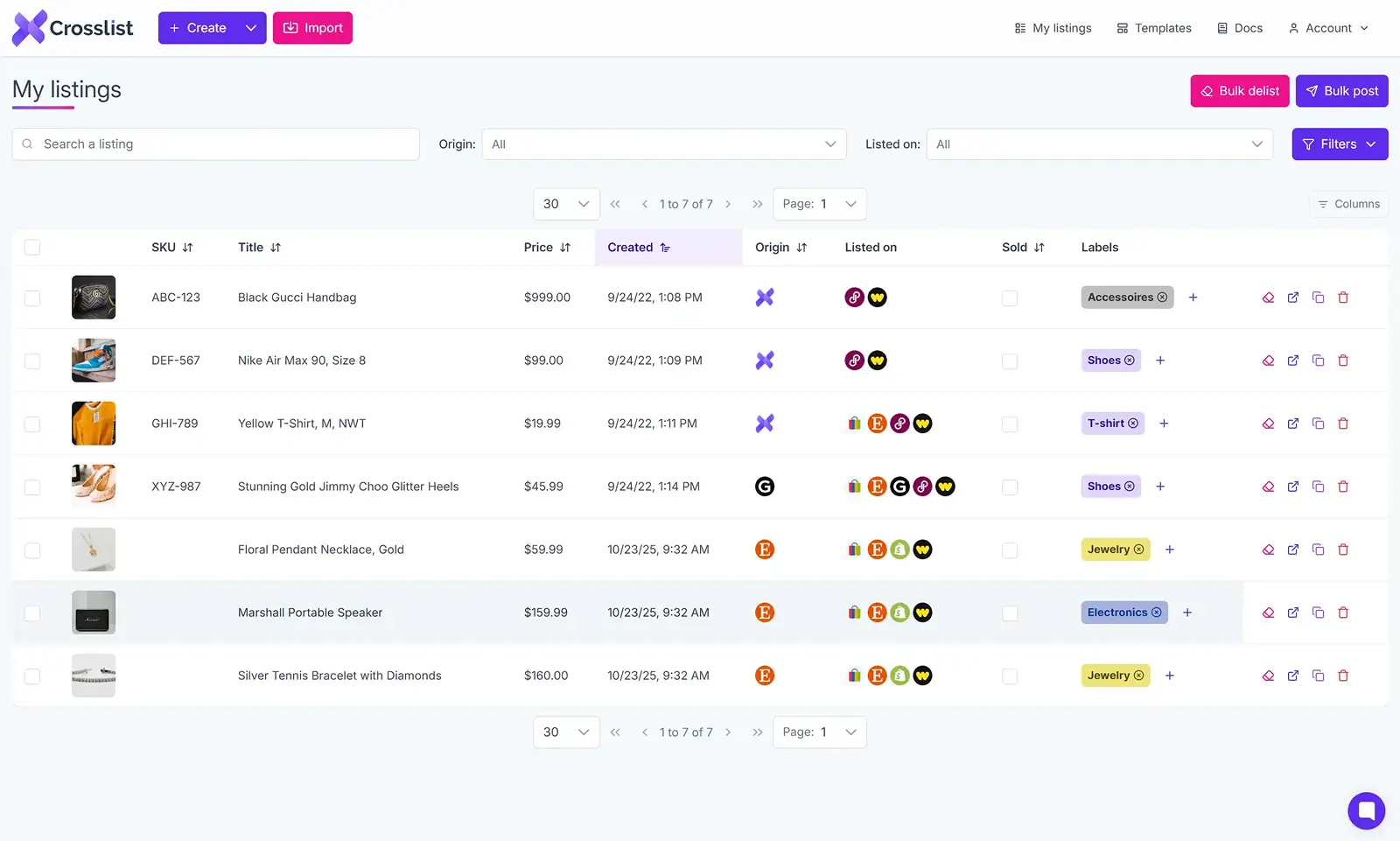
Since we’re only going to relist on eBay, we only need the listings that have been listed on eBay.
If you just imported your eBay listings through step 1, you can use the Origin tab to only show the listings that were created on eBay.
If you were already a Crosslist user and had your eBay inventory here, use the Listed on tab to only show the listings that are live on eBay.
💡 Instead of just relisting eBay items, you can make changes to your listings to give them a fresher look. In addition to making sure that your listings reflect the latest information, this also gives you a boost in SEO.
You can update your title, product description, prices, or product photos to better reflect the current trends.
While you can edit each listing manually, Crosslist makes it easier to edit them in bulk!
To edit the prices of your listings in bulk, use Crosslist’s bulk price mark-up feature. Go to Account settings → Price markup and enter a number or percentage in the box beside eBay. For example, if you enter 5%, then all of your eBay listing prices will increase by 5%. If you enter $5, all the listing prices will increase by $5. To mark down the prices, use negative numbers or percentages.
To make the same kind of edits to a large number of listings, you can use a template and apply it to all the required listings.
Step 3: Select the listings you want to relist on eBay
From the listing overview, select all the listings you want to relist on eBay. If you want to relist everything, simply select all by checking the box at the top of the listings.
eBay relisting is actually a two-step process: delisting (deleting the listing), then relisting it.
But, when you use Crosslist, you don’t have to worry about deleting the listings first. Crosslist does it automatically.
Crosslist can also delist and relist your entire eBay inventory in bulk, all within minutes.
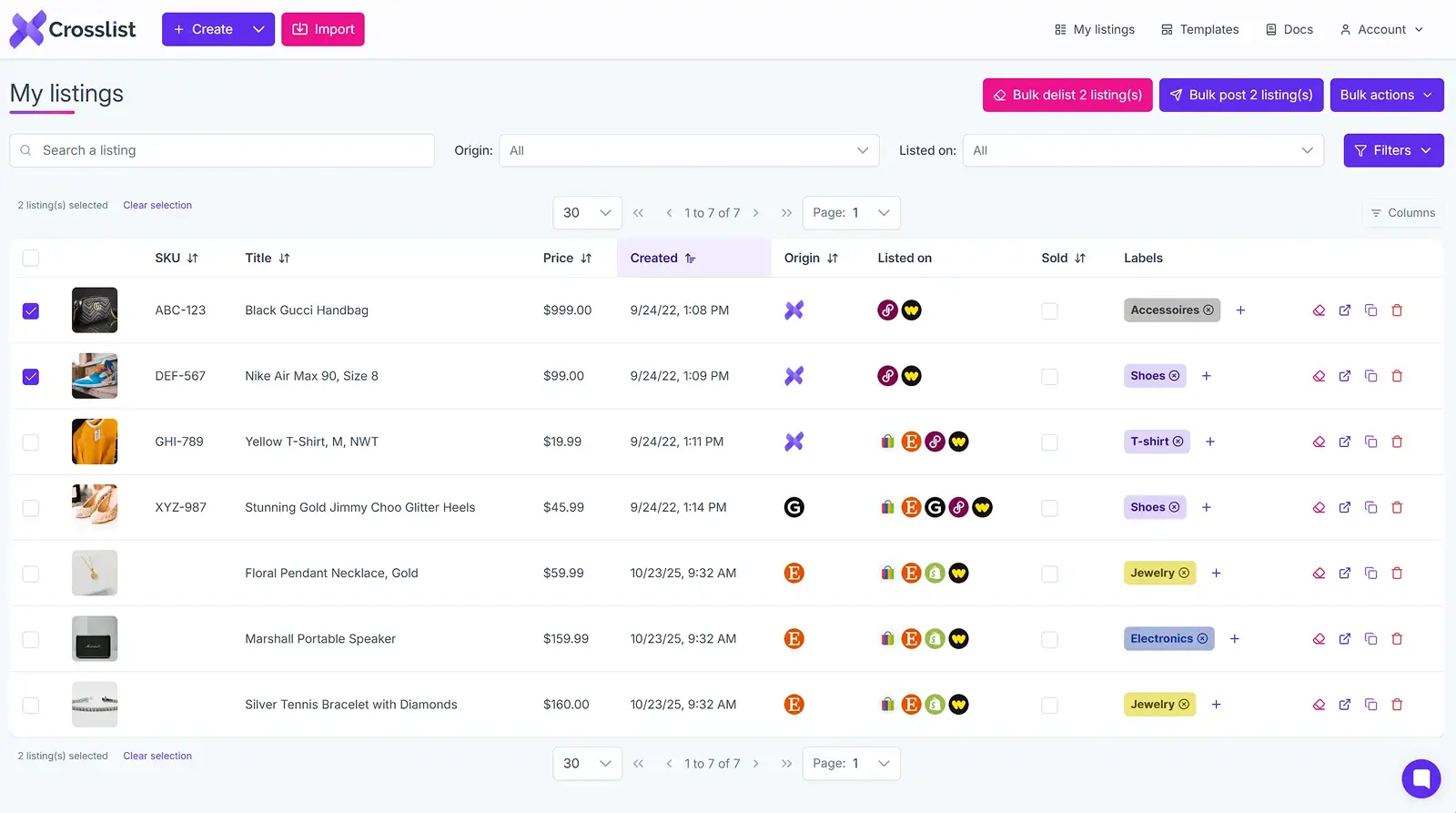
Once you’ve made your selection, click on the Bulk post (x) listings button at the top right corner of the screen.
You’ll see the same pop-up with the supported marketplaces again. Select eBay (since this is an eBay relist).
Step 4: Click the “Relist” button
Now, for the final step. On the same pop-up, you’ll see a Relist button at the bottom. Click on it, aaaaand your eBay relist is done!
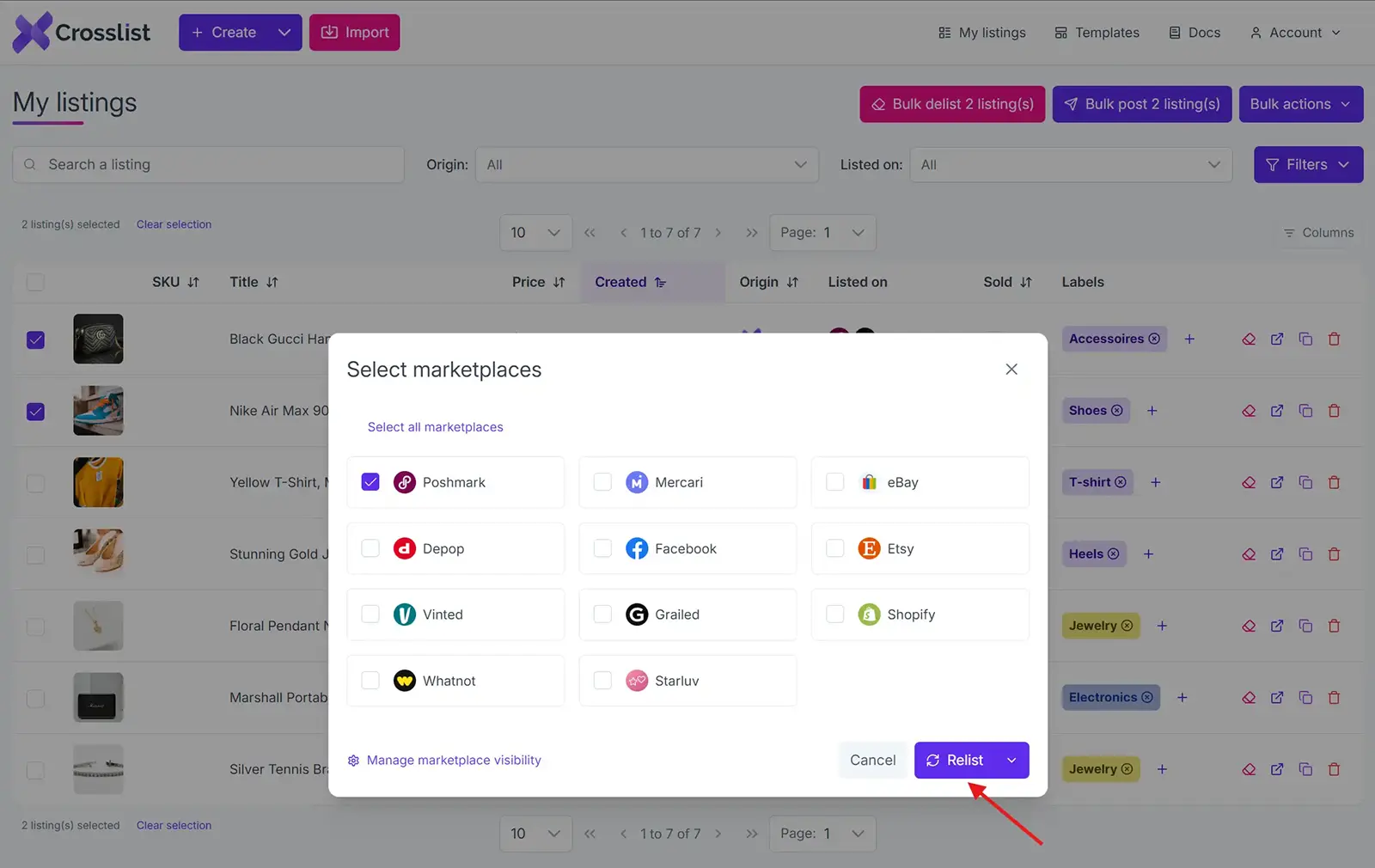
Crosslist will automatically delete your existing eBay listings and replace them with fresh versions.
Since Crosslist has autoposting, all the listings will automatically go live on eBay. No more manual intervention needed from you at all.
With Crosslist, you also don’t have to worry about falling victim to rate limits or having your computer turn sluggish, as our tool uses a queuing system to distribute listings at periodic intervals.
Relisting a single listing on eBay
The above method works great for eBay relisting in bulk and separately. But, if you’re just going to relist a single listing, there’s an easier way.
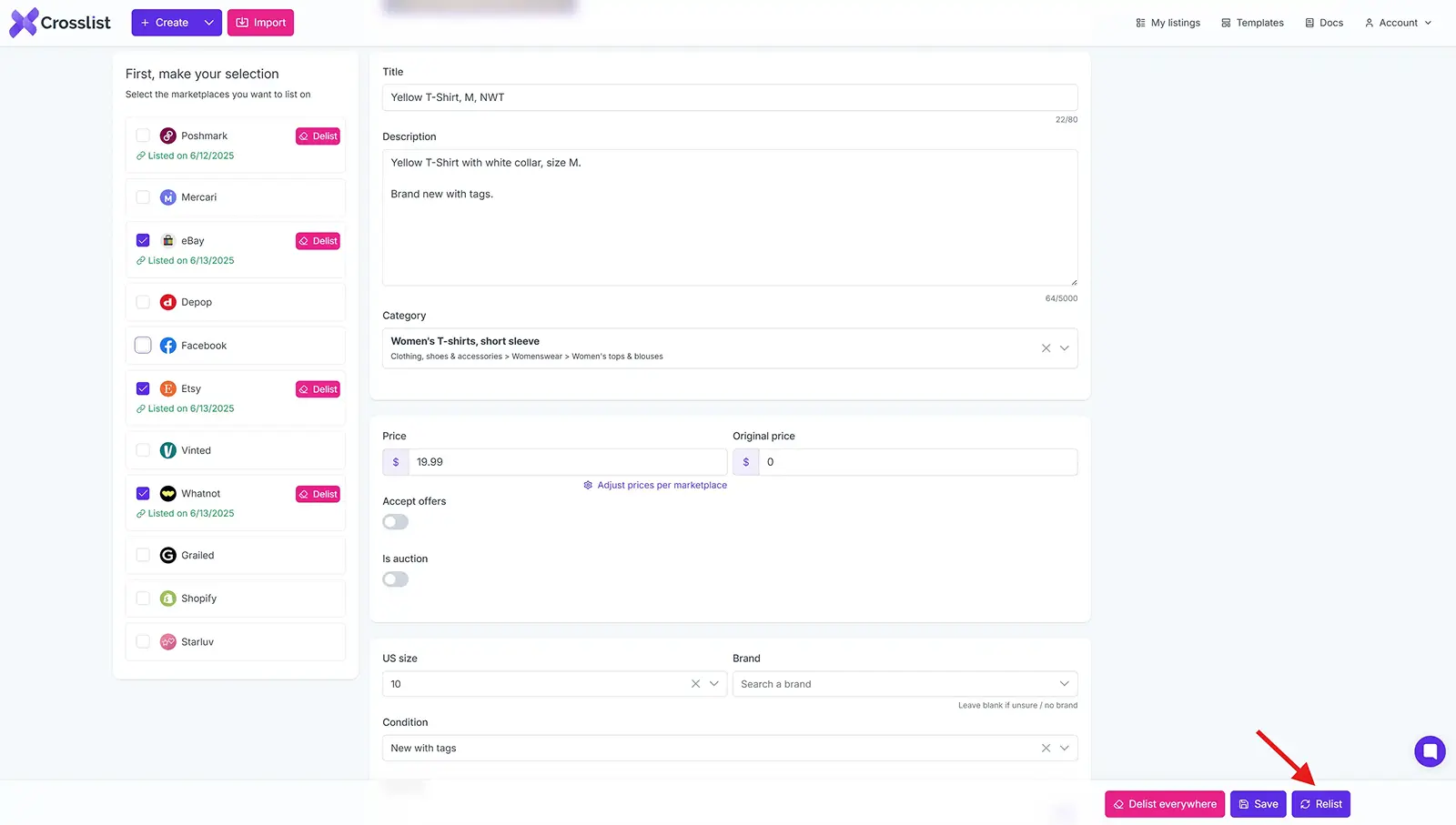
Go to the listing overview and select the eBay listing you want to relist.
Click on the listing, which will open up all of its details. Make any changes you want to the listing fields.
Select eBay from the list of marketplaces on the left corner of the screen.
Click the Relist button at the bottom. That’s it!
eBay relisting tool: why Crosslist?
Crosslist is more than an eBay relisting tool. It handles the repetitive work of relisting in bulk so you can focus on sourcing and selling, and it does a lot more once you're set up.
Fill out one dynamic form and post to every major marketplace at once. No separate form per platform, the way most cross listing apps still make you do it.
Relist, edit, and manage your inventory straight from your phone with the mobile app. Source items in the morning, relist them on the bus, check your sales over coffee.
When an item sells on any connected marketplace, Crosslist will detect the sale and removes the listing from other marketplaces with autodelist.
Don't feel like rewriting descriptions during a relist? Upload your photos and Crosslist generates complete listings with AI, including titles, descriptions, condition, and competitive pricing.
The AI photo editor cleans up images and removes backgrounds in bulk, with unlimited removals on every plan.
And because Crosslist supports the US, UK, Canada, and Australia, you can expand into regional marketplace variants most competitors can't reliably handle.
Here's what sellers say:
“This is a game changer. Keeps all inventory in one place, easy to delist and relist. Not just for huge resellers, it has saved me so much time and increased my sales. It pays for itself many times over.”
— Lorraine F., Trustpilot
Relisting is just one way to keep your eBay sales moving. Try Crosslist risk-free with our 3-day money-back guarantee.
It’s common for your eBay sales to lose steam over time. It could be a seasonal lowering of demand, a post-festive slump, or just a natural part of online selling.
But, this doesn’t mean you can’t do anything about it.
And no, we aren’t talking about paid ads. The easiest way to get more visibility for your eBay listings and boost sales (without spending any money) is this: an eBay relist.
In this guide, we go over how to relist on eBay, why it's necessary, and how a product relister for eBay like Crosslist can speed up the process.
Key takeaways
Relisting on eBay replaces stale listings with fresh ones, giving them a visibility boost in search results and triggering saved alerts for interested buyers.
Wait at least 40–60 days before relisting to avoid being flagged by eBay’s algorithm.
eBay fee note: you get 250 zero-insertion-fee listings per month. After that, each new listing (including relists) costs $0.35. Factor this into your relisting strategy.
With Crosslist, you can bulk relist your entire eBay inventory in minutes, no manual copy-pasting, no tabs to manage.
Crosslist also offers autodelist: when an item sells on any connected marketplace, it's automatically removed from eBay and every other platform to prevent double-selling.
What is eBay relisting?
eBay relisting is the process of deleting your current eBay listing(s) and replacing them with an identical, or updated, listing (for the same products).
It’s essentially giving your old listings a makeover to help them attract more attention.
Picture it this way. When you sell at a brick-and-mortar store, you typically stock the newest products at the front of the shelves, making them more visible.
But, the downside is that your old, unsold products are now at the back of the shelves, invisible to customers.
To clear them out, you may periodically take them, dust them off, and place them at the front. This is essentially what an eBay relist is to your online store.
Does eBay automatically relist your listings?
Partly, and the difference is worth knowing before you start.
There are three ways to get a listing back in front of buyers, and they don't all do the same thing. Here's how they compare:
Automatic eBay relist | Puts your listing back up with its original history, listing ID, and post date | Only good for listings that have great stats and sales history |
eBay relist button | Keeps your sales history and watchers, but reuses the original listing date, so no "newly listed" boost. | When you want to keep watchers and history but don't need a visibility bump. |
Sell similar (i.e. manually relist) | Treats it as a fresh listing; new post date with stats and sales history wiped clean | Great for listings with poor performance |
So why would you ever use the first two?
Automatic relisting is hands-off: eBay just renews the listing for you when it ends.
So it's useful if you sell occasionally and don't want to think about it, but it keeps the original post date, so it does nothing for visibility.
The eBay relist button is the manual version of the same idea.
You choose when to put the item back up, and it holds on to your sales history and watchers, which matters if you've built up interest you don't want to lose.
The catch is the same: it reuses the original listing date, so eBay doesn't treat it as new and you get no search boost.
Sell Similar is the only one that fixes that. It creates a brand-new listing with a fresh post date, so eBay treats it as new and pushes it back up in search.
The trade-off is that you lose the old watchers and sales history.
For stale inventory that isn't moving, that's a trade worth making, which is why Sell Similar is the option most sellers want for relisting.
Benefits of relisting on eBay
eBay relisting essentially gives your listings a second lease on life, which translates to more sales. This is primarily because of how eBay’s algorithm works.
It prioritizes newer listings, showing them first to users. An eBay relist is considered the same as posting a new listing, so you'll get more eyeballs on your listings.
Here are the benefits of an eBay relist in detail:
SEO boost: eBay’s algorithm boosts new listings, so when a user searches for products in your category, they’ll see your relisted items towards the top. The online marketplace will also feature your listings prominently in the news feed.
More visibility: eBay users who have set saved alerts for products in your category will get a notification every time a new item is listed (or relisted). So, by relisting, your potential customers get notified.
Inventory refresh: Relisting old items that have gone stale refreshes your inventory, letting potential buyers know that you’re still actively selling.
More sales: When you relist, you essentially put your products in front of new users (again), which increases your chances of making sales.
When should you relist on eBay?
As a general rule of thumb, you should relist eBay items only when they’ve gone stale.
We recommend waiting at least 40-60 days from the original post date before you go about relisting.
Apart from this, you can (and should) relist if:
You want to make significant changes to the product listing, either because you updated your product, or just want to refresh your listing with new product photos and better tags
You notice your listing accumulating poor statistics (for example, your views trickle down to zero)
You haven’t made a single sale from the listing in over a month
You have multiple variants of a particular product listed, but haven’t had any luck in selling a few of the variants
Your eBay listing has expired, or you ended the listing early, but you still have the product in stock
You’re selling seasonal items and the peak season is coming up
How often should you relist on eBay?
While eBay relisting your stale listings is a good strategy, you should also take care not to do it too often. Let your listings gather data and watchers first.
If it performs well, you may not even have to relist it for a while.
Frequent eBay relists may get your account flagged for suspicious activity, which could result in a warning, suspension, restriction, or even account termination.
On top of that, frequently relisting your eBay items may also send the signal that you don't have any new stock to sell. This may deter potential customers from checking out your account.
One thing to keep in mind: eBay gives you 250 zero-insertion-fee listings per month. After that, each new listing costs $0.35 (here's the full breakdown of eBay's seller fees).
Since a relist counts as a new listing, it eats into that free allowance.
If you’re relisting 50 items a month on top of your regular new listings, make sure you’re not going over the 250 threshold, you’ll start paying $0.35 per relist.
For the full process across every platform you sell on, see our relist and delist guide.
How to relist on eBay manually
The good news is you don't have to copy anything into a separate document. eBay has a built-in Sell Similar option that does the heavy lifting.
Here's the quickest way to do it right from the platform.
Step 1: Head to your Seller Hub and open the Unsold (or Active) section, then find the listing you want to refresh.
Step 2: If the listing is still live, end it first, otherwise eBay won't let you create a duplicate. Once it's ended, click Sell Similar. eBay copies all the details into a brand-new listing for you.
Step 3: Review the details and update anything that's gone stale, like the title, description, price, or photos. This is your chance to refresh tired listings, not just repost them.
Step 4: Post it. eBay treats it as a brand-new listing, which is exactly what gives you the visibility boost. Just delete the old ended listing afterwards so you don't accidentally repost a duplicate.
The manual eBay relisting process is fine for a single listing or two. But, if you’re serious about improving your sales, you need to have a relisting strategy in place.
This involves periodically refreshing your listings so that they aren’t forgotten.
For example, if you have 200 active listings, your relisting strategy might be to refresh 20 listings each week.
Obviously, doing this manually is going to be very difficult and time-consuming.
Even if copying, deleting, and relisting a single listing takes 15 minutes, you’ll be spending 5 hours each week on this process alone.
This is where Crosslist comes into play. It automates the whole process for you, helping you relist eBay items in bulk within minutes instead of hours (yes, really).
Here’s a quick comparison of how the two processes compare:
Relisting on eBay manually | Using Crosslist |
Very time-consuming; will likely eat up hours of your time | Quick and easy; only takes minutes |
Wastes a lot of energy that would be better spent on growth strategy | Only takes the click of a few buttons |
Highly prone to error | Error-free |
Bottom line: Using Crosslist to automate your relisting strategy is the smarter choice.
We’ll show you how it works.
Autodelist: what happens when an item sells?
One thing many relisting guides don’t talk about is what happens after an item sells on eBay.
If you’re selling the same item across multiple marketplaces, a sale on one platform does not automatically remove it from the others.
Until you manually delist the item everywhere else, it can still be purchased by another buyer, without you noticing.
If it happens, you've double-sold. You’re forced to cancel an order, issue a refund, and potentially deal with negative feedback or marketplace penalties.
The more platforms you sell on, the easier it becomes to lose track of inventory manually.
This is why autodelist exists. Cross listing tools like Crosslist can detect when an item sells on any connected marketplace and automatically remove the listing from every other platform.
That means less manual checking, fewer mistakes, and a much lower risk of double-selling.
Note: for some marketplaces, this requires your desktop app or browser extension to be running in the background.
These solve two different problems: relisting refreshes stale inventory to boost visibility, and autodelist protects sold inventory from double-selling.
If you're selling on more than one marketplace, you need both.
How to relist on eBay in bulk (with Crosslist)
This simple 4-step process illustrates how Crosslist makes it easy to relist on eBay in bulk. It will only take you a few minutes, we promise! 🙂
Before we begin, though, you need a Crosslist subscription (if you don’t have one already), so go on and sign up. All of our pricing plans are affordable.
There’s also a 3-day money-back guarantee (as long as you relist 20 or fewer eBay listings).
Step 1: Import your existing eBay inventory to Crosslist
The first step is to bring all of your existing eBay inventory to Crosslist.
If you’ve been using Crosslist for a while, and have your eBay inventory here already, you can skip this step and go right ahead to the next one.
For all the others… Log in to your Crosslist account and head over to the dashboard. You’ll see an Import button at the top left corner of the screen. Click on it.
A pop-up with all the marketplaces supported by Crosslist will appear on the screen.
Since we’re going to be bringing in your eBay listings, choose eBay from the list.
A yellow sync button will appear on the screen to indicate that your eBay inventory is being prepped and synced to Crosslist.
Give it a few minutes to do its job, especially if you have a large inventory.
Once the sync process is complete, you’ll see a list of all of your eBay listings. They are now ready to be imported to Crosslist.
You can import your listings in one of two ways:
Import your full eBay inventory in one go (no matter how many listings you have)
Import specific listings in batches (you can import a maximum of 100 listings in a single batch)
If you have a large number of eBay listings, and are planning to relist them all at some point, the first option will be ideal for you.
This way, even if you relist only a few listings on eBay and save the rest for later, you won’t have to keep repeating this step every time.
Before you ask: yes, whether you have 30 listings or 300, Crosslist will import them all together in bulk.
The first option also makes it easy to cross list your eBay listings to other platforms from Crosslist.
However, if you no longer sell certain items (and don’t think you ever will), or if you’re waiting on some inventory before selling a few products, you can pick the second option.
This will let you search for and select the specific listings you want to relist.
You can use Crosslist’s advanced search bar to search for the listings you want to import.
To make sure you’re not accidentally importing the same listings twice, toggle the Only show listings not yet imported button.
Once you’ve selected all the listings you want to import, click on the Import button and wait for Crosslist to bring all of them in.
Step 2: Navigate to the listing overview on Crosslist
The listing overview is just your dashboard where you’ll see all of your imported listings at a glance. Here’s all the information that this page contains:
Listing title
Preview image
SKU (if available)
Date on which the listing was created
Where the listing originated from (i.e. whether it was created inside Crosslist, or imported from a marketplace. Since we imported from eBay, the origin will show as “eBay”)
All the marketplaces it has been listed on
Any labels you’ve added to the listings
Since we’re only going to relist on eBay, we only need the listings that have been listed on eBay.
If you just imported your eBay listings through step 1, you can use the Origin tab to only show the listings that were created on eBay.
If you were already a Crosslist user and had your eBay inventory here, use the Listed on tab to only show the listings that are live on eBay.
💡 Instead of just relisting eBay items, you can make changes to your listings to give them a fresher look. In addition to making sure that your listings reflect the latest information, this also gives you a boost in SEO.
You can update your title, product description, prices, or product photos to better reflect the current trends.
While you can edit each listing manually, Crosslist makes it easier to edit them in bulk!
To edit the prices of your listings in bulk, use Crosslist’s bulk price mark-up feature. Go to Account settings → Price markup and enter a number or percentage in the box beside eBay. For example, if you enter 5%, then all of your eBay listing prices will increase by 5%. If you enter $5, all the listing prices will increase by $5. To mark down the prices, use negative numbers or percentages.
To make the same kind of edits to a large number of listings, you can use a template and apply it to all the required listings.
Step 3: Select the listings you want to relist on eBay
From the listing overview, select all the listings you want to relist on eBay. If you want to relist everything, simply select all by checking the box at the top of the listings.
eBay relisting is actually a two-step process: delisting (deleting the listing), then relisting it.
But, when you use Crosslist, you don’t have to worry about deleting the listings first. Crosslist does it automatically.
Crosslist can also delist and relist your entire eBay inventory in bulk, all within minutes.
Once you’ve made your selection, click on the Bulk post (x) listings button at the top right corner of the screen.
You’ll see the same pop-up with the supported marketplaces again. Select eBay (since this is an eBay relist).
Step 4: Click the “Relist” button
Now, for the final step. On the same pop-up, you’ll see a Relist button at the bottom. Click on it, aaaaand your eBay relist is done!
Crosslist will automatically delete your existing eBay listings and replace them with fresh versions.
Since Crosslist has autoposting, all the listings will automatically go live on eBay. No more manual intervention needed from you at all.
With Crosslist, you also don’t have to worry about falling victim to rate limits or having your computer turn sluggish, as our tool uses a queuing system to distribute listings at periodic intervals.
Relisting a single listing on eBay
The above method works great for eBay relisting in bulk and separately. But, if you’re just going to relist a single listing, there’s an easier way.
Go to the listing overview and select the eBay listing you want to relist.
Click on the listing, which will open up all of its details. Make any changes you want to the listing fields.
Select eBay from the list of marketplaces on the left corner of the screen.
Click the Relist button at the bottom. That’s it!
eBay relisting tool: why Crosslist?
Crosslist is more than an eBay relisting tool. It handles the repetitive work of relisting in bulk so you can focus on sourcing and selling, and it does a lot more once you're set up.
Fill out one dynamic form and post to every major marketplace at once. No separate form per platform, the way most cross listing apps still make you do it.
Relist, edit, and manage your inventory straight from your phone with the mobile app. Source items in the morning, relist them on the bus, check your sales over coffee.
When an item sells on any connected marketplace, Crosslist will detect the sale and removes the listing from other marketplaces with autodelist.
Don't feel like rewriting descriptions during a relist? Upload your photos and Crosslist generates complete listings with AI, including titles, descriptions, condition, and competitive pricing.
The AI photo editor cleans up images and removes backgrounds in bulk, with unlimited removals on every plan.
And because Crosslist supports the US, UK, Canada, and Australia, you can expand into regional marketplace variants most competitors can't reliably handle.
Here's what sellers say:
“This is a game changer. Keeps all inventory in one place, easy to delist and relist. Not just for huge resellers, it has saved me so much time and increased my sales. It pays for itself many times over.”
— Lorraine F., Trustpilot
Relisting is just one way to keep your eBay sales moving. Try Crosslist risk-free with our 3-day money-back guarantee.
It’s common for your eBay sales to lose steam over time. It could be a seasonal lowering of demand, a post-festive slump, or just a natural part of online selling.
But, this doesn’t mean you can’t do anything about it.
And no, we aren’t talking about paid ads. The easiest way to get more visibility for your eBay listings and boost sales (without spending any money) is this: an eBay relist.
In this guide, we go over how to relist on eBay, why it's necessary, and how a product relister for eBay like Crosslist can speed up the process.
Key takeaways
Relisting on eBay replaces stale listings with fresh ones, giving them a visibility boost in search results and triggering saved alerts for interested buyers.
Wait at least 40–60 days before relisting to avoid being flagged by eBay’s algorithm.
eBay fee note: you get 250 zero-insertion-fee listings per month. After that, each new listing (including relists) costs $0.35. Factor this into your relisting strategy.
With Crosslist, you can bulk relist your entire eBay inventory in minutes, no manual copy-pasting, no tabs to manage.
Crosslist also offers autodelist: when an item sells on any connected marketplace, it's automatically removed from eBay and every other platform to prevent double-selling.
What is eBay relisting?
eBay relisting is the process of deleting your current eBay listing(s) and replacing them with an identical, or updated, listing (for the same products).
It’s essentially giving your old listings a makeover to help them attract more attention.
Picture it this way. When you sell at a brick-and-mortar store, you typically stock the newest products at the front of the shelves, making them more visible.
But, the downside is that your old, unsold products are now at the back of the shelves, invisible to customers.
To clear them out, you may periodically take them, dust them off, and place them at the front. This is essentially what an eBay relist is to your online store.
Does eBay automatically relist your listings?
Partly, and the difference is worth knowing before you start.
There are three ways to get a listing back in front of buyers, and they don't all do the same thing. Here's how they compare:
Automatic eBay relist | Puts your listing back up with its original history, listing ID, and post date | Only good for listings that have great stats and sales history |
eBay relist button | Keeps your sales history and watchers, but reuses the original listing date, so no "newly listed" boost. | When you want to keep watchers and history but don't need a visibility bump. |
Sell similar (i.e. manually relist) | Treats it as a fresh listing; new post date with stats and sales history wiped clean | Great for listings with poor performance |
So why would you ever use the first two?
Automatic relisting is hands-off: eBay just renews the listing for you when it ends.
So it's useful if you sell occasionally and don't want to think about it, but it keeps the original post date, so it does nothing for visibility.
The eBay relist button is the manual version of the same idea.
You choose when to put the item back up, and it holds on to your sales history and watchers, which matters if you've built up interest you don't want to lose.
The catch is the same: it reuses the original listing date, so eBay doesn't treat it as new and you get no search boost.
Sell Similar is the only one that fixes that. It creates a brand-new listing with a fresh post date, so eBay treats it as new and pushes it back up in search.
The trade-off is that you lose the old watchers and sales history.
For stale inventory that isn't moving, that's a trade worth making, which is why Sell Similar is the option most sellers want for relisting.
Benefits of relisting on eBay
eBay relisting essentially gives your listings a second lease on life, which translates to more sales. This is primarily because of how eBay’s algorithm works.
It prioritizes newer listings, showing them first to users. An eBay relist is considered the same as posting a new listing, so you'll get more eyeballs on your listings.
Here are the benefits of an eBay relist in detail:
SEO boost: eBay’s algorithm boosts new listings, so when a user searches for products in your category, they’ll see your relisted items towards the top. The online marketplace will also feature your listings prominently in the news feed.
More visibility: eBay users who have set saved alerts for products in your category will get a notification every time a new item is listed (or relisted). So, by relisting, your potential customers get notified.
Inventory refresh: Relisting old items that have gone stale refreshes your inventory, letting potential buyers know that you’re still actively selling.
More sales: When you relist, you essentially put your products in front of new users (again), which increases your chances of making sales.
When should you relist on eBay?
As a general rule of thumb, you should relist eBay items only when they’ve gone stale.
We recommend waiting at least 40-60 days from the original post date before you go about relisting.
Apart from this, you can (and should) relist if:
You want to make significant changes to the product listing, either because you updated your product, or just want to refresh your listing with new product photos and better tags
You notice your listing accumulating poor statistics (for example, your views trickle down to zero)
You haven’t made a single sale from the listing in over a month
You have multiple variants of a particular product listed, but haven’t had any luck in selling a few of the variants
Your eBay listing has expired, or you ended the listing early, but you still have the product in stock
You’re selling seasonal items and the peak season is coming up
How often should you relist on eBay?
While eBay relisting your stale listings is a good strategy, you should also take care not to do it too often. Let your listings gather data and watchers first.
If it performs well, you may not even have to relist it for a while.
Frequent eBay relists may get your account flagged for suspicious activity, which could result in a warning, suspension, restriction, or even account termination.
On top of that, frequently relisting your eBay items may also send the signal that you don't have any new stock to sell. This may deter potential customers from checking out your account.
One thing to keep in mind: eBay gives you 250 zero-insertion-fee listings per month. After that, each new listing costs $0.35 (here's the full breakdown of eBay's seller fees).
Since a relist counts as a new listing, it eats into that free allowance.
If you’re relisting 50 items a month on top of your regular new listings, make sure you’re not going over the 250 threshold, you’ll start paying $0.35 per relist.
For the full process across every platform you sell on, see our relist and delist guide.
How to relist on eBay manually
The good news is you don't have to copy anything into a separate document. eBay has a built-in Sell Similar option that does the heavy lifting.
Here's the quickest way to do it right from the platform.
Step 1: Head to your Seller Hub and open the Unsold (or Active) section, then find the listing you want to refresh.
Step 2: If the listing is still live, end it first, otherwise eBay won't let you create a duplicate. Once it's ended, click Sell Similar. eBay copies all the details into a brand-new listing for you.
Step 3: Review the details and update anything that's gone stale, like the title, description, price, or photos. This is your chance to refresh tired listings, not just repost them.
Step 4: Post it. eBay treats it as a brand-new listing, which is exactly what gives you the visibility boost. Just delete the old ended listing afterwards so you don't accidentally repost a duplicate.
The manual eBay relisting process is fine for a single listing or two. But, if you’re serious about improving your sales, you need to have a relisting strategy in place.
This involves periodically refreshing your listings so that they aren’t forgotten.
For example, if you have 200 active listings, your relisting strategy might be to refresh 20 listings each week.
Obviously, doing this manually is going to be very difficult and time-consuming.
Even if copying, deleting, and relisting a single listing takes 15 minutes, you’ll be spending 5 hours each week on this process alone.
This is where Crosslist comes into play. It automates the whole process for you, helping you relist eBay items in bulk within minutes instead of hours (yes, really).
Here’s a quick comparison of how the two processes compare:
Relisting on eBay manually | Using Crosslist |
Very time-consuming; will likely eat up hours of your time | Quick and easy; only takes minutes |
Wastes a lot of energy that would be better spent on growth strategy | Only takes the click of a few buttons |
Highly prone to error | Error-free |
Bottom line: Using Crosslist to automate your relisting strategy is the smarter choice.
We’ll show you how it works.
Autodelist: what happens when an item sells?
One thing many relisting guides don’t talk about is what happens after an item sells on eBay.
If you’re selling the same item across multiple marketplaces, a sale on one platform does not automatically remove it from the others.
Until you manually delist the item everywhere else, it can still be purchased by another buyer, without you noticing.
If it happens, you've double-sold. You’re forced to cancel an order, issue a refund, and potentially deal with negative feedback or marketplace penalties.
The more platforms you sell on, the easier it becomes to lose track of inventory manually.
This is why autodelist exists. Cross listing tools like Crosslist can detect when an item sells on any connected marketplace and automatically remove the listing from every other platform.
That means less manual checking, fewer mistakes, and a much lower risk of double-selling.
Note: for some marketplaces, this requires your desktop app or browser extension to be running in the background.
These solve two different problems: relisting refreshes stale inventory to boost visibility, and autodelist protects sold inventory from double-selling.
If you're selling on more than one marketplace, you need both.
How to relist on eBay in bulk (with Crosslist)
This simple 4-step process illustrates how Crosslist makes it easy to relist on eBay in bulk. It will only take you a few minutes, we promise! 🙂
Before we begin, though, you need a Crosslist subscription (if you don’t have one already), so go on and sign up. All of our pricing plans are affordable.
There’s also a 3-day money-back guarantee (as long as you relist 20 or fewer eBay listings).
Step 1: Import your existing eBay inventory to Crosslist
The first step is to bring all of your existing eBay inventory to Crosslist.
If you’ve been using Crosslist for a while, and have your eBay inventory here already, you can skip this step and go right ahead to the next one.
For all the others… Log in to your Crosslist account and head over to the dashboard. You’ll see an Import button at the top left corner of the screen. Click on it.
A pop-up with all the marketplaces supported by Crosslist will appear on the screen.
Since we’re going to be bringing in your eBay listings, choose eBay from the list.
A yellow sync button will appear on the screen to indicate that your eBay inventory is being prepped and synced to Crosslist.
Give it a few minutes to do its job, especially if you have a large inventory.
Once the sync process is complete, you’ll see a list of all of your eBay listings. They are now ready to be imported to Crosslist.
You can import your listings in one of two ways:
Import your full eBay inventory in one go (no matter how many listings you have)
Import specific listings in batches (you can import a maximum of 100 listings in a single batch)
If you have a large number of eBay listings, and are planning to relist them all at some point, the first option will be ideal for you.
This way, even if you relist only a few listings on eBay and save the rest for later, you won’t have to keep repeating this step every time.
Before you ask: yes, whether you have 30 listings or 300, Crosslist will import them all together in bulk.
The first option also makes it easy to cross list your eBay listings to other platforms from Crosslist.
However, if you no longer sell certain items (and don’t think you ever will), or if you’re waiting on some inventory before selling a few products, you can pick the second option.
This will let you search for and select the specific listings you want to relist.
You can use Crosslist’s advanced search bar to search for the listings you want to import.
To make sure you’re not accidentally importing the same listings twice, toggle the Only show listings not yet imported button.
Once you’ve selected all the listings you want to import, click on the Import button and wait for Crosslist to bring all of them in.
Step 2: Navigate to the listing overview on Crosslist
The listing overview is just your dashboard where you’ll see all of your imported listings at a glance. Here’s all the information that this page contains:
Listing title
Preview image
SKU (if available)
Date on which the listing was created
Where the listing originated from (i.e. whether it was created inside Crosslist, or imported from a marketplace. Since we imported from eBay, the origin will show as “eBay”)
All the marketplaces it has been listed on
Any labels you’ve added to the listings
Since we’re only going to relist on eBay, we only need the listings that have been listed on eBay.
If you just imported your eBay listings through step 1, you can use the Origin tab to only show the listings that were created on eBay.
If you were already a Crosslist user and had your eBay inventory here, use the Listed on tab to only show the listings that are live on eBay.
💡 Instead of just relisting eBay items, you can make changes to your listings to give them a fresher look. In addition to making sure that your listings reflect the latest information, this also gives you a boost in SEO.
You can update your title, product description, prices, or product photos to better reflect the current trends.
While you can edit each listing manually, Crosslist makes it easier to edit them in bulk!
To edit the prices of your listings in bulk, use Crosslist’s bulk price mark-up feature. Go to Account settings → Price markup and enter a number or percentage in the box beside eBay. For example, if you enter 5%, then all of your eBay listing prices will increase by 5%. If you enter $5, all the listing prices will increase by $5. To mark down the prices, use negative numbers or percentages.
To make the same kind of edits to a large number of listings, you can use a template and apply it to all the required listings.
Step 3: Select the listings you want to relist on eBay
From the listing overview, select all the listings you want to relist on eBay. If you want to relist everything, simply select all by checking the box at the top of the listings.
eBay relisting is actually a two-step process: delisting (deleting the listing), then relisting it.
But, when you use Crosslist, you don’t have to worry about deleting the listings first. Crosslist does it automatically.
Crosslist can also delist and relist your entire eBay inventory in bulk, all within minutes.
Once you’ve made your selection, click on the Bulk post (x) listings button at the top right corner of the screen.
You’ll see the same pop-up with the supported marketplaces again. Select eBay (since this is an eBay relist).
Step 4: Click the “Relist” button
Now, for the final step. On the same pop-up, you’ll see a Relist button at the bottom. Click on it, aaaaand your eBay relist is done!
Crosslist will automatically delete your existing eBay listings and replace them with fresh versions.
Since Crosslist has autoposting, all the listings will automatically go live on eBay. No more manual intervention needed from you at all.
With Crosslist, you also don’t have to worry about falling victim to rate limits or having your computer turn sluggish, as our tool uses a queuing system to distribute listings at periodic intervals.
Relisting a single listing on eBay
The above method works great for eBay relisting in bulk and separately. But, if you’re just going to relist a single listing, there’s an easier way.
Go to the listing overview and select the eBay listing you want to relist.
Click on the listing, which will open up all of its details. Make any changes you want to the listing fields.
Select eBay from the list of marketplaces on the left corner of the screen.
Click the Relist button at the bottom. That’s it!
eBay relisting tool: why Crosslist?
Crosslist is more than an eBay relisting tool. It handles the repetitive work of relisting in bulk so you can focus on sourcing and selling, and it does a lot more once you're set up.
Fill out one dynamic form and post to every major marketplace at once. No separate form per platform, the way most cross listing apps still make you do it.
Relist, edit, and manage your inventory straight from your phone with the mobile app. Source items in the morning, relist them on the bus, check your sales over coffee.
When an item sells on any connected marketplace, Crosslist will detect the sale and removes the listing from other marketplaces with autodelist.
Don't feel like rewriting descriptions during a relist? Upload your photos and Crosslist generates complete listings with AI, including titles, descriptions, condition, and competitive pricing.
The AI photo editor cleans up images and removes backgrounds in bulk, with unlimited removals on every plan.
And because Crosslist supports the US, UK, Canada, and Australia, you can expand into regional marketplace variants most competitors can't reliably handle.
Here's what sellers say:
“This is a game changer. Keeps all inventory in one place, easy to delist and relist. Not just for huge resellers, it has saved me so much time and increased my sales. It pays for itself many times over.”
— Lorraine F., Trustpilot
Relisting is just one way to keep your eBay sales moving. Try Crosslist risk-free with our 3-day money-back guarantee.
It’s common for your eBay sales to lose steam over time. It could be a seasonal lowering of demand, a post-festive slump, or just a natural part of online selling.
But, this doesn’t mean you can’t do anything about it.
And no, we aren’t talking about paid ads. The easiest way to get more visibility for your eBay listings and boost sales (without spending any money) is this: an eBay relist.
In this guide, we go over how to relist on eBay, why it's necessary, and how a product relister for eBay like Crosslist can speed up the process.
Key takeaways
Relisting on eBay replaces stale listings with fresh ones, giving them a visibility boost in search results and triggering saved alerts for interested buyers.
Wait at least 40–60 days before relisting to avoid being flagged by eBay’s algorithm.
eBay fee note: you get 250 zero-insertion-fee listings per month. After that, each new listing (including relists) costs $0.35. Factor this into your relisting strategy.
With Crosslist, you can bulk relist your entire eBay inventory in minutes, no manual copy-pasting, no tabs to manage.
Crosslist also offers autodelist: when an item sells on any connected marketplace, it's automatically removed from eBay and every other platform to prevent double-selling.
What is eBay relisting?
eBay relisting is the process of deleting your current eBay listing(s) and replacing them with an identical, or updated, listing (for the same products).
It’s essentially giving your old listings a makeover to help them attract more attention.
Picture it this way. When you sell at a brick-and-mortar store, you typically stock the newest products at the front of the shelves, making them more visible.
But, the downside is that your old, unsold products are now at the back of the shelves, invisible to customers.
To clear them out, you may periodically take them, dust them off, and place them at the front. This is essentially what an eBay relist is to your online store.
Does eBay automatically relist your listings?
Partly, and the difference is worth knowing before you start.
There are three ways to get a listing back in front of buyers, and they don't all do the same thing. Here's how they compare:
Automatic eBay relist | Puts your listing back up with its original history, listing ID, and post date | Only good for listings that have great stats and sales history |
eBay relist button | Keeps your sales history and watchers, but reuses the original listing date, so no "newly listed" boost. | When you want to keep watchers and history but don't need a visibility bump. |
Sell similar (i.e. manually relist) | Treats it as a fresh listing; new post date with stats and sales history wiped clean | Great for listings with poor performance |
So why would you ever use the first two?
Automatic relisting is hands-off: eBay just renews the listing for you when it ends.
So it's useful if you sell occasionally and don't want to think about it, but it keeps the original post date, so it does nothing for visibility.
The eBay relist button is the manual version of the same idea.
You choose when to put the item back up, and it holds on to your sales history and watchers, which matters if you've built up interest you don't want to lose.
The catch is the same: it reuses the original listing date, so eBay doesn't treat it as new and you get no search boost.
Sell Similar is the only one that fixes that. It creates a brand-new listing with a fresh post date, so eBay treats it as new and pushes it back up in search.
The trade-off is that you lose the old watchers and sales history.
For stale inventory that isn't moving, that's a trade worth making, which is why Sell Similar is the option most sellers want for relisting.
Benefits of relisting on eBay
eBay relisting essentially gives your listings a second lease on life, which translates to more sales. This is primarily because of how eBay’s algorithm works.
It prioritizes newer listings, showing them first to users. An eBay relist is considered the same as posting a new listing, so you'll get more eyeballs on your listings.
Here are the benefits of an eBay relist in detail:
SEO boost: eBay’s algorithm boosts new listings, so when a user searches for products in your category, they’ll see your relisted items towards the top. The online marketplace will also feature your listings prominently in the news feed.
More visibility: eBay users who have set saved alerts for products in your category will get a notification every time a new item is listed (or relisted). So, by relisting, your potential customers get notified.
Inventory refresh: Relisting old items that have gone stale refreshes your inventory, letting potential buyers know that you’re still actively selling.
More sales: When you relist, you essentially put your products in front of new users (again), which increases your chances of making sales.
When should you relist on eBay?
As a general rule of thumb, you should relist eBay items only when they’ve gone stale.
We recommend waiting at least 40-60 days from the original post date before you go about relisting.
Apart from this, you can (and should) relist if:
You want to make significant changes to the product listing, either because you updated your product, or just want to refresh your listing with new product photos and better tags
You notice your listing accumulating poor statistics (for example, your views trickle down to zero)
You haven’t made a single sale from the listing in over a month
You have multiple variants of a particular product listed, but haven’t had any luck in selling a few of the variants
Your eBay listing has expired, or you ended the listing early, but you still have the product in stock
You’re selling seasonal items and the peak season is coming up
How often should you relist on eBay?
While eBay relisting your stale listings is a good strategy, you should also take care not to do it too often. Let your listings gather data and watchers first.
If it performs well, you may not even have to relist it for a while.
Frequent eBay relists may get your account flagged for suspicious activity, which could result in a warning, suspension, restriction, or even account termination.
On top of that, frequently relisting your eBay items may also send the signal that you don't have any new stock to sell. This may deter potential customers from checking out your account.
One thing to keep in mind: eBay gives you 250 zero-insertion-fee listings per month. After that, each new listing costs $0.35 (here's the full breakdown of eBay's seller fees).
Since a relist counts as a new listing, it eats into that free allowance.
If you’re relisting 50 items a month on top of your regular new listings, make sure you’re not going over the 250 threshold, you’ll start paying $0.35 per relist.
For the full process across every platform you sell on, see our relist and delist guide.
How to relist on eBay manually
The good news is you don't have to copy anything into a separate document. eBay has a built-in Sell Similar option that does the heavy lifting.
Here's the quickest way to do it right from the platform.
Step 1: Head to your Seller Hub and open the Unsold (or Active) section, then find the listing you want to refresh.
Step 2: If the listing is still live, end it first, otherwise eBay won't let you create a duplicate. Once it's ended, click Sell Similar. eBay copies all the details into a brand-new listing for you.
Step 3: Review the details and update anything that's gone stale, like the title, description, price, or photos. This is your chance to refresh tired listings, not just repost them.
Step 4: Post it. eBay treats it as a brand-new listing, which is exactly what gives you the visibility boost. Just delete the old ended listing afterwards so you don't accidentally repost a duplicate.
The manual eBay relisting process is fine for a single listing or two. But, if you’re serious about improving your sales, you need to have a relisting strategy in place.
This involves periodically refreshing your listings so that they aren’t forgotten.
For example, if you have 200 active listings, your relisting strategy might be to refresh 20 listings each week.
Obviously, doing this manually is going to be very difficult and time-consuming.
Even if copying, deleting, and relisting a single listing takes 15 minutes, you’ll be spending 5 hours each week on this process alone.
This is where Crosslist comes into play. It automates the whole process for you, helping you relist eBay items in bulk within minutes instead of hours (yes, really).
Here’s a quick comparison of how the two processes compare:
Relisting on eBay manually | Using Crosslist |
Very time-consuming; will likely eat up hours of your time | Quick and easy; only takes minutes |
Wastes a lot of energy that would be better spent on growth strategy | Only takes the click of a few buttons |
Highly prone to error | Error-free |
Bottom line: Using Crosslist to automate your relisting strategy is the smarter choice.
We’ll show you how it works.
Autodelist: what happens when an item sells?
One thing many relisting guides don’t talk about is what happens after an item sells on eBay.
If you’re selling the same item across multiple marketplaces, a sale on one platform does not automatically remove it from the others.
Until you manually delist the item everywhere else, it can still be purchased by another buyer, without you noticing.
If it happens, you've double-sold. You’re forced to cancel an order, issue a refund, and potentially deal with negative feedback or marketplace penalties.
The more platforms you sell on, the easier it becomes to lose track of inventory manually.
This is why autodelist exists. Cross listing tools like Crosslist can detect when an item sells on any connected marketplace and automatically remove the listing from every other platform.
That means less manual checking, fewer mistakes, and a much lower risk of double-selling.
Note: for some marketplaces, this requires your desktop app or browser extension to be running in the background.
These solve two different problems: relisting refreshes stale inventory to boost visibility, and autodelist protects sold inventory from double-selling.
If you're selling on more than one marketplace, you need both.
How to relist on eBay in bulk (with Crosslist)
This simple 4-step process illustrates how Crosslist makes it easy to relist on eBay in bulk. It will only take you a few minutes, we promise! 🙂
Before we begin, though, you need a Crosslist subscription (if you don’t have one already), so go on and sign up. All of our pricing plans are affordable.
There’s also a 3-day money-back guarantee (as long as you relist 20 or fewer eBay listings).
Step 1: Import your existing eBay inventory to Crosslist
The first step is to bring all of your existing eBay inventory to Crosslist.
If you’ve been using Crosslist for a while, and have your eBay inventory here already, you can skip this step and go right ahead to the next one.
For all the others… Log in to your Crosslist account and head over to the dashboard. You’ll see an Import button at the top left corner of the screen. Click on it.
A pop-up with all the marketplaces supported by Crosslist will appear on the screen.
Since we’re going to be bringing in your eBay listings, choose eBay from the list.
A yellow sync button will appear on the screen to indicate that your eBay inventory is being prepped and synced to Crosslist.
Give it a few minutes to do its job, especially if you have a large inventory.
Once the sync process is complete, you’ll see a list of all of your eBay listings. They are now ready to be imported to Crosslist.
You can import your listings in one of two ways:
Import your full eBay inventory in one go (no matter how many listings you have)
Import specific listings in batches (you can import a maximum of 100 listings in a single batch)
If you have a large number of eBay listings, and are planning to relist them all at some point, the first option will be ideal for you.
This way, even if you relist only a few listings on eBay and save the rest for later, you won’t have to keep repeating this step every time.
Before you ask: yes, whether you have 30 listings or 300, Crosslist will import them all together in bulk.
The first option also makes it easy to cross list your eBay listings to other platforms from Crosslist.
However, if you no longer sell certain items (and don’t think you ever will), or if you’re waiting on some inventory before selling a few products, you can pick the second option.
This will let you search for and select the specific listings you want to relist.
You can use Crosslist’s advanced search bar to search for the listings you want to import.
To make sure you’re not accidentally importing the same listings twice, toggle the Only show listings not yet imported button.
Once you’ve selected all the listings you want to import, click on the Import button and wait for Crosslist to bring all of them in.
Step 2: Navigate to the listing overview on Crosslist
The listing overview is just your dashboard where you’ll see all of your imported listings at a glance. Here’s all the information that this page contains:
Listing title
Preview image
SKU (if available)
Date on which the listing was created
Where the listing originated from (i.e. whether it was created inside Crosslist, or imported from a marketplace. Since we imported from eBay, the origin will show as “eBay”)
All the marketplaces it has been listed on
Any labels you’ve added to the listings
Since we’re only going to relist on eBay, we only need the listings that have been listed on eBay.
If you just imported your eBay listings through step 1, you can use the Origin tab to only show the listings that were created on eBay.
If you were already a Crosslist user and had your eBay inventory here, use the Listed on tab to only show the listings that are live on eBay.
💡 Instead of just relisting eBay items, you can make changes to your listings to give them a fresher look. In addition to making sure that your listings reflect the latest information, this also gives you a boost in SEO.
You can update your title, product description, prices, or product photos to better reflect the current trends.
While you can edit each listing manually, Crosslist makes it easier to edit them in bulk!
To edit the prices of your listings in bulk, use Crosslist’s bulk price mark-up feature. Go to Account settings → Price markup and enter a number or percentage in the box beside eBay. For example, if you enter 5%, then all of your eBay listing prices will increase by 5%. If you enter $5, all the listing prices will increase by $5. To mark down the prices, use negative numbers or percentages.
To make the same kind of edits to a large number of listings, you can use a template and apply it to all the required listings.
Step 3: Select the listings you want to relist on eBay
From the listing overview, select all the listings you want to relist on eBay. If you want to relist everything, simply select all by checking the box at the top of the listings.
eBay relisting is actually a two-step process: delisting (deleting the listing), then relisting it.
But, when you use Crosslist, you don’t have to worry about deleting the listings first. Crosslist does it automatically.
Crosslist can also delist and relist your entire eBay inventory in bulk, all within minutes.
Once you’ve made your selection, click on the Bulk post (x) listings button at the top right corner of the screen.
You’ll see the same pop-up with the supported marketplaces again. Select eBay (since this is an eBay relist).
Step 4: Click the “Relist” button
Now, for the final step. On the same pop-up, you’ll see a Relist button at the bottom. Click on it, aaaaand your eBay relist is done!
Crosslist will automatically delete your existing eBay listings and replace them with fresh versions.
Since Crosslist has autoposting, all the listings will automatically go live on eBay. No more manual intervention needed from you at all.
With Crosslist, you also don’t have to worry about falling victim to rate limits or having your computer turn sluggish, as our tool uses a queuing system to distribute listings at periodic intervals.
Relisting a single listing on eBay
The above method works great for eBay relisting in bulk and separately. But, if you’re just going to relist a single listing, there’s an easier way.
Go to the listing overview and select the eBay listing you want to relist.
Click on the listing, which will open up all of its details. Make any changes you want to the listing fields.
Select eBay from the list of marketplaces on the left corner of the screen.
Click the Relist button at the bottom. That’s it!
eBay relisting tool: why Crosslist?
Crosslist is more than an eBay relisting tool. It handles the repetitive work of relisting in bulk so you can focus on sourcing and selling, and it does a lot more once you're set up.
Fill out one dynamic form and post to every major marketplace at once. No separate form per platform, the way most cross listing apps still make you do it.
Relist, edit, and manage your inventory straight from your phone with the mobile app. Source items in the morning, relist them on the bus, check your sales over coffee.
When an item sells on any connected marketplace, Crosslist will detect the sale and removes the listing from other marketplaces with autodelist.
Don't feel like rewriting descriptions during a relist? Upload your photos and Crosslist generates complete listings with AI, including titles, descriptions, condition, and competitive pricing.
The AI photo editor cleans up images and removes backgrounds in bulk, with unlimited removals on every plan.
And because Crosslist supports the US, UK, Canada, and Australia, you can expand into regional marketplace variants most competitors can't reliably handle.
Here's what sellers say:
“This is a game changer. Keeps all inventory in one place, easy to delist and relist. Not just for huge resellers, it has saved me so much time and increased my sales. It pays for itself many times over.”
— Lorraine F., Trustpilot
Relisting is just one way to keep your eBay sales moving. Try Crosslist risk-free with our 3-day money-back guarantee.