

Mercari and Poshmark are two of the biggest reselling platforms in the US, but they work very differently.
Mercari is a straightforward marketplace where you list an item, set a price, and wait for a buyer.
Poshmark is a social selling platform where visibility depends on sharing, following, and community engagement.
The fee gap is significant too. Mercari charges a flat 10% on every sale. Poshmark takes 20% on sales over $15. On a $50 item, that's the difference between keeping $45 and keeping $40.
So which platform is better for your reselling business?
It depends on what you sell, how much time you want to spend, and whether you'd rather pay less in fees or tap into a more engaged buyer community. Let's break it down.
Key takeaways
Mercari charges a flat 10% selling fee with no processing fees. Poshmark charges 20% on sales over $15 (or a flat $2.95 under $15).
Poshmark is built around social selling, sharing, following, virtual parties. Mercari is a straightforward marketplace with no social features required.
Poshmark focuses on fashion, accessories, and home goods. Mercari accepts almost anything that can be shipped, including electronics, toys, and collectibles.
Poshmark includes a prepaid USPS shipping label. Mercari offers flexible shipping through USPS, UPS, and FedEx at discounted rates.
For fashion sellers with an engaged audience, Poshmark's community features drive faster sales despite higher fees. For general merchandise or casual sellers, Mercari's lower fees and simpler listing process often win.
The best strategy for most resellers is to list on both platforms using a cross listing tool like Crosslist.
Some background information...
Poshmark
Poshmark, doesn't tread far from its name and focuses on “posh” fashion and jewelry items.
The marketplace was founded in 2011 to replace eBay in the high-end clothing (think GUCCI, Louis Vuitton) department at reasonable prices.
Feeling buyers remorse after getting an expensive handbag or not liking the design of the dress your friend gifted you and now you’re too embarrassed to ask for the receipt to return it?
List the items quietly on Poshmark and get the best prices possible for them!
While high-end items do dominate the marketplace, mid-range brands also do well on Poshmark.
Poshmark also has a unique social media aspect to it. Unlike Mercari, which is a simple marketplace like eBay, Poshmark incorporates social dynamics for business.
Confused?
Imagine Instagram and eBay fell in love and had a child; yep, that's Poshmark in a nutshell for you. You can comment, like, and even share different listings and support each other.
Wait, that's not all. Poshmark even allows sellers to host live virtual parties to increase product exposure and sales. They regularly bring new features to the marketplace to help their sellers sell more.
You can read up more awesome tips to make a killer income on Poshmark here.
So basically, Poshmark found its place at the top due to its ease of use, social features, and convenient services.
The platform caters to savvy fashionistas to find great pricing and customers.
In addition to that, they also IPO'ed in 2021, making it the first social marketplace to go public.
Read our Poshmark review to see what sellers actually think of the platform.
Mercari
Mercari, on the other hand, can be compared more to a flea market that has anything and everything available for sale.
Founded in 2013 in Japan, they quickly expanded to the United States just a year later.
Now, they are one of the most successul Japanese startups to enter the global market.
Pretty much any item can be sold on Mercari as long as it can be shipped and is not on their prohibited item list.
Mercari boasts a vast user base of millions and also caters to an international audience in over a whopping 100 countries, so you can be certain your business will never suffer from a lack of reach.
Curious whether sellers actually like the platform? Read our full breakdown of Mercari reviews based on Trustpilot, Sitejabber, and Influenster ratings.
How does Poshmark differ from Mercari?
Both these marketplaces are phenomenal for your reselling business. Still, there are a few differences between the two you should know before jumping in.
Let's have a look at how both marketplaces fare against each other.
1. Community
Poshmark has really built a strong community around its marketplace, using Poshmark Ambassadors to spread their message.
The focus is really about a journey of selling together rather than just merely flipping stuff.
Mercari on the other hand is more of a bland marketplace like eBay where people get together and sell, but do not really interact with each other.
You'll find it easier to sell an iPhone on Mercari than some niche dress you found in a thrift store, as the community isn't that fashion inspired like on Poshmark.
Our verdict
Poshmark is the clear winner here with its thriving community of resellers that are very well connected to each other.
Their virtual parties and the ability to add in Instagram reels are phenomenal for all fashionistas out there regardless of whether they're selling or buying on the platform.
2. Prohibited items
Buyers love online marketplaces because they offer various products and low prices.
As incredible as these marketplaces are for your side biz, you can't just sell anything.
Poshmark and Mercari need to maintain a certain standard of quality to attract and retain customers.
They do this by setting guidelines for sellers on their platforms. While it might seem arbitrary, there are logical reasons why certain products are not permitted.
After all, you wouldn't want just anyone selling anything without any restrictions.
Let's take a look at the guidelines each marketplace has in place!
Poshmark
It's safe to assume that whatever Mercari has banned isn't allowed on Poshmark either.
Still, they have some additional product rules since they're more niche and exclusive than Mercari. Let's jump through the rules quickly.
The following items and activities are strictly prohibited on Poshmark:
Pre-owned items can be listed, but they must be in good condition if you want to sell them.
All liquid products must be in sealed packaging and clearly and accurately represented.
All illegal items, including replicas and fakes of originals including products derived from threatened animal species. Listing such things can lead to you getting permanently suspended on the platform.
Violating trademark laws or implying a product is made after or inspired by a brand.
Taking parts of branded items and using them to make a new product, e.g., taking a button from a brand clothing and turning it into jewelry, is prohibited.
All items that can't be shipped according to USPS regulations. You can check out USPS regulations here.
Dealing with the following specific items is not allowed either:
Furniture.
Appliances.
Used makeup/personal care products.
Used underwear.
Used health and wellness products like breast pumps, protein powder, diet supplements and, body wrap.
Current airline and airport uniforms.
Mercari
As a good rule of thumb, avoid trying to place anything shady or illegal on the internet, let alone on a marketplace with your contact and location on it.
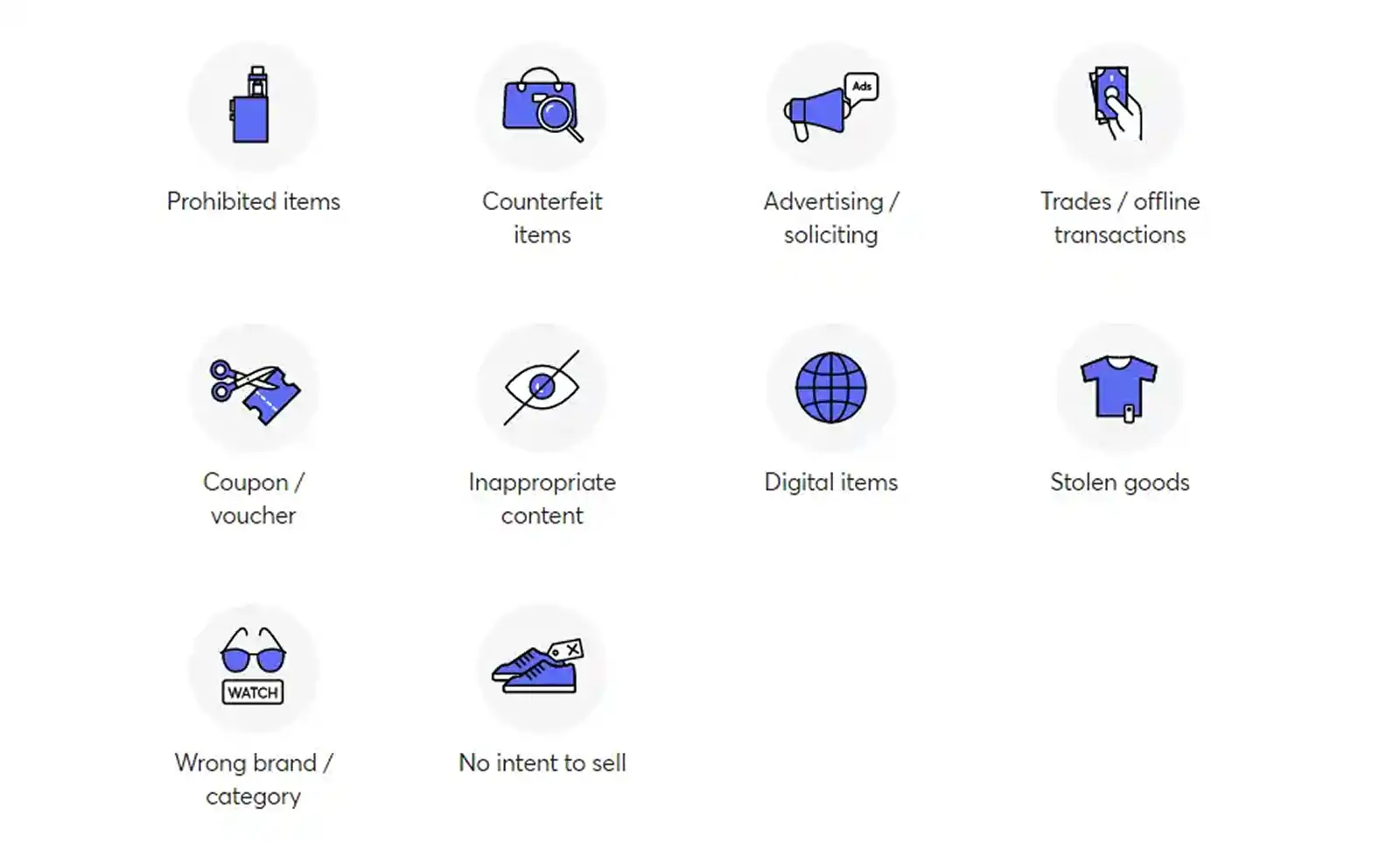
With that out of the way, the following activities and items are banned on Mercari:
Selling drugs or associated components, including prescription or homemade medicines.
Selling an item that has been reported as "Stolen," which can result in confiscation of the item.
Any firearm regardless of its legality in your local area.
The platform has a firm policy against selling counterfeit goods and requires serial numbers or receipts when selling brand-name products.
Any military-grade products, including explosives.
Alcoholic products.
All tobacco products are banned from the platform. This includes vapes, cigarettes, e-hookahs, and any product associated with nicotine usage.
Any sort of account credentials or login information that can contribute to identity theft.
Digital products, i.e., products that can't be shipped, are not allowed on the platform. These include ebooks, software, games, etc.
Items you don't own when you list them. This includes dropshipping products or selling coupons.
All items prohibited by mailing companies are not allowed on the platform. However, you can send flammable products using the "ship on your own" option.
Any products that infringe copyrights or are designed to circumvent them including chips that allow unlicensed software to be used in computers.
Regulated financial products like crypto, bonds, currency exchange, etc., cannot be traded.
Live animals, including taxidermy, are prohibited; however, animal parts from non-protected species are allowed.
Pornographic or sexually explicit products.
Offensive listings that promote hatred or violence.
Our verdict
Mercari beats out Poshmark in this area as it has fewer restrictions on the type of products you can sell there marketplace.
Admittedly, this does lower the feel of exclusivity and branding around Mercari.
In particular, Mercari is really good if you're not selling fashion items in the first place.
3. Fees
While there is serious money to be made selling online, as the old saying goes, nothing good in life comes easy…or free!
The same can be said for selling on Poshmark or Mercari.
In order to keep their platforms running and employ a team of customer service experts, these marketplaces must charge fees.
Before you start selling, it is important to have a thorough understanding of each marketplace’s fee structure so you’re not taken by surprise when fees are deducted from your account.
While we believe the fees and commissions charged are fair considering the service and platform being made available to you, they can add up quickly, particularly for new sellers.
Poshmark seller fees
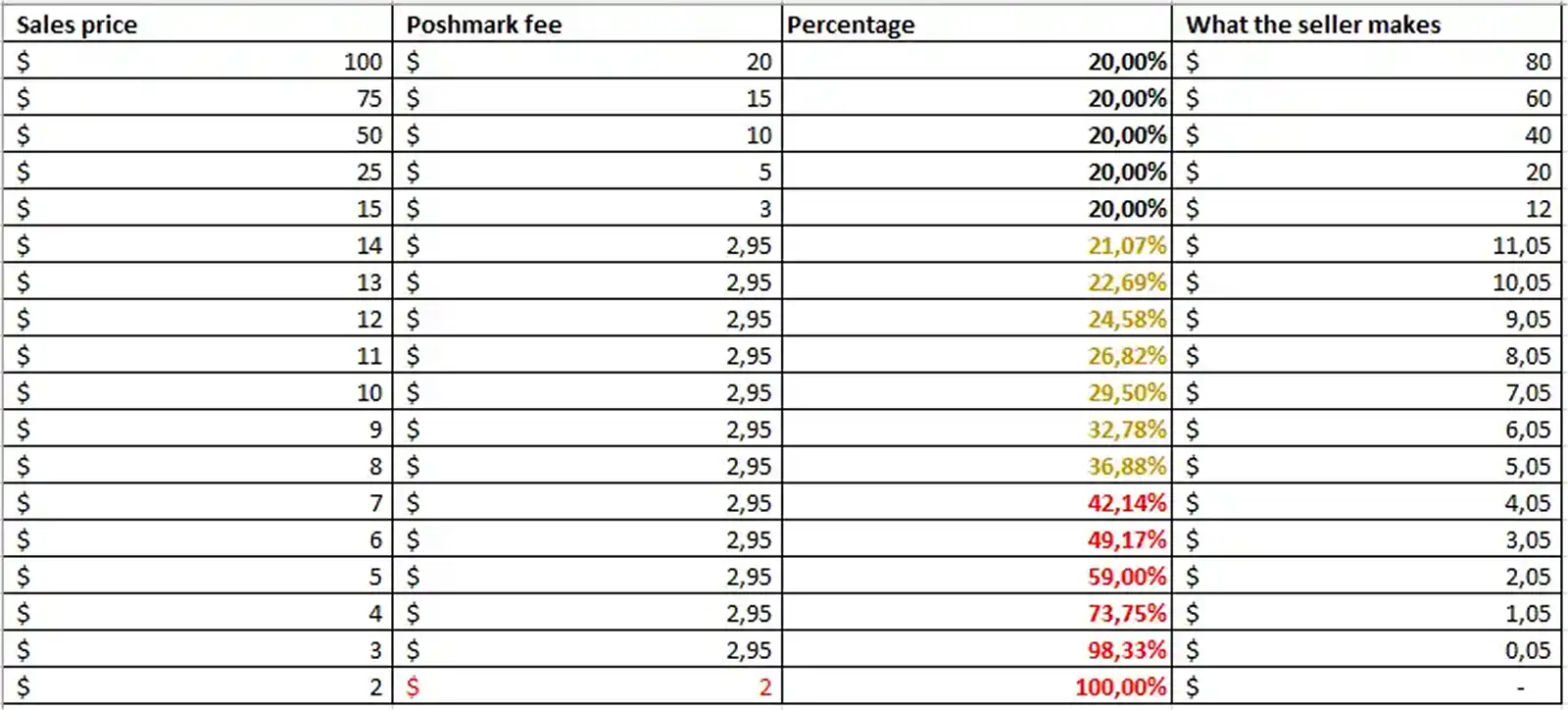
Poshmark’s fees for sellers are pretty straightforward. To list your item is completely free, the commission comes into play when your item sells. On items under $15, a small flat fee of $2.95 is deducted.
For the sale of items over $15, there is a 20% commission fee automatically deducted by Poshmark.
If you look at it logically, it doesn’t really make sense to sell an item that costs less than $5 because you’ll be left with very little profit after all is said and done.
Take a look at the below table for a visual representation of how the supposedly nominal $2.95 can really hurt smaller sellers.
Shipping is pretty simple too with a flat rate of $6.49 being charged to buyers for all orders under 5lbs.
However, we think the fees are worth it because you get:
A free pre-paid shipping label.
Credit card transactions are processed for free.
Automatic calculation and collection of sales tax.
A huge, active marketplace of motivated buyers to sell to.
Mercari seller fees
Mercari charges a 10% selling fee on all sales regardless of the product price, which is calculated on the cost of an item + buyer-paid shipping. There are no other payment processing fees.
You’ll also have to pay a $3 fee every time you want to cash out your earnings through Instant Pay.
If you choose the bank transfer cash out option, though, there’s no fee.
Mercari has fixed shipping rates with different shipping agencies.
They also have a weight limit of shippable products at 150lbs, products above the weight limit won’t be shipped by Mercari, and you’ll have to dispatch them on your own.
Here’s a chart from the Mercari website giving a reasonable estimate of shipping rates for a $50 sale:
Mercari | Poshmark | |
|---|---|---|
Selling fee | $5.00 (10%) | Cell 1-3 |
Processing fee | $0 (removed) | Cell 2-3 |
Total fees | $5.00 | $10.00 |
Your payout | $45.00 | $40.00 |
Listing fee | $0 | $0 |
Shipping | Flexible (USPS/UPS/FedEx, $4.59+ | Flat $6.49 prepaid USPS label |
Withdrawal | Free (direct deposit) or $3 (instant) | Free (direct deposit) or $2 (instant) |
Our verdict
Mercari once again comes out on top as their commission rates are VERY competitive and favorable for small businesses.
However, this doesn’t mean that Poshmark is ripping anyone off as they also offer good rates but Mercari edges them out here.
If you want to compare your profit and margin between Poshmark and Mercari, then you can use the free seller fee calculators below:
4. Payment methods
Let's be honest, everyone hates payment delays and processing issues. Your buyers' products get delayed and you end up spending precious time dealing with these problems
So Poshmark and Mercari have included top-notch integrations on their sites with popular payment processors for accessible business and smooth transactions.
Paying on Poshmark
Poshmark allows buyers to pay through all major credit and debit cards. These cards include MasterCard, Visa, Discover, JCB, and American Express.
Buyers can also use Venmo, Paypal, PayPal Pay Later, Affirm, Google Pay, Apple Pay, or Poshmark Gift Cards to pay for products on Poshmark.
Paying on Mercari
Mercari accepts major credit cards like VISA, Mastercard, American Express, and Discover.
Buyers can also use PayPal, Zip, Venmo, or Apple Pay to pay for products on Mercari.
Our verdict
This is a really close one as both the platforms have awesome integrations and payment processes available.
Both platforms are excellent here and we’re at a stalemate, so we’ll have to call in this one as a draw.
Categories and audience
Poshmark audience
Poshmark is a fashion-first platform. Clothing, shoes, accessories, jewelry, and some home goods make up the vast majority of listings.
The buyer base skews toward women shopping for name-brand and designer items at a discount. If you're selling a Coach bag or a pair of Lululemon leggings, Poshmark buyers are already looking for them.
Mercari audience
Mercari is a general marketplace closer to eBay. You can sell electronics, video games, toys, collectibles, sporting goods, furniture, and pretty much anything else that can be shipped legally.
The buyer base is broader and more price-driven than brand-driven. If you're clearing out a garage with a mix of items, Mercari is the easier platform to list everything on.
Listing process and visibility
This is where the two platforms diverge most.
Mercari's listing process
On Mercari, you list an item and you're done. The algorithm surfaces your listing in search results based on relevance and price. There are no daily maintenance required.
However, Mercari does reward active sellers, so it helps to relist on Mercari regularly to stay visible in search.
Poshmark's listing process
Poshmark is different as visibility is tied to activity. You need to share your own listings daily, share other sellers' listings, follow buyers, and participate in Posh Parties to stay visible in the feed.
If you stop sharing for a week, your listings will disappear. Experienced Poshmark sellers spend approximately 15-30 minutes per day just on community activity.
Our verdict
If you prefer a hands-off approach, Mercari wins. If you enjoy the social side of selling and want to build a following, Poshmark rewards that effort with a more engaged buyer audience.
Shipping
Mercari's shipping
Mercari gives sellers more flexibility. You can choose between USPS, UPS, and FedEx, with prepaid label rates starting at $4.59, depending on size and weight.
Sellers can also ship on their own with any carrier. The buyer or seller can pay shipping, and offering free shipping is a common strategy to improve listing visibility.
For lightweight items, Mercari's flexible rates are often cheaper. For heavier items up to 5 lbs, Poshmark's flat rate can be the better deal since it includes Priority Mail service regardless of distance.
Poshmark's shipping
Poshmark keeps shipping simple. Every order gets a prepaid USPS Priority Mail label at a flat rate of $6.49 for packages up to 5 lbs.
The buyer pays this fee. If the package exceeds 5 lbs, the seller pays overweight fees starting at $4.50 per additional pound.
Our verdict
Mercari wins on flexibility, especially if you sell a wide range of item sizes or want more control over shipping costs. Its lower rates can make lightweight items more attractive to buyers, and the option to ship on your own gives sellers extra room to optimize margins.
Poshmark wins on simplicity. The flat-rate USPS Priority Mail label is easy to understand and often a strong deal for heavier items up to 5 lbs. But for very light items, the fixed shipping fee can feel expensive to buyers, and overweight packages can quickly eat into your profit.
The final verdict
Overall we have to call this bout a draw.
Both platforms are absolutely phenomenal at what they do and are toe to toe in market competition.
Mercari nails it in the variety and quantity department while Poshmark makes a killing in the branded-clothing branch.
Both platforms are amazing resources and can be extremely beneficial for your business and the best strategy is to simultaneously work on both platforms side by side so you can get the best of both worlds!
Now that we're clear about how each platform runs, there are a few brilliant strategies and methods that you can use to maximize your hustle and make some good dough for your bank accounts.
Why not.. list on both?
So now that you've read the pros and cons of Poshmark and Mercari, you're probably wondering which one to go for.
What if we told you that you could easily list on both with the same amount of effort?
Enter Crosslist, the best cross listing app for resellers.
Instead of listing your inventory on one marketplace, use a tool like Crosslist to easily list on multiple platforms while still only completing one listing form!
Cross listing is a strategy employed by tons of resellers online looking to gain more exposure to their products and attract more buyers by differentiating across platforms.
It's an effective way to increase brand awareness and drive sales by reaching new audiences with different preferences.
Cross listing is a must for any serious e-commerce business.
By cross listing, you can skip filling endless listing forms, managing different inventories, and uploading data repeatedly. Instead, you can use your time to focus on the things that matter more.
Cross listing consistently gives businesses thousands of potential new customers and tons in revenue.
And, hey, you also get to manage your entire inventory from a single dashboard, which is another less thing to worry about, right?
List on both Mercari and Poshmark with Crosslist
The real answer to ‘Poshmark vs Mercari’ is both. Mercari's lower fees keep more money in your pocket. Poshmark's engaged community moves fashion items faster.
Different buyers browse different platforms, listing the same inventory on both doubles your exposure.
The problem is doing both by hand, entering every item twice and keeping the two in sync. Crosslist takes that off your plate.
Fill in one universal form once and your item posts to Mercari, Poshmark, and 11+ other major marketplaces, with sending listings live in the background.
That frees up your time for the part that actually moves fashion on Poshmark: sharing and engaging with the community.
Meanwhile, when an item sells anywhere, autodelist pulls it from every other platform automatically, so you never double-sell across the two.
Try Crosslist risk-free with the 3-day money-back guarantee and post to both marketplaces.
Plans start at $29.99/month.
Mercari and Poshmark are two of the biggest reselling platforms in the US, but they work very differently.
Mercari is a straightforward marketplace where you list an item, set a price, and wait for a buyer.
Poshmark is a social selling platform where visibility depends on sharing, following, and community engagement.
The fee gap is significant too. Mercari charges a flat 10% on every sale. Poshmark takes 20% on sales over $15. On a $50 item, that's the difference between keeping $45 and keeping $40.
So which platform is better for your reselling business?
It depends on what you sell, how much time you want to spend, and whether you'd rather pay less in fees or tap into a more engaged buyer community. Let's break it down.
Key takeaways
Mercari charges a flat 10% selling fee with no processing fees. Poshmark charges 20% on sales over $15 (or a flat $2.95 under $15).
Poshmark is built around social selling, sharing, following, virtual parties. Mercari is a straightforward marketplace with no social features required.
Poshmark focuses on fashion, accessories, and home goods. Mercari accepts almost anything that can be shipped, including electronics, toys, and collectibles.
Poshmark includes a prepaid USPS shipping label. Mercari offers flexible shipping through USPS, UPS, and FedEx at discounted rates.
For fashion sellers with an engaged audience, Poshmark's community features drive faster sales despite higher fees. For general merchandise or casual sellers, Mercari's lower fees and simpler listing process often win.
The best strategy for most resellers is to list on both platforms using a cross listing tool like Crosslist.
Some background information...
Poshmark
Poshmark, doesn't tread far from its name and focuses on “posh” fashion and jewelry items.
The marketplace was founded in 2011 to replace eBay in the high-end clothing (think GUCCI, Louis Vuitton) department at reasonable prices.
Feeling buyers remorse after getting an expensive handbag or not liking the design of the dress your friend gifted you and now you’re too embarrassed to ask for the receipt to return it?
List the items quietly on Poshmark and get the best prices possible for them!
While high-end items do dominate the marketplace, mid-range brands also do well on Poshmark.
Poshmark also has a unique social media aspect to it. Unlike Mercari, which is a simple marketplace like eBay, Poshmark incorporates social dynamics for business.
Confused?
Imagine Instagram and eBay fell in love and had a child; yep, that's Poshmark in a nutshell for you. You can comment, like, and even share different listings and support each other.
Wait, that's not all. Poshmark even allows sellers to host live virtual parties to increase product exposure and sales. They regularly bring new features to the marketplace to help their sellers sell more.
You can read up more awesome tips to make a killer income on Poshmark here.
So basically, Poshmark found its place at the top due to its ease of use, social features, and convenient services.
The platform caters to savvy fashionistas to find great pricing and customers.
In addition to that, they also IPO'ed in 2021, making it the first social marketplace to go public.
Read our Poshmark review to see what sellers actually think of the platform.
Mercari
Mercari, on the other hand, can be compared more to a flea market that has anything and everything available for sale.
Founded in 2013 in Japan, they quickly expanded to the United States just a year later.
Now, they are one of the most successul Japanese startups to enter the global market.
Pretty much any item can be sold on Mercari as long as it can be shipped and is not on their prohibited item list.
Mercari boasts a vast user base of millions and also caters to an international audience in over a whopping 100 countries, so you can be certain your business will never suffer from a lack of reach.
Curious whether sellers actually like the platform? Read our full breakdown of Mercari reviews based on Trustpilot, Sitejabber, and Influenster ratings.
How does Poshmark differ from Mercari?
Both these marketplaces are phenomenal for your reselling business. Still, there are a few differences between the two you should know before jumping in.
Let's have a look at how both marketplaces fare against each other.
1. Community
Poshmark has really built a strong community around its marketplace, using Poshmark Ambassadors to spread their message.
The focus is really about a journey of selling together rather than just merely flipping stuff.
Mercari on the other hand is more of a bland marketplace like eBay where people get together and sell, but do not really interact with each other.
You'll find it easier to sell an iPhone on Mercari than some niche dress you found in a thrift store, as the community isn't that fashion inspired like on Poshmark.
Our verdict
Poshmark is the clear winner here with its thriving community of resellers that are very well connected to each other.
Their virtual parties and the ability to add in Instagram reels are phenomenal for all fashionistas out there regardless of whether they're selling or buying on the platform.
2. Prohibited items
Buyers love online marketplaces because they offer various products and low prices.
As incredible as these marketplaces are for your side biz, you can't just sell anything.
Poshmark and Mercari need to maintain a certain standard of quality to attract and retain customers.
They do this by setting guidelines for sellers on their platforms. While it might seem arbitrary, there are logical reasons why certain products are not permitted.
After all, you wouldn't want just anyone selling anything without any restrictions.
Let's take a look at the guidelines each marketplace has in place!
Poshmark
It's safe to assume that whatever Mercari has banned isn't allowed on Poshmark either.
Still, they have some additional product rules since they're more niche and exclusive than Mercari. Let's jump through the rules quickly.
The following items and activities are strictly prohibited on Poshmark:
Pre-owned items can be listed, but they must be in good condition if you want to sell them.
All liquid products must be in sealed packaging and clearly and accurately represented.
All illegal items, including replicas and fakes of originals including products derived from threatened animal species. Listing such things can lead to you getting permanently suspended on the platform.
Violating trademark laws or implying a product is made after or inspired by a brand.
Taking parts of branded items and using them to make a new product, e.g., taking a button from a brand clothing and turning it into jewelry, is prohibited.
All items that can't be shipped according to USPS regulations. You can check out USPS regulations here.
Dealing with the following specific items is not allowed either:
Furniture.
Appliances.
Used makeup/personal care products.
Used underwear.
Used health and wellness products like breast pumps, protein powder, diet supplements and, body wrap.
Current airline and airport uniforms.
Mercari
As a good rule of thumb, avoid trying to place anything shady or illegal on the internet, let alone on a marketplace with your contact and location on it.
With that out of the way, the following activities and items are banned on Mercari:
Selling drugs or associated components, including prescription or homemade medicines.
Selling an item that has been reported as "Stolen," which can result in confiscation of the item.
Any firearm regardless of its legality in your local area.
The platform has a firm policy against selling counterfeit goods and requires serial numbers or receipts when selling brand-name products.
Any military-grade products, including explosives.
Alcoholic products.
All tobacco products are banned from the platform. This includes vapes, cigarettes, e-hookahs, and any product associated with nicotine usage.
Any sort of account credentials or login information that can contribute to identity theft.
Digital products, i.e., products that can't be shipped, are not allowed on the platform. These include ebooks, software, games, etc.
Items you don't own when you list them. This includes dropshipping products or selling coupons.
All items prohibited by mailing companies are not allowed on the platform. However, you can send flammable products using the "ship on your own" option.
Any products that infringe copyrights or are designed to circumvent them including chips that allow unlicensed software to be used in computers.
Regulated financial products like crypto, bonds, currency exchange, etc., cannot be traded.
Live animals, including taxidermy, are prohibited; however, animal parts from non-protected species are allowed.
Pornographic or sexually explicit products.
Offensive listings that promote hatred or violence.
Our verdict
Mercari beats out Poshmark in this area as it has fewer restrictions on the type of products you can sell there marketplace.
Admittedly, this does lower the feel of exclusivity and branding around Mercari.
In particular, Mercari is really good if you're not selling fashion items in the first place.
3. Fees
While there is serious money to be made selling online, as the old saying goes, nothing good in life comes easy…or free!
The same can be said for selling on Poshmark or Mercari.
In order to keep their platforms running and employ a team of customer service experts, these marketplaces must charge fees.
Before you start selling, it is important to have a thorough understanding of each marketplace’s fee structure so you’re not taken by surprise when fees are deducted from your account.
While we believe the fees and commissions charged are fair considering the service and platform being made available to you, they can add up quickly, particularly for new sellers.
Poshmark seller fees
Poshmark’s fees for sellers are pretty straightforward. To list your item is completely free, the commission comes into play when your item sells. On items under $15, a small flat fee of $2.95 is deducted.
For the sale of items over $15, there is a 20% commission fee automatically deducted by Poshmark.
If you look at it logically, it doesn’t really make sense to sell an item that costs less than $5 because you’ll be left with very little profit after all is said and done.
Take a look at the below table for a visual representation of how the supposedly nominal $2.95 can really hurt smaller sellers.
Shipping is pretty simple too with a flat rate of $6.49 being charged to buyers for all orders under 5lbs.
However, we think the fees are worth it because you get:
A free pre-paid shipping label.
Credit card transactions are processed for free.
Automatic calculation and collection of sales tax.
A huge, active marketplace of motivated buyers to sell to.
Mercari seller fees
Mercari charges a 10% selling fee on all sales regardless of the product price, which is calculated on the cost of an item + buyer-paid shipping. There are no other payment processing fees.
You’ll also have to pay a $3 fee every time you want to cash out your earnings through Instant Pay.
If you choose the bank transfer cash out option, though, there’s no fee.
Mercari has fixed shipping rates with different shipping agencies.
They also have a weight limit of shippable products at 150lbs, products above the weight limit won’t be shipped by Mercari, and you’ll have to dispatch them on your own.
Here’s a chart from the Mercari website giving a reasonable estimate of shipping rates for a $50 sale:
Mercari | Poshmark | |
|---|---|---|
Selling fee | $5.00 (10%) | Cell 1-3 |
Processing fee | $0 (removed) | Cell 2-3 |
Total fees | $5.00 | $10.00 |
Your payout | $45.00 | $40.00 |
Listing fee | $0 | $0 |
Shipping | Flexible (USPS/UPS/FedEx, $4.59+ | Flat $6.49 prepaid USPS label |
Withdrawal | Free (direct deposit) or $3 (instant) | Free (direct deposit) or $2 (instant) |
Our verdict
Mercari once again comes out on top as their commission rates are VERY competitive and favorable for small businesses.
However, this doesn’t mean that Poshmark is ripping anyone off as they also offer good rates but Mercari edges them out here.
If you want to compare your profit and margin between Poshmark and Mercari, then you can use the free seller fee calculators below:
4. Payment methods
Let's be honest, everyone hates payment delays and processing issues. Your buyers' products get delayed and you end up spending precious time dealing with these problems
So Poshmark and Mercari have included top-notch integrations on their sites with popular payment processors for accessible business and smooth transactions.
Paying on Poshmark
Poshmark allows buyers to pay through all major credit and debit cards. These cards include MasterCard, Visa, Discover, JCB, and American Express.
Buyers can also use Venmo, Paypal, PayPal Pay Later, Affirm, Google Pay, Apple Pay, or Poshmark Gift Cards to pay for products on Poshmark.
Paying on Mercari
Mercari accepts major credit cards like VISA, Mastercard, American Express, and Discover.
Buyers can also use PayPal, Zip, Venmo, or Apple Pay to pay for products on Mercari.
Our verdict
This is a really close one as both the platforms have awesome integrations and payment processes available.
Both platforms are excellent here and we’re at a stalemate, so we’ll have to call in this one as a draw.
Categories and audience
Poshmark audience
Poshmark is a fashion-first platform. Clothing, shoes, accessories, jewelry, and some home goods make up the vast majority of listings.
The buyer base skews toward women shopping for name-brand and designer items at a discount. If you're selling a Coach bag or a pair of Lululemon leggings, Poshmark buyers are already looking for them.
Mercari audience
Mercari is a general marketplace closer to eBay. You can sell electronics, video games, toys, collectibles, sporting goods, furniture, and pretty much anything else that can be shipped legally.
The buyer base is broader and more price-driven than brand-driven. If you're clearing out a garage with a mix of items, Mercari is the easier platform to list everything on.
Listing process and visibility
This is where the two platforms diverge most.
Mercari's listing process
On Mercari, you list an item and you're done. The algorithm surfaces your listing in search results based on relevance and price. There are no daily maintenance required.
However, Mercari does reward active sellers, so it helps to relist on Mercari regularly to stay visible in search.
Poshmark's listing process
Poshmark is different as visibility is tied to activity. You need to share your own listings daily, share other sellers' listings, follow buyers, and participate in Posh Parties to stay visible in the feed.
If you stop sharing for a week, your listings will disappear. Experienced Poshmark sellers spend approximately 15-30 minutes per day just on community activity.
Our verdict
If you prefer a hands-off approach, Mercari wins. If you enjoy the social side of selling and want to build a following, Poshmark rewards that effort with a more engaged buyer audience.
Shipping
Mercari's shipping
Mercari gives sellers more flexibility. You can choose between USPS, UPS, and FedEx, with prepaid label rates starting at $4.59, depending on size and weight.
Sellers can also ship on their own with any carrier. The buyer or seller can pay shipping, and offering free shipping is a common strategy to improve listing visibility.
For lightweight items, Mercari's flexible rates are often cheaper. For heavier items up to 5 lbs, Poshmark's flat rate can be the better deal since it includes Priority Mail service regardless of distance.
Poshmark's shipping
Poshmark keeps shipping simple. Every order gets a prepaid USPS Priority Mail label at a flat rate of $6.49 for packages up to 5 lbs.
The buyer pays this fee. If the package exceeds 5 lbs, the seller pays overweight fees starting at $4.50 per additional pound.
Our verdict
Mercari wins on flexibility, especially if you sell a wide range of item sizes or want more control over shipping costs. Its lower rates can make lightweight items more attractive to buyers, and the option to ship on your own gives sellers extra room to optimize margins.
Poshmark wins on simplicity. The flat-rate USPS Priority Mail label is easy to understand and often a strong deal for heavier items up to 5 lbs. But for very light items, the fixed shipping fee can feel expensive to buyers, and overweight packages can quickly eat into your profit.
The final verdict
Overall we have to call this bout a draw.
Both platforms are absolutely phenomenal at what they do and are toe to toe in market competition.
Mercari nails it in the variety and quantity department while Poshmark makes a killing in the branded-clothing branch.
Both platforms are amazing resources and can be extremely beneficial for your business and the best strategy is to simultaneously work on both platforms side by side so you can get the best of both worlds!
Now that we're clear about how each platform runs, there are a few brilliant strategies and methods that you can use to maximize your hustle and make some good dough for your bank accounts.
Why not.. list on both?
So now that you've read the pros and cons of Poshmark and Mercari, you're probably wondering which one to go for.
What if we told you that you could easily list on both with the same amount of effort?
Enter Crosslist, the best cross listing app for resellers.
Instead of listing your inventory on one marketplace, use a tool like Crosslist to easily list on multiple platforms while still only completing one listing form!
Cross listing is a strategy employed by tons of resellers online looking to gain more exposure to their products and attract more buyers by differentiating across platforms.
It's an effective way to increase brand awareness and drive sales by reaching new audiences with different preferences.
Cross listing is a must for any serious e-commerce business.
By cross listing, you can skip filling endless listing forms, managing different inventories, and uploading data repeatedly. Instead, you can use your time to focus on the things that matter more.
Cross listing consistently gives businesses thousands of potential new customers and tons in revenue.
And, hey, you also get to manage your entire inventory from a single dashboard, which is another less thing to worry about, right?
List on both Mercari and Poshmark with Crosslist
The real answer to ‘Poshmark vs Mercari’ is both. Mercari's lower fees keep more money in your pocket. Poshmark's engaged community moves fashion items faster.
Different buyers browse different platforms, listing the same inventory on both doubles your exposure.
The problem is doing both by hand, entering every item twice and keeping the two in sync. Crosslist takes that off your plate.
Fill in one universal form once and your item posts to Mercari, Poshmark, and 11+ other major marketplaces, with sending listings live in the background.
That frees up your time for the part that actually moves fashion on Poshmark: sharing and engaging with the community.
Meanwhile, when an item sells anywhere, autodelist pulls it from every other platform automatically, so you never double-sell across the two.
Try Crosslist risk-free with the 3-day money-back guarantee and post to both marketplaces.
Plans start at $29.99/month.
Mercari and Poshmark are two of the biggest reselling platforms in the US, but they work very differently.
Mercari is a straightforward marketplace where you list an item, set a price, and wait for a buyer.
Poshmark is a social selling platform where visibility depends on sharing, following, and community engagement.
The fee gap is significant too. Mercari charges a flat 10% on every sale. Poshmark takes 20% on sales over $15. On a $50 item, that's the difference between keeping $45 and keeping $40.
So which platform is better for your reselling business?
It depends on what you sell, how much time you want to spend, and whether you'd rather pay less in fees or tap into a more engaged buyer community. Let's break it down.
Key takeaways
Mercari charges a flat 10% selling fee with no processing fees. Poshmark charges 20% on sales over $15 (or a flat $2.95 under $15).
Poshmark is built around social selling, sharing, following, virtual parties. Mercari is a straightforward marketplace with no social features required.
Poshmark focuses on fashion, accessories, and home goods. Mercari accepts almost anything that can be shipped, including electronics, toys, and collectibles.
Poshmark includes a prepaid USPS shipping label. Mercari offers flexible shipping through USPS, UPS, and FedEx at discounted rates.
For fashion sellers with an engaged audience, Poshmark's community features drive faster sales despite higher fees. For general merchandise or casual sellers, Mercari's lower fees and simpler listing process often win.
The best strategy for most resellers is to list on both platforms using a cross listing tool like Crosslist.
Some background information...
Poshmark
Poshmark, doesn't tread far from its name and focuses on “posh” fashion and jewelry items.
The marketplace was founded in 2011 to replace eBay in the high-end clothing (think GUCCI, Louis Vuitton) department at reasonable prices.
Feeling buyers remorse after getting an expensive handbag or not liking the design of the dress your friend gifted you and now you’re too embarrassed to ask for the receipt to return it?
List the items quietly on Poshmark and get the best prices possible for them!
While high-end items do dominate the marketplace, mid-range brands also do well on Poshmark.
Poshmark also has a unique social media aspect to it. Unlike Mercari, which is a simple marketplace like eBay, Poshmark incorporates social dynamics for business.
Confused?
Imagine Instagram and eBay fell in love and had a child; yep, that's Poshmark in a nutshell for you. You can comment, like, and even share different listings and support each other.
Wait, that's not all. Poshmark even allows sellers to host live virtual parties to increase product exposure and sales. They regularly bring new features to the marketplace to help their sellers sell more.
You can read up more awesome tips to make a killer income on Poshmark here.
So basically, Poshmark found its place at the top due to its ease of use, social features, and convenient services.
The platform caters to savvy fashionistas to find great pricing and customers.
In addition to that, they also IPO'ed in 2021, making it the first social marketplace to go public.
Read our Poshmark review to see what sellers actually think of the platform.
Mercari
Mercari, on the other hand, can be compared more to a flea market that has anything and everything available for sale.
Founded in 2013 in Japan, they quickly expanded to the United States just a year later.
Now, they are one of the most successul Japanese startups to enter the global market.
Pretty much any item can be sold on Mercari as long as it can be shipped and is not on their prohibited item list.
Mercari boasts a vast user base of millions and also caters to an international audience in over a whopping 100 countries, so you can be certain your business will never suffer from a lack of reach.
Curious whether sellers actually like the platform? Read our full breakdown of Mercari reviews based on Trustpilot, Sitejabber, and Influenster ratings.
How does Poshmark differ from Mercari?
Both these marketplaces are phenomenal for your reselling business. Still, there are a few differences between the two you should know before jumping in.
Let's have a look at how both marketplaces fare against each other.
1. Community
Poshmark has really built a strong community around its marketplace, using Poshmark Ambassadors to spread their message.
The focus is really about a journey of selling together rather than just merely flipping stuff.
Mercari on the other hand is more of a bland marketplace like eBay where people get together and sell, but do not really interact with each other.
You'll find it easier to sell an iPhone on Mercari than some niche dress you found in a thrift store, as the community isn't that fashion inspired like on Poshmark.
Our verdict
Poshmark is the clear winner here with its thriving community of resellers that are very well connected to each other.
Their virtual parties and the ability to add in Instagram reels are phenomenal for all fashionistas out there regardless of whether they're selling or buying on the platform.
2. Prohibited items
Buyers love online marketplaces because they offer various products and low prices.
As incredible as these marketplaces are for your side biz, you can't just sell anything.
Poshmark and Mercari need to maintain a certain standard of quality to attract and retain customers.
They do this by setting guidelines for sellers on their platforms. While it might seem arbitrary, there are logical reasons why certain products are not permitted.
After all, you wouldn't want just anyone selling anything without any restrictions.
Let's take a look at the guidelines each marketplace has in place!
Poshmark
It's safe to assume that whatever Mercari has banned isn't allowed on Poshmark either.
Still, they have some additional product rules since they're more niche and exclusive than Mercari. Let's jump through the rules quickly.
The following items and activities are strictly prohibited on Poshmark:
Pre-owned items can be listed, but they must be in good condition if you want to sell them.
All liquid products must be in sealed packaging and clearly and accurately represented.
All illegal items, including replicas and fakes of originals including products derived from threatened animal species. Listing such things can lead to you getting permanently suspended on the platform.
Violating trademark laws or implying a product is made after or inspired by a brand.
Taking parts of branded items and using them to make a new product, e.g., taking a button from a brand clothing and turning it into jewelry, is prohibited.
All items that can't be shipped according to USPS regulations. You can check out USPS regulations here.
Dealing with the following specific items is not allowed either:
Furniture.
Appliances.
Used makeup/personal care products.
Used underwear.
Used health and wellness products like breast pumps, protein powder, diet supplements and, body wrap.
Current airline and airport uniforms.
Mercari
As a good rule of thumb, avoid trying to place anything shady or illegal on the internet, let alone on a marketplace with your contact and location on it.
With that out of the way, the following activities and items are banned on Mercari:
Selling drugs or associated components, including prescription or homemade medicines.
Selling an item that has been reported as "Stolen," which can result in confiscation of the item.
Any firearm regardless of its legality in your local area.
The platform has a firm policy against selling counterfeit goods and requires serial numbers or receipts when selling brand-name products.
Any military-grade products, including explosives.
Alcoholic products.
All tobacco products are banned from the platform. This includes vapes, cigarettes, e-hookahs, and any product associated with nicotine usage.
Any sort of account credentials or login information that can contribute to identity theft.
Digital products, i.e., products that can't be shipped, are not allowed on the platform. These include ebooks, software, games, etc.
Items you don't own when you list them. This includes dropshipping products or selling coupons.
All items prohibited by mailing companies are not allowed on the platform. However, you can send flammable products using the "ship on your own" option.
Any products that infringe copyrights or are designed to circumvent them including chips that allow unlicensed software to be used in computers.
Regulated financial products like crypto, bonds, currency exchange, etc., cannot be traded.
Live animals, including taxidermy, are prohibited; however, animal parts from non-protected species are allowed.
Pornographic or sexually explicit products.
Offensive listings that promote hatred or violence.
Our verdict
Mercari beats out Poshmark in this area as it has fewer restrictions on the type of products you can sell there marketplace.
Admittedly, this does lower the feel of exclusivity and branding around Mercari.
In particular, Mercari is really good if you're not selling fashion items in the first place.
3. Fees
While there is serious money to be made selling online, as the old saying goes, nothing good in life comes easy…or free!
The same can be said for selling on Poshmark or Mercari.
In order to keep their platforms running and employ a team of customer service experts, these marketplaces must charge fees.
Before you start selling, it is important to have a thorough understanding of each marketplace’s fee structure so you’re not taken by surprise when fees are deducted from your account.
While we believe the fees and commissions charged are fair considering the service and platform being made available to you, they can add up quickly, particularly for new sellers.
Poshmark seller fees
Poshmark’s fees for sellers are pretty straightforward. To list your item is completely free, the commission comes into play when your item sells. On items under $15, a small flat fee of $2.95 is deducted.
For the sale of items over $15, there is a 20% commission fee automatically deducted by Poshmark.
If you look at it logically, it doesn’t really make sense to sell an item that costs less than $5 because you’ll be left with very little profit after all is said and done.
Take a look at the below table for a visual representation of how the supposedly nominal $2.95 can really hurt smaller sellers.
Shipping is pretty simple too with a flat rate of $6.49 being charged to buyers for all orders under 5lbs.
However, we think the fees are worth it because you get:
A free pre-paid shipping label.
Credit card transactions are processed for free.
Automatic calculation and collection of sales tax.
A huge, active marketplace of motivated buyers to sell to.
Mercari seller fees
Mercari charges a 10% selling fee on all sales regardless of the product price, which is calculated on the cost of an item + buyer-paid shipping. There are no other payment processing fees.
You’ll also have to pay a $3 fee every time you want to cash out your earnings through Instant Pay.
If you choose the bank transfer cash out option, though, there’s no fee.
Mercari has fixed shipping rates with different shipping agencies.
They also have a weight limit of shippable products at 150lbs, products above the weight limit won’t be shipped by Mercari, and you’ll have to dispatch them on your own.
Here’s a chart from the Mercari website giving a reasonable estimate of shipping rates for a $50 sale:
Mercari | Poshmark | |
|---|---|---|
Selling fee | $5.00 (10%) | Cell 1-3 |
Processing fee | $0 (removed) | Cell 2-3 |
Total fees | $5.00 | $10.00 |
Your payout | $45.00 | $40.00 |
Listing fee | $0 | $0 |
Shipping | Flexible (USPS/UPS/FedEx, $4.59+ | Flat $6.49 prepaid USPS label |
Withdrawal | Free (direct deposit) or $3 (instant) | Free (direct deposit) or $2 (instant) |
Our verdict
Mercari once again comes out on top as their commission rates are VERY competitive and favorable for small businesses.
However, this doesn’t mean that Poshmark is ripping anyone off as they also offer good rates but Mercari edges them out here.
If you want to compare your profit and margin between Poshmark and Mercari, then you can use the free seller fee calculators below:
4. Payment methods
Let's be honest, everyone hates payment delays and processing issues. Your buyers' products get delayed and you end up spending precious time dealing with these problems
So Poshmark and Mercari have included top-notch integrations on their sites with popular payment processors for accessible business and smooth transactions.
Paying on Poshmark
Poshmark allows buyers to pay through all major credit and debit cards. These cards include MasterCard, Visa, Discover, JCB, and American Express.
Buyers can also use Venmo, Paypal, PayPal Pay Later, Affirm, Google Pay, Apple Pay, or Poshmark Gift Cards to pay for products on Poshmark.
Paying on Mercari
Mercari accepts major credit cards like VISA, Mastercard, American Express, and Discover.
Buyers can also use PayPal, Zip, Venmo, or Apple Pay to pay for products on Mercari.
Our verdict
This is a really close one as both the platforms have awesome integrations and payment processes available.
Both platforms are excellent here and we’re at a stalemate, so we’ll have to call in this one as a draw.
Categories and audience
Poshmark audience
Poshmark is a fashion-first platform. Clothing, shoes, accessories, jewelry, and some home goods make up the vast majority of listings.
The buyer base skews toward women shopping for name-brand and designer items at a discount. If you're selling a Coach bag or a pair of Lululemon leggings, Poshmark buyers are already looking for them.
Mercari audience
Mercari is a general marketplace closer to eBay. You can sell electronics, video games, toys, collectibles, sporting goods, furniture, and pretty much anything else that can be shipped legally.
The buyer base is broader and more price-driven than brand-driven. If you're clearing out a garage with a mix of items, Mercari is the easier platform to list everything on.
Listing process and visibility
This is where the two platforms diverge most.
Mercari's listing process
On Mercari, you list an item and you're done. The algorithm surfaces your listing in search results based on relevance and price. There are no daily maintenance required.
However, Mercari does reward active sellers, so it helps to relist on Mercari regularly to stay visible in search.
Poshmark's listing process
Poshmark is different as visibility is tied to activity. You need to share your own listings daily, share other sellers' listings, follow buyers, and participate in Posh Parties to stay visible in the feed.
If you stop sharing for a week, your listings will disappear. Experienced Poshmark sellers spend approximately 15-30 minutes per day just on community activity.
Our verdict
If you prefer a hands-off approach, Mercari wins. If you enjoy the social side of selling and want to build a following, Poshmark rewards that effort with a more engaged buyer audience.
Shipping
Mercari's shipping
Mercari gives sellers more flexibility. You can choose between USPS, UPS, and FedEx, with prepaid label rates starting at $4.59, depending on size and weight.
Sellers can also ship on their own with any carrier. The buyer or seller can pay shipping, and offering free shipping is a common strategy to improve listing visibility.
For lightweight items, Mercari's flexible rates are often cheaper. For heavier items up to 5 lbs, Poshmark's flat rate can be the better deal since it includes Priority Mail service regardless of distance.
Poshmark's shipping
Poshmark keeps shipping simple. Every order gets a prepaid USPS Priority Mail label at a flat rate of $6.49 for packages up to 5 lbs.
The buyer pays this fee. If the package exceeds 5 lbs, the seller pays overweight fees starting at $4.50 per additional pound.
Our verdict
Mercari wins on flexibility, especially if you sell a wide range of item sizes or want more control over shipping costs. Its lower rates can make lightweight items more attractive to buyers, and the option to ship on your own gives sellers extra room to optimize margins.
Poshmark wins on simplicity. The flat-rate USPS Priority Mail label is easy to understand and often a strong deal for heavier items up to 5 lbs. But for very light items, the fixed shipping fee can feel expensive to buyers, and overweight packages can quickly eat into your profit.
The final verdict
Overall we have to call this bout a draw.
Both platforms are absolutely phenomenal at what they do and are toe to toe in market competition.
Mercari nails it in the variety and quantity department while Poshmark makes a killing in the branded-clothing branch.
Both platforms are amazing resources and can be extremely beneficial for your business and the best strategy is to simultaneously work on both platforms side by side so you can get the best of both worlds!
Now that we're clear about how each platform runs, there are a few brilliant strategies and methods that you can use to maximize your hustle and make some good dough for your bank accounts.
Why not.. list on both?
So now that you've read the pros and cons of Poshmark and Mercari, you're probably wondering which one to go for.
What if we told you that you could easily list on both with the same amount of effort?
Enter Crosslist, the best cross listing app for resellers.
Instead of listing your inventory on one marketplace, use a tool like Crosslist to easily list on multiple platforms while still only completing one listing form!
Cross listing is a strategy employed by tons of resellers online looking to gain more exposure to their products and attract more buyers by differentiating across platforms.
It's an effective way to increase brand awareness and drive sales by reaching new audiences with different preferences.
Cross listing is a must for any serious e-commerce business.
By cross listing, you can skip filling endless listing forms, managing different inventories, and uploading data repeatedly. Instead, you can use your time to focus on the things that matter more.
Cross listing consistently gives businesses thousands of potential new customers and tons in revenue.
And, hey, you also get to manage your entire inventory from a single dashboard, which is another less thing to worry about, right?
List on both Mercari and Poshmark with Crosslist
The real answer to ‘Poshmark vs Mercari’ is both. Mercari's lower fees keep more money in your pocket. Poshmark's engaged community moves fashion items faster.
Different buyers browse different platforms, listing the same inventory on both doubles your exposure.
The problem is doing both by hand, entering every item twice and keeping the two in sync. Crosslist takes that off your plate.
Fill in one universal form once and your item posts to Mercari, Poshmark, and 11+ other major marketplaces, with sending listings live in the background.
That frees up your time for the part that actually moves fashion on Poshmark: sharing and engaging with the community.
Meanwhile, when an item sells anywhere, autodelist pulls it from every other platform automatically, so you never double-sell across the two.
Try Crosslist risk-free with the 3-day money-back guarantee and post to both marketplaces.
Plans start at $29.99/month.
Mercari and Poshmark are two of the biggest reselling platforms in the US, but they work very differently.
Mercari is a straightforward marketplace where you list an item, set a price, and wait for a buyer.
Poshmark is a social selling platform where visibility depends on sharing, following, and community engagement.
The fee gap is significant too. Mercari charges a flat 10% on every sale. Poshmark takes 20% on sales over $15. On a $50 item, that's the difference between keeping $45 and keeping $40.
So which platform is better for your reselling business?
It depends on what you sell, how much time you want to spend, and whether you'd rather pay less in fees or tap into a more engaged buyer community. Let's break it down.
Key takeaways
Mercari charges a flat 10% selling fee with no processing fees. Poshmark charges 20% on sales over $15 (or a flat $2.95 under $15).
Poshmark is built around social selling, sharing, following, virtual parties. Mercari is a straightforward marketplace with no social features required.
Poshmark focuses on fashion, accessories, and home goods. Mercari accepts almost anything that can be shipped, including electronics, toys, and collectibles.
Poshmark includes a prepaid USPS shipping label. Mercari offers flexible shipping through USPS, UPS, and FedEx at discounted rates.
For fashion sellers with an engaged audience, Poshmark's community features drive faster sales despite higher fees. For general merchandise or casual sellers, Mercari's lower fees and simpler listing process often win.
The best strategy for most resellers is to list on both platforms using a cross listing tool like Crosslist.
Some background information...
Poshmark
Poshmark, doesn't tread far from its name and focuses on “posh” fashion and jewelry items.
The marketplace was founded in 2011 to replace eBay in the high-end clothing (think GUCCI, Louis Vuitton) department at reasonable prices.
Feeling buyers remorse after getting an expensive handbag or not liking the design of the dress your friend gifted you and now you’re too embarrassed to ask for the receipt to return it?
List the items quietly on Poshmark and get the best prices possible for them!
While high-end items do dominate the marketplace, mid-range brands also do well on Poshmark.
Poshmark also has a unique social media aspect to it. Unlike Mercari, which is a simple marketplace like eBay, Poshmark incorporates social dynamics for business.
Confused?
Imagine Instagram and eBay fell in love and had a child; yep, that's Poshmark in a nutshell for you. You can comment, like, and even share different listings and support each other.
Wait, that's not all. Poshmark even allows sellers to host live virtual parties to increase product exposure and sales. They regularly bring new features to the marketplace to help their sellers sell more.
You can read up more awesome tips to make a killer income on Poshmark here.
So basically, Poshmark found its place at the top due to its ease of use, social features, and convenient services.
The platform caters to savvy fashionistas to find great pricing and customers.
In addition to that, they also IPO'ed in 2021, making it the first social marketplace to go public.
Read our Poshmark review to see what sellers actually think of the platform.
Mercari
Mercari, on the other hand, can be compared more to a flea market that has anything and everything available for sale.
Founded in 2013 in Japan, they quickly expanded to the United States just a year later.
Now, they are one of the most successul Japanese startups to enter the global market.
Pretty much any item can be sold on Mercari as long as it can be shipped and is not on their prohibited item list.
Mercari boasts a vast user base of millions and also caters to an international audience in over a whopping 100 countries, so you can be certain your business will never suffer from a lack of reach.
Curious whether sellers actually like the platform? Read our full breakdown of Mercari reviews based on Trustpilot, Sitejabber, and Influenster ratings.
How does Poshmark differ from Mercari?
Both these marketplaces are phenomenal for your reselling business. Still, there are a few differences between the two you should know before jumping in.
Let's have a look at how both marketplaces fare against each other.
1. Community
Poshmark has really built a strong community around its marketplace, using Poshmark Ambassadors to spread their message.
The focus is really about a journey of selling together rather than just merely flipping stuff.
Mercari on the other hand is more of a bland marketplace like eBay where people get together and sell, but do not really interact with each other.
You'll find it easier to sell an iPhone on Mercari than some niche dress you found in a thrift store, as the community isn't that fashion inspired like on Poshmark.
Our verdict
Poshmark is the clear winner here with its thriving community of resellers that are very well connected to each other.
Their virtual parties and the ability to add in Instagram reels are phenomenal for all fashionistas out there regardless of whether they're selling or buying on the platform.
2. Prohibited items
Buyers love online marketplaces because they offer various products and low prices.
As incredible as these marketplaces are for your side biz, you can't just sell anything.
Poshmark and Mercari need to maintain a certain standard of quality to attract and retain customers.
They do this by setting guidelines for sellers on their platforms. While it might seem arbitrary, there are logical reasons why certain products are not permitted.
After all, you wouldn't want just anyone selling anything without any restrictions.
Let's take a look at the guidelines each marketplace has in place!
Poshmark
It's safe to assume that whatever Mercari has banned isn't allowed on Poshmark either.
Still, they have some additional product rules since they're more niche and exclusive than Mercari. Let's jump through the rules quickly.
The following items and activities are strictly prohibited on Poshmark:
Pre-owned items can be listed, but they must be in good condition if you want to sell them.
All liquid products must be in sealed packaging and clearly and accurately represented.
All illegal items, including replicas and fakes of originals including products derived from threatened animal species. Listing such things can lead to you getting permanently suspended on the platform.
Violating trademark laws or implying a product is made after or inspired by a brand.
Taking parts of branded items and using them to make a new product, e.g., taking a button from a brand clothing and turning it into jewelry, is prohibited.
All items that can't be shipped according to USPS regulations. You can check out USPS regulations here.
Dealing with the following specific items is not allowed either:
Furniture.
Appliances.
Used makeup/personal care products.
Used underwear.
Used health and wellness products like breast pumps, protein powder, diet supplements and, body wrap.
Current airline and airport uniforms.
Mercari
As a good rule of thumb, avoid trying to place anything shady or illegal on the internet, let alone on a marketplace with your contact and location on it.
With that out of the way, the following activities and items are banned on Mercari:
Selling drugs or associated components, including prescription or homemade medicines.
Selling an item that has been reported as "Stolen," which can result in confiscation of the item.
Any firearm regardless of its legality in your local area.
The platform has a firm policy against selling counterfeit goods and requires serial numbers or receipts when selling brand-name products.
Any military-grade products, including explosives.
Alcoholic products.
All tobacco products are banned from the platform. This includes vapes, cigarettes, e-hookahs, and any product associated with nicotine usage.
Any sort of account credentials or login information that can contribute to identity theft.
Digital products, i.e., products that can't be shipped, are not allowed on the platform. These include ebooks, software, games, etc.
Items you don't own when you list them. This includes dropshipping products or selling coupons.
All items prohibited by mailing companies are not allowed on the platform. However, you can send flammable products using the "ship on your own" option.
Any products that infringe copyrights or are designed to circumvent them including chips that allow unlicensed software to be used in computers.
Regulated financial products like crypto, bonds, currency exchange, etc., cannot be traded.
Live animals, including taxidermy, are prohibited; however, animal parts from non-protected species are allowed.
Pornographic or sexually explicit products.
Offensive listings that promote hatred or violence.
Our verdict
Mercari beats out Poshmark in this area as it has fewer restrictions on the type of products you can sell there marketplace.
Admittedly, this does lower the feel of exclusivity and branding around Mercari.
In particular, Mercari is really good if you're not selling fashion items in the first place.
3. Fees
While there is serious money to be made selling online, as the old saying goes, nothing good in life comes easy…or free!
The same can be said for selling on Poshmark or Mercari.
In order to keep their platforms running and employ a team of customer service experts, these marketplaces must charge fees.
Before you start selling, it is important to have a thorough understanding of each marketplace’s fee structure so you’re not taken by surprise when fees are deducted from your account.
While we believe the fees and commissions charged are fair considering the service and platform being made available to you, they can add up quickly, particularly for new sellers.
Poshmark seller fees
Poshmark’s fees for sellers are pretty straightforward. To list your item is completely free, the commission comes into play when your item sells. On items under $15, a small flat fee of $2.95 is deducted.
For the sale of items over $15, there is a 20% commission fee automatically deducted by Poshmark.
If you look at it logically, it doesn’t really make sense to sell an item that costs less than $5 because you’ll be left with very little profit after all is said and done.
Take a look at the below table for a visual representation of how the supposedly nominal $2.95 can really hurt smaller sellers.
Shipping is pretty simple too with a flat rate of $6.49 being charged to buyers for all orders under 5lbs.
However, we think the fees are worth it because you get:
A free pre-paid shipping label.
Credit card transactions are processed for free.
Automatic calculation and collection of sales tax.
A huge, active marketplace of motivated buyers to sell to.
Mercari seller fees
Mercari charges a 10% selling fee on all sales regardless of the product price, which is calculated on the cost of an item + buyer-paid shipping. There are no other payment processing fees.
You’ll also have to pay a $3 fee every time you want to cash out your earnings through Instant Pay.
If you choose the bank transfer cash out option, though, there’s no fee.
Mercari has fixed shipping rates with different shipping agencies.
They also have a weight limit of shippable products at 150lbs, products above the weight limit won’t be shipped by Mercari, and you’ll have to dispatch them on your own.
Here’s a chart from the Mercari website giving a reasonable estimate of shipping rates for a $50 sale:
Mercari | Poshmark | |
|---|---|---|
Selling fee | $5.00 (10%) | Cell 1-3 |
Processing fee | $0 (removed) | Cell 2-3 |
Total fees | $5.00 | $10.00 |
Your payout | $45.00 | $40.00 |
Listing fee | $0 | $0 |
Shipping | Flexible (USPS/UPS/FedEx, $4.59+ | Flat $6.49 prepaid USPS label |
Withdrawal | Free (direct deposit) or $3 (instant) | Free (direct deposit) or $2 (instant) |
Our verdict
Mercari once again comes out on top as their commission rates are VERY competitive and favorable for small businesses.
However, this doesn’t mean that Poshmark is ripping anyone off as they also offer good rates but Mercari edges them out here.
If you want to compare your profit and margin between Poshmark and Mercari, then you can use the free seller fee calculators below:
4. Payment methods
Let's be honest, everyone hates payment delays and processing issues. Your buyers' products get delayed and you end up spending precious time dealing with these problems
So Poshmark and Mercari have included top-notch integrations on their sites with popular payment processors for accessible business and smooth transactions.
Paying on Poshmark
Poshmark allows buyers to pay through all major credit and debit cards. These cards include MasterCard, Visa, Discover, JCB, and American Express.
Buyers can also use Venmo, Paypal, PayPal Pay Later, Affirm, Google Pay, Apple Pay, or Poshmark Gift Cards to pay for products on Poshmark.
Paying on Mercari
Mercari accepts major credit cards like VISA, Mastercard, American Express, and Discover.
Buyers can also use PayPal, Zip, Venmo, or Apple Pay to pay for products on Mercari.
Our verdict
This is a really close one as both the platforms have awesome integrations and payment processes available.
Both platforms are excellent here and we’re at a stalemate, so we’ll have to call in this one as a draw.
Categories and audience
Poshmark audience
Poshmark is a fashion-first platform. Clothing, shoes, accessories, jewelry, and some home goods make up the vast majority of listings.
The buyer base skews toward women shopping for name-brand and designer items at a discount. If you're selling a Coach bag or a pair of Lululemon leggings, Poshmark buyers are already looking for them.
Mercari audience
Mercari is a general marketplace closer to eBay. You can sell electronics, video games, toys, collectibles, sporting goods, furniture, and pretty much anything else that can be shipped legally.
The buyer base is broader and more price-driven than brand-driven. If you're clearing out a garage with a mix of items, Mercari is the easier platform to list everything on.
Listing process and visibility
This is where the two platforms diverge most.
Mercari's listing process
On Mercari, you list an item and you're done. The algorithm surfaces your listing in search results based on relevance and price. There are no daily maintenance required.
However, Mercari does reward active sellers, so it helps to relist on Mercari regularly to stay visible in search.
Poshmark's listing process
Poshmark is different as visibility is tied to activity. You need to share your own listings daily, share other sellers' listings, follow buyers, and participate in Posh Parties to stay visible in the feed.
If you stop sharing for a week, your listings will disappear. Experienced Poshmark sellers spend approximately 15-30 minutes per day just on community activity.
Our verdict
If you prefer a hands-off approach, Mercari wins. If you enjoy the social side of selling and want to build a following, Poshmark rewards that effort with a more engaged buyer audience.
Shipping
Mercari's shipping
Mercari gives sellers more flexibility. You can choose between USPS, UPS, and FedEx, with prepaid label rates starting at $4.59, depending on size and weight.
Sellers can also ship on their own with any carrier. The buyer or seller can pay shipping, and offering free shipping is a common strategy to improve listing visibility.
For lightweight items, Mercari's flexible rates are often cheaper. For heavier items up to 5 lbs, Poshmark's flat rate can be the better deal since it includes Priority Mail service regardless of distance.
Poshmark's shipping
Poshmark keeps shipping simple. Every order gets a prepaid USPS Priority Mail label at a flat rate of $6.49 for packages up to 5 lbs.
The buyer pays this fee. If the package exceeds 5 lbs, the seller pays overweight fees starting at $4.50 per additional pound.
Our verdict
Mercari wins on flexibility, especially if you sell a wide range of item sizes or want more control over shipping costs. Its lower rates can make lightweight items more attractive to buyers, and the option to ship on your own gives sellers extra room to optimize margins.
Poshmark wins on simplicity. The flat-rate USPS Priority Mail label is easy to understand and often a strong deal for heavier items up to 5 lbs. But for very light items, the fixed shipping fee can feel expensive to buyers, and overweight packages can quickly eat into your profit.
The final verdict
Overall we have to call this bout a draw.
Both platforms are absolutely phenomenal at what they do and are toe to toe in market competition.
Mercari nails it in the variety and quantity department while Poshmark makes a killing in the branded-clothing branch.
Both platforms are amazing resources and can be extremely beneficial for your business and the best strategy is to simultaneously work on both platforms side by side so you can get the best of both worlds!
Now that we're clear about how each platform runs, there are a few brilliant strategies and methods that you can use to maximize your hustle and make some good dough for your bank accounts.
Why not.. list on both?
So now that you've read the pros and cons of Poshmark and Mercari, you're probably wondering which one to go for.
What if we told you that you could easily list on both with the same amount of effort?
Enter Crosslist, the best cross listing app for resellers.
Instead of listing your inventory on one marketplace, use a tool like Crosslist to easily list on multiple platforms while still only completing one listing form!
Cross listing is a strategy employed by tons of resellers online looking to gain more exposure to their products and attract more buyers by differentiating across platforms.
It's an effective way to increase brand awareness and drive sales by reaching new audiences with different preferences.
Cross listing is a must for any serious e-commerce business.
By cross listing, you can skip filling endless listing forms, managing different inventories, and uploading data repeatedly. Instead, you can use your time to focus on the things that matter more.
Cross listing consistently gives businesses thousands of potential new customers and tons in revenue.
And, hey, you also get to manage your entire inventory from a single dashboard, which is another less thing to worry about, right?
List on both Mercari and Poshmark with Crosslist
The real answer to ‘Poshmark vs Mercari’ is both. Mercari's lower fees keep more money in your pocket. Poshmark's engaged community moves fashion items faster.
Different buyers browse different platforms, listing the same inventory on both doubles your exposure.
The problem is doing both by hand, entering every item twice and keeping the two in sync. Crosslist takes that off your plate.
Fill in one universal form once and your item posts to Mercari, Poshmark, and 11+ other major marketplaces, with sending listings live in the background.
That frees up your time for the part that actually moves fashion on Poshmark: sharing and engaging with the community.
Meanwhile, when an item sells anywhere, autodelist pulls it from every other platform automatically, so you never double-sell across the two.
Try Crosslist risk-free with the 3-day money-back guarantee and post to both marketplaces.
Plans start at $29.99/month.